Category Archives: Uncategorized

A highveldt run

This morning’s run was at an altitude of 1700 metres. Johannesburg is a city of trees built on rolling hills on a high plateau in the middle of South Africa where the rocks were once filled with gold and the plains hosted huge herds of antelope and other game. Both are now gone, replaced by a vibrant African city that epitomises everything good, and bad, about the new South Africa.

None of that mattered particularly on the run this morning. Fellow runners came in all shapes, sizes and colours, as did the impatient drivers in their flashy SUVs breaking the traffic laws, driving straight through the red lights and making road crossings highly hazardous for a country runner like me. The spring has broken through here, birds busily building nests in all those trees, gardens blooming with early flowers.  As I ran along the suburban streets up the final hill, lungs heaving in the oxygen depleted air and on the point of giving up, The Boss came on the headphones and told me we were “Born to Run”.  Up came the head, out went the chest and I sucked in the thin air and pushed up the hill triumphantly kicking with my heels.  One step closer to fitness.

Back on the farm rain and mild weather have brought in the spring with the first flowering bulbs, the crocus like Babinia fragrens. A veritable trove of light and colour is everywhere, the crisp lime green of the leucodendrons, the brilliant scarlet of Microloma tenufolio climbing through the branches of Mulratia heisteria, the delicate lilac of Morea tripetala, the endless tiny bells of many different Ericas in assorted pastels and much more that has emerged in the last month.

It has been a week of travel, in Geneva and Johannesburg. I am already looking forward to Monday morning, and a damp cool run with the wolfhounds to see what’s flowering next.

Coral colours Microloma tenufolia climbs through the branches of Muraltia heisteria

Coral colours Microloma tenufolia climbs through the branches of Muraltia heisteria

Morea tripetala, like a tiny tiny Iris, grows along the drive, and in other cool damp places

Morea tripetala, like a tiny tiny Iris, grows along the drive, and in other cool damp places

A Flight of Flamingos

I read George Orwell’s Homage to Catalonia when I was still a teenager.  The book is about his time with the communists in Barcelona fighting against Franco.  He describes a time when the communists were the most right wing group in the city as the anarchist movement took hold and there are memorable descriptions of what anarchy might actually look like in terms of politics and non-adminstration.  He moves up to fight Franco’s army in the foothills of the Pyrenees mountains where he is shot through the throat.  As they evacuate him on a stretcher, dripping with blood and certain he is going die, the leaves of a silver poplar tree brush against his face.  “How lucky”, he thinks, “I am to be alive in a world where silver poplars grow.”  There were silver poplars along the lane I rode down most days as an Irish teenager and those words often came to mind.  One morning last week I was up early and driving to the stables to ride here in South Africa.  The valley was dark but the sun was just climbing over the mountain behind me and as it climbed it caught in its fiery dawn light a flock of flamingos flying in stately formation overhead, brilliantly pink, astonishing and uncommon, even here.  How lucky I am, I thought, to live in a world where I can see a flight of flamigos in the dawn.

And this morning, running with the dogs, I saw this.  Despite the dry winter and then the  torrents of rain last Friday, this brilliant coral-red Gladiolus watsonius has chosen to emerge in the winter cold.  The wind was howling today and I could not get a great shot, but it is too good not to share.  Last year we saw it in June, the same plant, and got a wonderful shot of it which I’ve included here.  The slightly shabbier ones are from today.

After a wild and windy day the sunset last night was magnificent.  Occasionally, just for a moment, the entire mountain behind us is light by the flooding last light of the sunset.  I usually miss the moment.  Last night it happened just as I pulled into the car park and I sprinted down to the dam wall just in time to capture it.

Dawn Run

Dawn Run.  Until today those words evoked a racehorse, an Irish mare so famous that she is commemorated in bronze at Cheltenham Racecourse.  In a totally different context the words came to me this morning as I trotted down the drive and saw the pink tinge to the cloud across the valley against the Paarl Mountain.

The start of the Dawn Run

The start of the Dawn Run

The number one rule of a blog is frequent updates to keep your audience interested.  If I still have an audience I apologise to you.  The point of this blog is to share the morning run and the flowers on the mountain.  The long end of summer and autumn drought means far fewer flowers than in previous years.  A newcomer would still be astonished by the nature and variety our winter flowering season, old hands like us are a little disapointed by the lack of profusion.  The other restraint might be that I’m doing a lot of writing:  first, a book.  I think it might be a good one too, though I am a little daunted at the challenge of finding a publisher.  Secondly a new business and the need to develop a more business related “online presence”.  All that means a lot of writing and perhaps the blog has suffered because of that.

Even with fewer flowers this mountain rewards every run.  The winter has been odd, a bit too dry, a bit too mild.  Out running that’s not bad at all.  Seamus in particular relishes winter, even a mild one, and gets a new lease of life when summer’s heat gives way to the autumn cool.  He’s an old boy now but he lights up when the running shoes come out.  The girls are always enthusiastic; they put up an antelope again the other day.  Luckily their passion for hunting far outweighs any skills they may have.  Other signs of life include porcupine quills on the road, and little holes where he digs up the wild bulbs during the night.  We can spare them and I love that while we sit in the study in front of a winter fire, high up on the mountain the porcupine snuffles along the road where we will run in the morning.

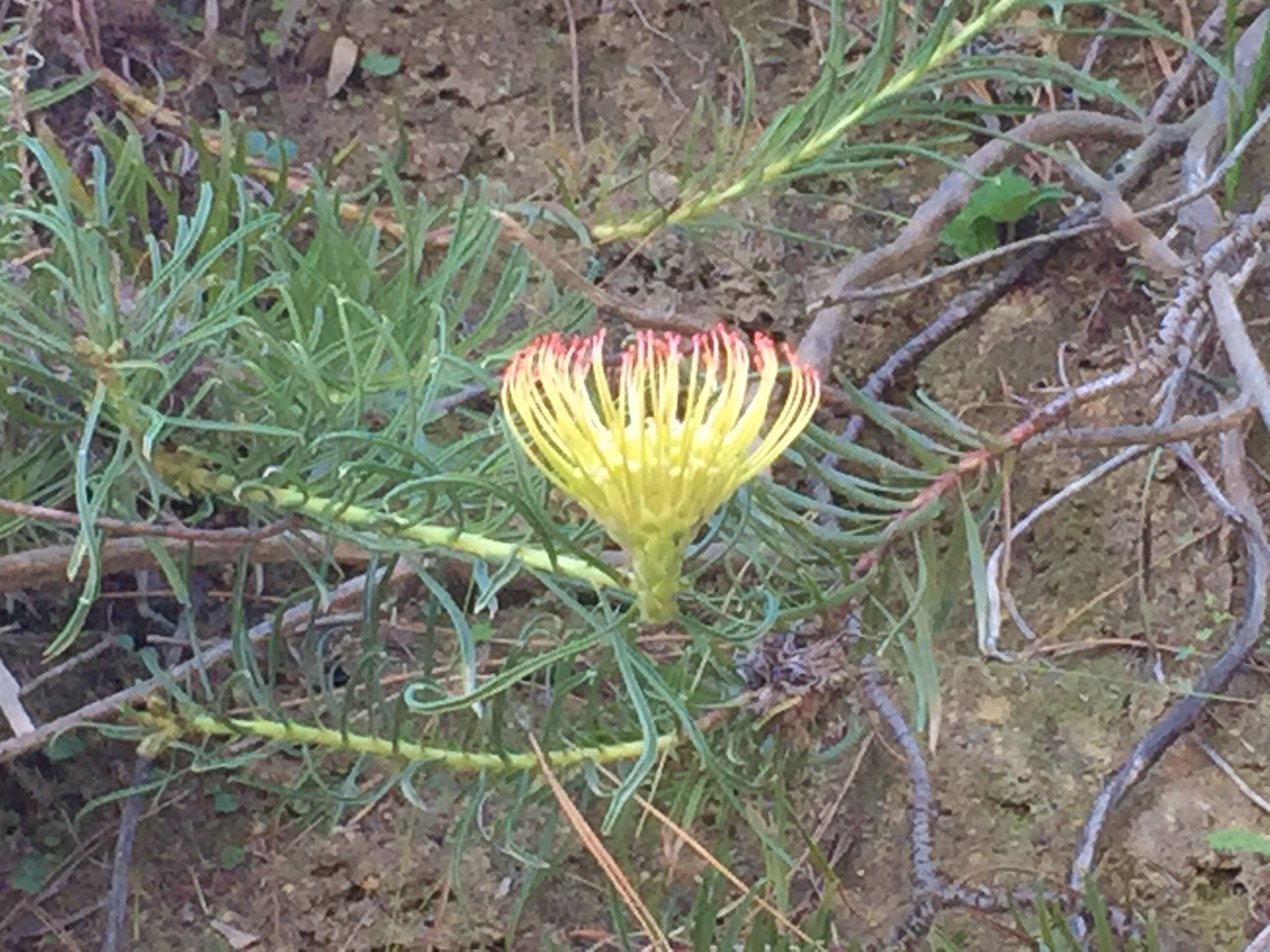
Flowers there are and we’ve taken the time to capture them.  Witness the first Leucospermum lineare of the year.  This lovely pincushion, known as “The Vulnerable” and a member of the protea family, is endangered so it’s wonderful that it grows here.  Even better that this one comes from a new plant, so it’s thriving on the farm.  There will be more photos of this as the flowers appear over the coming months.

Leucospermum lineare "The Vulnerable"

Leucospermum lineare “The Vulnerable”

More of the Eriocephalus africanus, the wild rosemary, is appearing at last.  Not as prolific as in other years, but some are covered with these gorgeous tiny white flowers.

Our winter jewels especially include the many varieties of Oxalis whose brilliant flowers stud the banks, the lands and the olive groves.

The waterfall is low, but still falling and beautiful on a weekend morning.  Near it grows the magnificent Protea Nitida.  Not so many flowers this year and not so easy to get close enough to take good pictures as they seem to like steep slopes.

Another winter delight is Leucospermum salignum.  The flowers are a wonderful yellow lime green and the plants glow on the mountain in the dull light of a winter dawn.  The male and female flowers are completely different but the shrubs like to grow side by side.

Wolfhounds in the mist

April was the driest since 1952.  And May won’t be far behind it, certainly the first half.  I have always seen the month of May here on the mountain as a kind of mini-spring, an awakening of the land after the long dry crackling heat of the summer.  Not this year.  We have permanent streams on the farm, pouring out of the mountain above us in a flow that most often roars but that trickles now.  The dams below us are emptying, a worrying sign; it will take the entire winter’s rains to replenish some of the biggest.  There are flowers, there are always flowers here; the proteas I have already posted continue to flourish, impervious to the water requirements of other, lesser plants.  And a few plants flower all year round, like the gorsey Mulraltia heisteria.  At this time of year there should be thousands of Oxalis, of many different varieties littering every bank, every part of the lands, every flourishing spot.  There are hardly any.

At last the drought has broken.  For the first time we have had a dull cloudy week with actual rain.  Not masses of rain, but light, steady, falling through the night, showering through the days.  There is heavy rain forecast next week and every farmer in the province must be praying that this massed gathering of life-bearing cloud does not disappear off into the southern oceans but this time hits us fair and square.  Those in Cape Nature whose task it is to clean up after the massive fires on Table Mountain will feel more ambiguously.  They need the rain to help the fynbos recover, of course.  But their biggest concern is the massive and almost inevitable landslides that will be the result of the dry, brittle, burnt soil with nothing to hold it to the mountain.  Meanwhile our dogs love the damp misty weather.  Maebh, caught in the early morning mist here looks like an impressionist painting.

Maebh in the early morning mist

Maebh in the early morning mist

Just before leaving for New York a couple of weeks ago I caught a glimpse of something pretty and pink high on the bank above the drive.  It had almost finished flowering.  I think it was a Nerine but it was too high and too far for me to confirm it.

This on the other hand is highly distinctive.  Chironia baccifera,known as the Christmas berry it gives us the lovely mass of pink flowers that I posted in December and then these red berries in the autumn.

Chrionia baccifera

Chrionia backfire

Running up the mountain in the mist I saw at last that the wild rosemary is coming into flower.  The tiny white flowers are exquisite and will appear soon in this blog.  It is worth waiting for the right light and the right shot.  They are among the first shrubs to flower and then delight the eye for months during the winter, covering the lands in white confetti.  I’m sure there will be some to blog about soon.  The other little harbinger of hope that I saw was a few green leaves of Babinia that had broken through the hard, sun-battered earth of the road as I ran towards home.  By now these are usually everywhere, little bulbs preparing to throw out their beautiful blue crocus-like flowers in late July and early August.  Still, even one is a good sign.

In the meantime this is a place of spectacular beauty.  The moon sets in the early morning behind Paarl Mountain.  The sun sets behind the Paaderburg and the last splash of colour is reflected in the dwindling dams below us.  This is a beautiful place, autumn replaces the winds of summer with a still calm that brings thoughts of cathedrals and holy places, here on the mountain.

Back on the Run

A combination of trips away and what my father used to call the dreaded lurgy have kept me off the mountain.  Indeed many things have conspired against blog updates in the past few weeks but none so much as the weather.  Almost the end of April and still not a drop of rain beyond a couple of localised showers.  This may not be the first time it’s happened but its the first time since we’ve been on the farm.  We have permanent water here, but it’s slowing down to a trickle yet this spongey, water-filled mountain range must feed the whole of Cape Town in the dry weather.  Dams are half full; which is fine, if it rains soon.  There is nothing beyond a drop or two in the 10 day forecast.

So after two exceptional years this could be a poor one for flowers on the mountain.  By now we usually see the first signs of winter bulbs to come, the pushing up of determined leaves breaking through the hard summer burned soil as the first rains arrive.  This year, nothing.  The runs and flowers inspire this blog; we may be in for a slow year.

Some shrubs have to flower now, it is their season.  Despite the dry, there are signs of life. Senecio pubigerus is out this year with more determination than flourish.

The quality of today’s photos is not fantastic, I’ve been playing with the iphone’s camera and clearly got these exposures wrong.

The Phylica (I never know which one this is) though less prolific than usual is starting to show, .

The Selago corymbosa is doing better.  It likes damp areas and where there is seeping water it is flowering away quite happily.

This is new, I don’t think I’ve posted it before.  I suspect it’s Monopsis though I’m not convinced it’s Monopsis lutea, the more common variety.

Monopsis (lutea?)

Monopsis (lutea?)

The one dazzling display is the Protea Repens which seems not to mind the harshness of the elements.  Every plant is covered in bees.  A delight and a sign that life goes on, no matter how tough the conditions.

I took the dogs for a walk at sunset tonight.  Despite the lateness of the season the air still holds the last vestiges of summer, mild with that hint of warmth and faintly dusty, it envelops the skin like silk.  The atmostphere on a still evening is hard to describe, the great mountain protecting our back and the glorious evening light to the west.  As we walked the sun set over the Paardeberg and I took photos of the changing sky.

Back on the run

Just when all is going swimmingly, and I’m bouncing up the mountain with two in-laws who are both 20 years younger than me but not running any faster… then…. splat!  We went to a fabulous New Year’s Eve party and of course I can never resist wearing high heels at a party.  I’m not very tall, you see, which is a nuisance at parties.  And it was a farm party so I wore wedges which are comfortable on the gravel and in the grass.  Only you are not supposed to dance on unlevel fields in wedges.  The music started, a gorgeous if rather drunken German friend invited me to dance and off we went.  Then off I went, off the high wedge, over on my ankle and into the “ouch” zone.  Sprained ankles are the most common of atheletes injuries apparently, so I will just tell you that horrific though it was – incredibly painful, swollen and black and blue – I followed the rules: rest, ice, compression (ie bandaging) and ice.  And took the anti-inflamatories for the first couple of days when it was really sore.  And used a wonderful patch anti-inflamatory called “Transact”.  Finally I bought a tailor made magnetic bandage to wear at night to stimulate the healing further.

The splendid result of all that is that I’m back on the run only two weeks later, with an ankle that is almost completely back to normal.   AND, importantly, I danced with gusto at the wedding.  Ola, the new daughter-in-law was cross enough to lose her running companion; she’d never have forgiven me if I’d failed to dance at her wedding.

Meanwhile despite one lovely night of respite from the heat when it poured with rain for four or five hours the mountain is dry and not much thrives in the dry summer weather.  I can see the proteas preparing for the winter – new growth at the tips and the green buds of pinky white Protea Repens flowers already showing – they are the first to come through, before the rains.

Quite a few shrubs flower all year round and Erica abetiana is one that really seems to thrive when it gets properly hot.  This one lives on the driveway and gives us a glorious flash of coral red as we drive up.

Erica abietana

Erica abietana

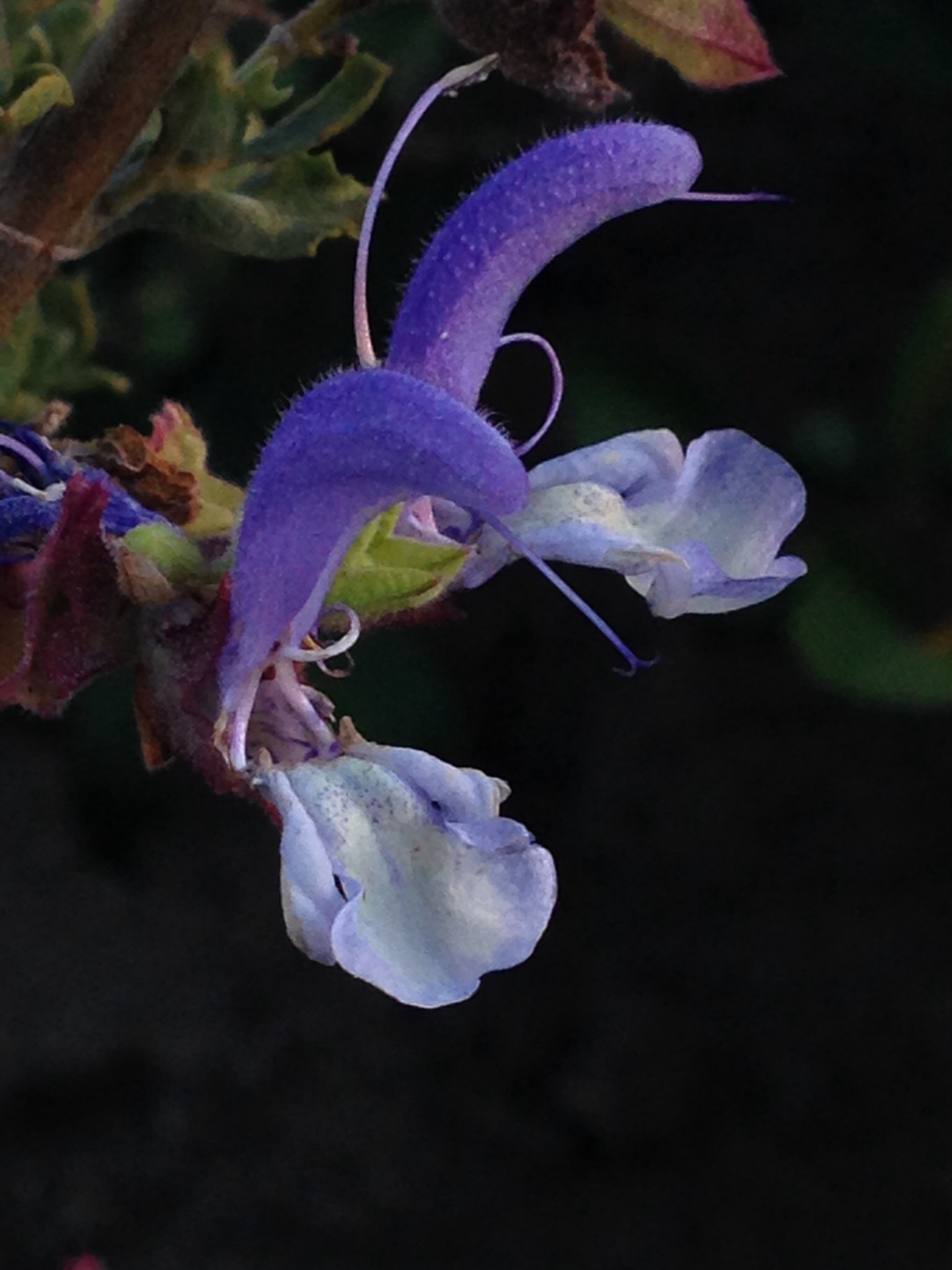
Another perennial flower is the Salvia africana – the blue flowers are a delight all over the mountain and the flowering is prolific now. I keep posting it – I love Salvia’s and particularly this one that thrives in the heat and dust of the Cape summer.

Salvia africana

Salvia africana

We have migratory birds who visit the farm year after year and in particular one buzzard who likes to keep watch from the tall pine trees in front of the house.  He seems to tease the dogs when we run down the drive – as we pass his tree he drops of and flies down the valley along side us – calling in either outrage or amusement.  He is a magnificent bird and we always believed him to be a Steppe Buzzard.  We were having lunch after the wedding with Peter’s cousin, Yvonne, who is a devoted twitcher and when we pointed out a similar bird she said, “you know it could be a Honey buzzard, they are very special and I know they live around here.”  We go home and look it up – the Steppe buzzard hardly calls when he’s here, whereas our bird yells out all the time.  I play the call of the Honey buzzard and sure enough, that’s it.  I know Yvonne is good but how does she perfectly identify a bird she hasn’t even seen?  Birds are tricky when compared to Fynbos flowers. There are only about 800 to be seen in “Southern” Africa (and Yvonne has seen almost all of them) while there are 660 Fynbos subspecies of Erica alone.  Flowers however have one massive advantage; they don’t fly away just as you think you’ve got the salient features and might be able to identify them.

The dogs of course are thrilled to be back to running (and will equally be devastated when I get on a plane to Paris in a couple of days time).  Though the light was quite poor I cannot resist sharing this little gallery of Maebh on an evening hunt.  She is all power and muscle, a wonderfully fit and agile wolfhound.

Finally, appropriately, a sunset.  They are stunning at this time of year when fires rage in the Cape and the smoke diffuses the light in a wind-ravaged sky.

Fiery sunset

Fiery sunset

The result

Glorious Gladiolus

In winter, usually round about July, I check out a certain patch of land in the hopes of seeing the beautiful Brown Afrikaner, Gladiolus maculata.  Now in the early summer it is a spot above the waterfall, where we cleared a lot of alien trees a few years ago and where the fynbos is now thick and healthy.  There flourishes the lovely Large Brown Afrikaner Glaiolus liliaceus.  The amazing thing about this flower is that it’s quite dull and boring when we run past in the morning, and easy to miss.  But towards sunset the flower opens dramatically, develops a mauve tinge and exudes the most divine, delicate spicy scent.  Yesterday morning we saw one on the run.  Yesterday evening Peter and I went up there together to see its evening display.  We are having a gorgeous early summer with balmy days and cool windy nights.  The light in the evenings is spectacular and the last rays of the setting sun caught the petals of this elegant flower just as I took these photos.  This isn’t the prettiest specimen, one of the flowers is a bit tatty, but it is still an absolute beauty and a treasure to be discovered anew every year.

Skipping up the mountain

After a week of howling wind that has distressed the garden and stripped the leaves and lots of baby olives off the trees, we finally had a quiet, damp, cloudy morning today.  This kind of weather is much more conducive to flower photos so we managed to capture a few we’d missed.

The Christmasberry, Chironia baccifera is in flower all over the place.  It has these pretty pink flowers now, and later in the year it will be covered in beautiful red berries.

As I’ve been running up the mountain in the past week I realised a sad truth.  We went to the bush for a few days at the end of November.  I love everything about the bush except for the fact that going running would make you a nice, easy, soft pink target for the predators.  So you can’t run.  A few years ago I realised the solution was to bring a skipping rope and this time I was quite good about skipping in the mornings.  It’s very boring, but it does work and to my amazement when I got home I ran quite effortlessly up the mountain.  Next time I’m struggling with fitness I’ll get that rope out.  Tiresome with amazing results.

Another tiresome thing is that I’ve missed some flowers.  I caught these comb flowers, Micranthus alopecuroides at the beginning of their flowering and this morning caught the end of the flowering, they are a little tatty but still very pretty.

Something happened while we were in the bush and it was funny enough to be worth the telling.  We came back from a game drive and I did my skipping, followed by a lovely brunch.  Tired from the early morning start, the exercise and the indulgent brunch, I decided to go for nap.  Off I went to our room, the last little cottage along the river, and lay on the bed.  It was hot; at this point I have to admit I was naked.  I duly fell asleep. A noise woke me.  I looked up.  Sitting on the balcony, lined up in rows as if in a cinema, the babies sitting on the shoulders of the adults, staring in at me through the huge windows, was an entire troop of baboons.  Just watching me sleep.  It was the most bizarre feeling.  I sat up.  They didn’t move, just stared.  It was rather unnerving.  Then quite quietly I said “go away” and equally calmly they all left.  I watched them go, en famille, off along the river bed.  We didn’t see them again for a couple of days.

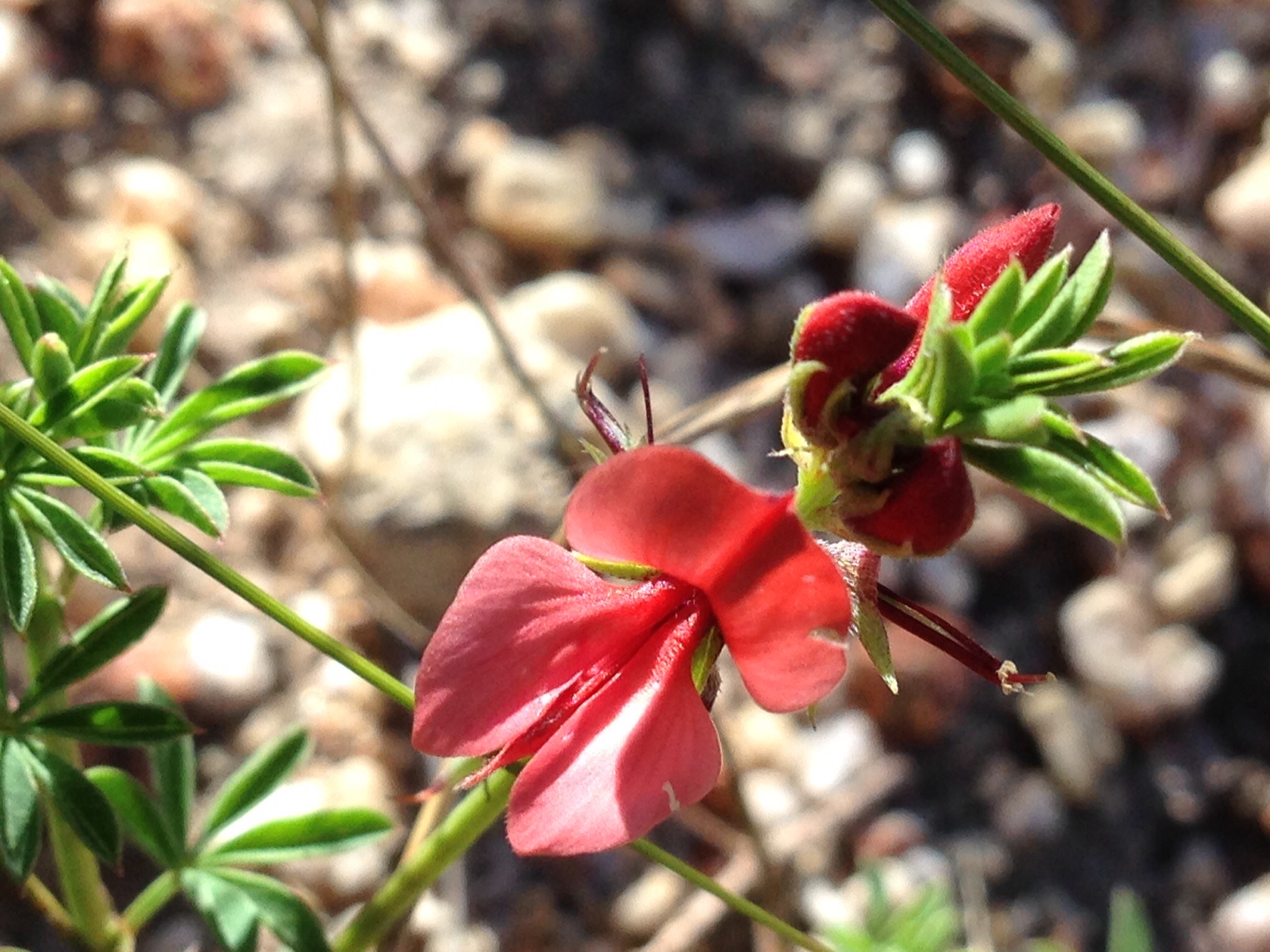
Back to the flowers.  I have no idea what this pinky red pea is.  I’ll post it on ispot and see if we can find out.

Unidentified pinky red pea

Unidentified pinky red pea

These are an old friend, Selago corymbosa, quite common and very charming.

I went for a walk the yesterday evening.  I’d missed the morning run and when the wind dropped in the evening I thought the dogs would like a walk.  They certainly did and I took a couple of beautiful photos of Maebh.  The focus isn’t perfect her coat looks great in the evening light.

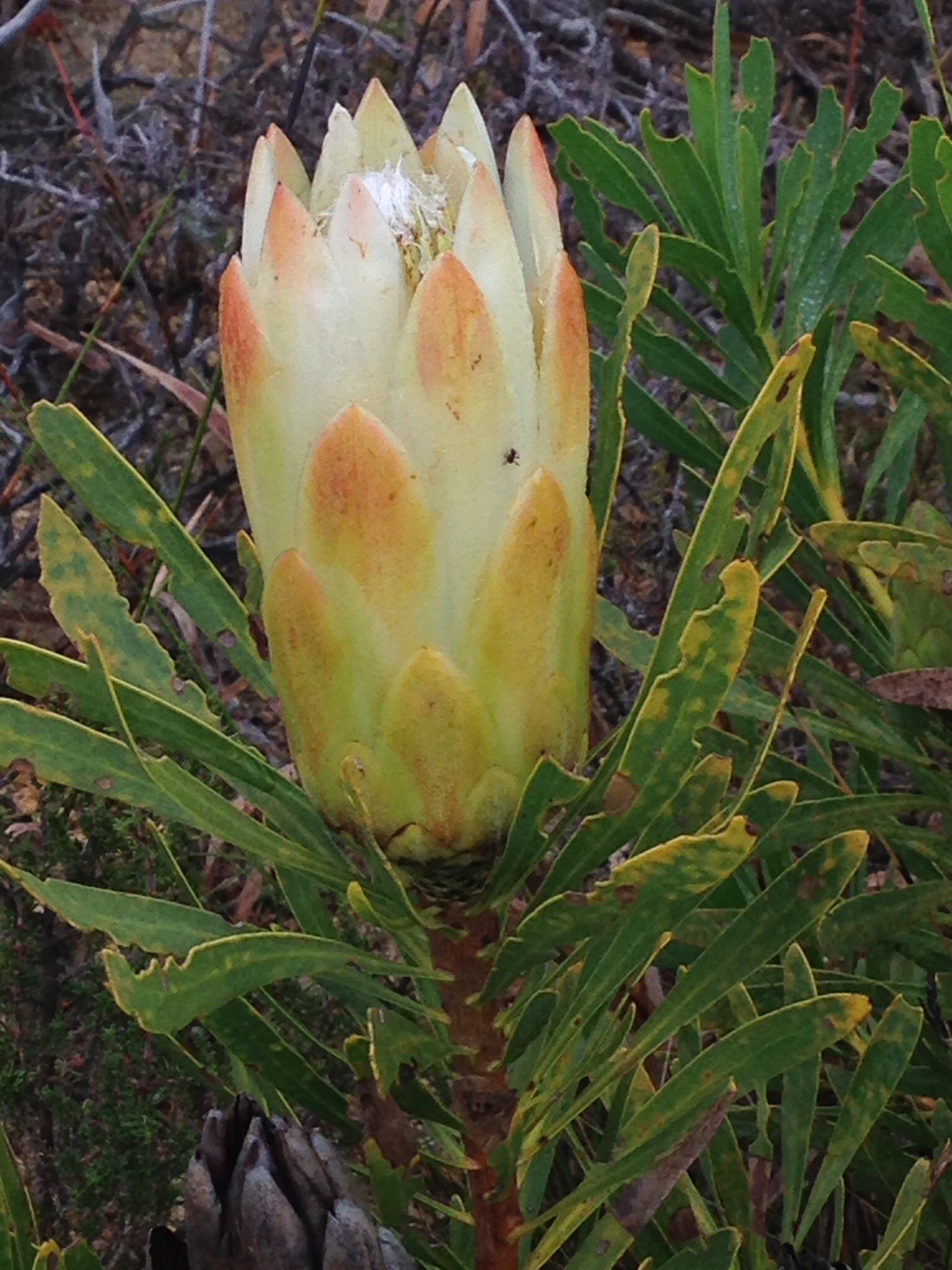
One of the first things to flower at the end of summer is the Protea repens and I think this might be a second flowering, it’s unusual to see them at this time of year.

Protea Repens

Protea Repens

I think this one is a Crassula but I’m not sure which one so once again I will ask the iSpot experts to identify it for us.

Gone with the Wind

So there I was only a couple of weeks ago feeling triumphant and even rather pleased with myself.  Then it struck me.  Not a brilliant idea; a tummy bug.  At first I hoped it was a 24 hour tummy bug but then I realised it didn’t have a time frame.  It took me a few days to realise I was actually really quite ill and by then I was already bored of it so I went to see the fabulous Dr Shelley and explained that I had to be on a plane to Plettenburg Bay in the morning.  “Have to?” says the Doc.  “Well, want to” says I.  She sharpens up her needles and gives me 5 injections, or was it 6?  I lost count.  “Now you’ll be able to travel if you want to,” says she “but if you do this will just go on for longer.”  She’s better at prediction than the weatherman; it took me another full week to be over it completely and back on the mountain again.

Everyone always says that the great thing about tummy bugs is that you lose weight, and while it’s true while you’ve got the bug, I always worry about compensating afterwards.  So I got back out on the mountain as soon as I could and after two or three runs I’m feeling pretty good out there.  I know I’ve missed some flowers though, which is always a bit sad – will have to wait until next year.  Fynbos bulbs can come and go in a day, but the shrubs are amazing – they will flower for months.  One example is the Lobostemon Fruticosus which is such a friend, I posted a photo of it in August and it is still flowering now.  On a bright hot day the flowers dim but a little grey and a dash of rain and they glow on the mountain.

It’s wonderful to recognise some special flowers that I identified last year and this is one of the them.  I notice them more this year, scattered all over the place and in partiular in one small shady area where a whole clump of them grow, but where the light didn’t lend itself to a good shot of the clump and we may try for a better photo of this charming Tritonia undulata the next time we are out.

Tritonia undulata

Tritonia undulata

A rather dark photo on a bright day – it’s almost impossible to get a good shot of a blue or white flower in bright sunlight.  I was glad I caught this Walhenbergia capensis on a run just before the flu hit, they are all gone now.

Wahlenbergia capensis

Wahlenbergia capensis

And isn’t this one absolutely gorgeous?  Another one that I captured on the run just before I had to stop and I’ve completely forgotten where I saw it and of course it has disappeared now.  I think it’s Geissorhiza exscapa.

Geissorhiza exscapa

Geissorhiza exscapa

I promised a better photo of the fabulously named lily, Wachendorfia paniculata.  This one grows along the drive and I was feeling so well on Sunday that at the end of our run the dogs and I trotted all the way down to find and photograph it while the light was dappled and it was still looking good.  Look how it glows against the yellow-grey sandy wall.

The flowers are amazing and really, that’s the point of the blog yet there are so many other special things, it’s just that flowers look great in pictures.  The grasses are absolutely gorgeous and I often try to capture their whimsical or even dramatic charm.  The iPhone doesn’t usually get it, but this one was a good attempt and I think these are Willdenovia incurvata.

As we bounced up the mountain the morning before I fell ill the wind was howling and I had decided not even to try and take a photo.  Then we came across this gorgeous Gladiolus angustus.  Luckily I decided that despite the wind I’d take a photo.  When I finally passed the same way 12 days later there was not the tiniest sign of it.

And finally – there is always a sunset.  I don’t capture them every day.  This one was special.

Sunset in the Western Cape

Sunset in the Western Cape

An auspicious day

A lovely run last night at the end of an auspicious day.  My nephew Beckett James Grey Mulhern was born in New York.  Birthday the 21st of October; an autumn child, harvest festivals and pumkins, the trees in Ireland wonderful shades of red and gold as you drive down Wexford roads to the Opera Festival.  The huge full moon.  October has always been a happy month in our family.

I remembered to take a couple of whiffs of the inhaler before we left the house which meant the lungs were clear to convert oxygen as needed and we fairly bounded up the mountain in the fading evening light.  As we climbed higher I could hear the baboons calling in the forest.  Maebh and Jemima Chew heard them too and shot off to explore.  Luckily they decided not to go too far and quickly came back to Seamus and to me as we climbed higher.  I have a new weapon against wandering wolfhounds – you can see it in this photo of Leucadendron tinctum in which Meabh elegantly arranged herself in the background.

The cones of Leucodendron tinctum with Maebh in the background

The cones of Leucodendron tinctum with Maebh in the background

The white you can see on her collar is a tracker.  I found it online, it’s German, works brilliantly in South Africa and tracks your dogs live when they go missing.  When the wolfhounds wander we get incredibly worried; we know they can travel a long way and dogs have been lost on this mountain more than once. Shouldn’t happen with this cute little piece of technology which links to the iPhone.

The baboons used to come down into the olive groves and even as far as the gum trees behind the house.  I haven’t seen them for quite a while, they really hate the wolfhounds.

One of my favourite flowers, Aristea capitata is in full flower at the moment.  There is a colony on the driveway and the blue spikes are a joy to behold.

This was one of the special evenings.  No wind, the end of a hot day with a dampness in the air that cooled us as we ran higher.  Lovely light.  When we stopped for a drink at the weir Maebh, who was in a modeling mood today, stood in front of the Ilex Mitis as I took a photo of the white trunks gleaming in the evening light.  With her dappled coat she almost disappears.

Maebh and the Ilex Mitis

Maebh and the Ilex Mitis

Paarl holds an iconic place in the South Africa psyche and the two huge granite rocks that stand above the town to the west are unmistakable to anyone who knows the Cape.  Maebh, once again, stood for a moment to watch as the sun slipped away behind the rocks, which happens just at this time of year.  Soon it will be setting well to the west, over Table Mountain.

Maebh watches the sun setting over Paarl Rock

Maebh watches the sun setting over Paarl Rock

There are so many flowers in bloom that it’s hard to know where to begin.  One is this tiny Pelargonium, I don’t know what it’s called but I do like the pink tinge to the end of the petals.

Another is a favourite, the spikes of Microdon dubium.

Microdon dubium

Microdon dubium

Talking of dubiums, some new bulbs have emerged.  This is Ornitholagum dubium.  It flowers in just one place on the farm and there it flowers copiously.

Ornitholagum dubium

Ornitholagum dubium

This one I’m less sure of – Bobartia I think, possibly Bobartia indica.

Bobatia indica

Bobatia indica

The farm is covered in this one, charmingly known as Lady’s Hand, because the petals, bent back in greeting, resemble the hand of a delicate girl waving a hello.  Cyanella hyacinthoides.

There’s a plethora of peas on the go at the moment and this is Aspalanthus cordite, unmistakable with its grumpy spiky leaves.

Aspalanthus cordite

Aspalanthus cordite

I love this shrub – Passerina cormybosa.  They are supposed to be pink and yellow, while we have some that some that seem to be white as well.

There is masses of Lobelia along the roads, this one I think is Lobelia coronopifolia.

image

Lobelia coronopifolia

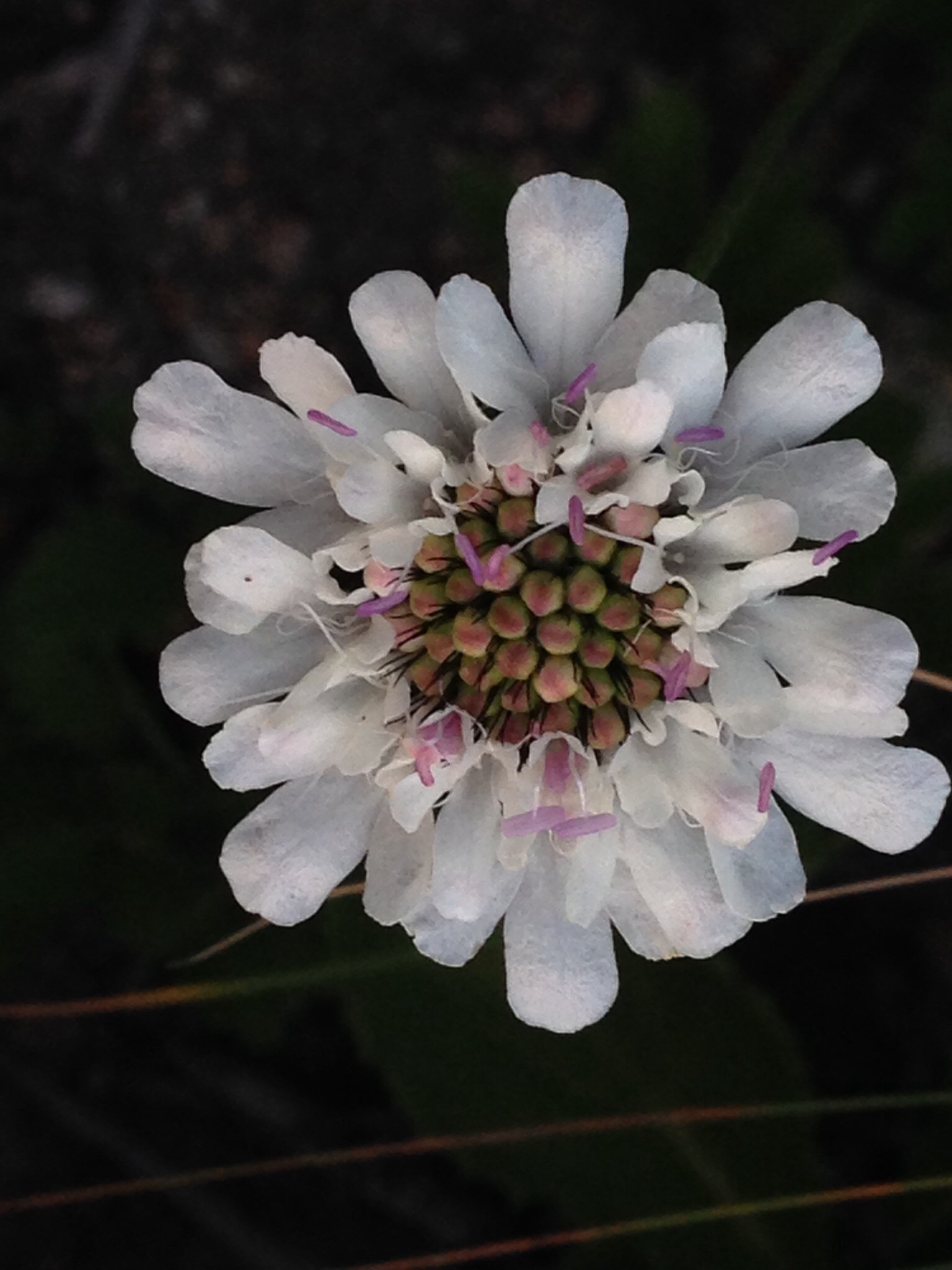
Another flower that is to be found absolutely everywhere and is flourishing in the garden as well is Scabious africana.  This one is particularly pretty.

Scabious africana

Scabious africana

« Older Entries Recent Entries »