Tag Archives: pelargonium

Flowing Water and Fowers – 28 June 2013

Home.  The desert sands of Qatar behind me at last.  It was a shock to return to glorious green after the thick humid sandy air of Doha.  It seems it’s done nothing but rain since we left home three weeks ago and the farm has a rich sodden feel to it, with water roaring through the river and tumbling down the waterfall.  The roads are in need of maintenance, full of rivulets and potholes but the seeds I planted in the garden before we left have all sprouted into healthy young plants and the fynbos is settling into a winter burst of life.   Seamus, the senior wolfhound, is joyous at my return and cannot bear to leave my side.
The dogs and I went for an evening walk, inspecting some of our usual routes, the dogs looking for new smells, and me looking for new flowers.  We started down in the stream below the house that leads to the damn.  The banks are lined with Arum Lilies at this time of year.  Just as the luminous grasses have disappeared the lilies flower along the rivers and roads all winter and their beauty speaks for itself.  We have a few months of them ahead, and there will be a lot more pictures to come.
Image
Arum Lilies
The great thing about this blog is that it focuses the mind on home, on the magnificence of this land and the plants that grow here.  I’ve seen Chasmathe all over the Cape, they remind me of the Montbretia that grown wild in Ireland, another South African wild flower that grows all over Ireland’s verges and banks in the summer.  At first I thought it was the same flower but Montbretia doesn’t grow in this part of the world, it belongs further north in a summer rainfall area.  This Chasmanthe is lovely, another of the anchors of a certain time of year, this winter time, when growth is rich and lush and yet only a herald of things to come.
 
image
Chasmanthe, most likely floribunda, but to be verified

When we moved to the farm eight years ago this little red creeper was one of the first flowers to awake my interest in fynbos. The flowers are tiny, smaller than my little fingernail and they appear suddenly in midwinter, winding around the stems of thicker fynbos. Despite their tiny size the jewel-like coral jumps out of the greenery and draws the eye. We will have them until mid-spring or later, all over the farm.

Microloma tenuifolium

Microloma tenuifolium

We could hear the waterfall long before we saw it – with the rainfall we’ve had in June the rivers on the farm are roaring and the land feels replenished.

The Waterfall

As we walked along the new road that leads to the waterfall this enchanting sight greeted us.  I don’t know what to say or even think about the
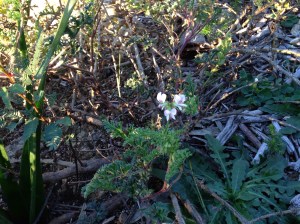
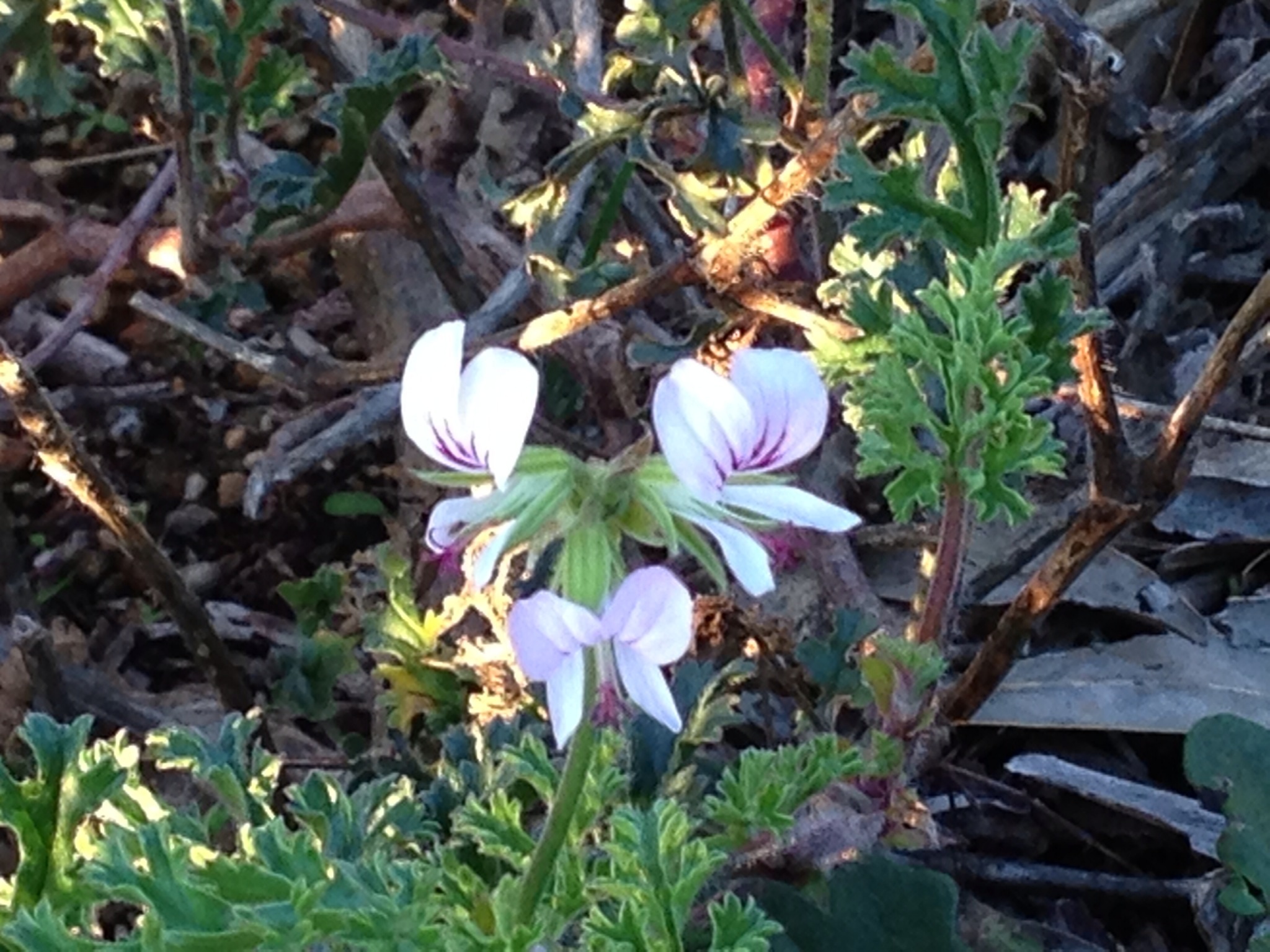
pelargoniums; though are stunning, charming, and endlessly delightful the sub-species seem impossible to identify.  Our new road is a pelargonium nursery and they thrive here all year round.  At least this one allowed me to take a good picture – gracefully gleaming in the evening light.
Pelargonium - subspecies unknown

Pelargonium – subspecies unknown

Pelargonium

Pelargonium


The books have a few pelargoniums but they don’t seem to flower at the right time of the year.  We have dozens and the best I can do is document them and find a real expert.  Some of those that I’ve transplanted to the garden are doing really well, perhaps that will help.  They are endlessly endearing.  My grandmother grew them, pelargoniums and geraniums, nursing them through the Irish winters.  She would have loved this place; not lush like Ireland with it’s dense choking green; more selective; intense; dramatic – she would most definitely have appreciated the drama.  It was her birthday on 22nd June, just after midsummer.   I was in Doha, so missed the shortest day of the year on the farm.  Today is the shortest day we will see this year, and this is the most north-westerly sunset, far over the Paarderberg.
Sunset over the Paaderberg  28 June 2013

By mid-summer this sun will set far to the South of Table Mountain.

My love of botany is definitely inspired by her, and by my stepgrandmother, both of whom were dedicated and knowledgable horticulturalists.  I thought of them both this evening as we descended in the gloom.  Two women, one Irish, one English, both Catholic, both of whom were born in one world war and raised their children through the next.   Gracious women, much loved, characters, who instilled in us both values and manners. They loved their gardens and gardening brought them together, unexpectedly and into a lifelong friendship.  They admired one another and both of them would like to know they are remembered and that they continue to inspire us.  

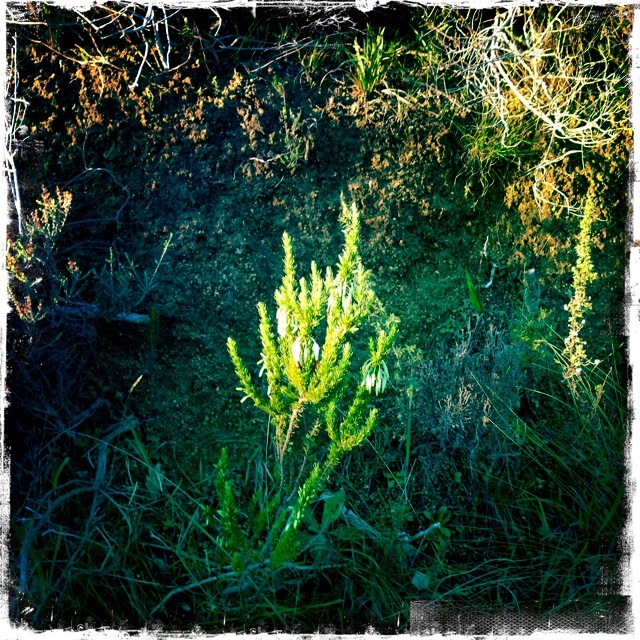
The Ericas are coming out all over the farm and I have not yet identified this one – a detailed book on Ericas as we as Pelargoniums is most definitely called for. The Erica family runs to 660 subspecies in the fynbos region, so we can’t expect to identify them all, but it will be fun to see how many we have on the farm and I will start a library page on them soon.

image

Pink and Golden Morning 29th May 2013

A week ago we’d had only 10% of the average rainfall for May and I really worried that I’d be blogging about the dry winter and all the flowers we might be missing because of it.  That may still be the case, but probably not because of the lack of rainfall in May, and if the predictions for the first two days in June are accurate, June should be accounted for almost before it starts.
I am learning to be grateful for the rain in Africa, though it doesn’t come easily to an Irish woman. Good rain here comes in 7 – 10 day waves and after a few days a break and a glorious pink and gold morning is truely welcome.  This morning was such a one – blue sky with pink and gold tipped clouds, fresh air and dampness in the scent and on the ground.  Happy dogs released from the contraints of the wet (largely spent on my bed) cavorting in the early light.
On our way up the mountain I saw this lovely pelargonium.  It is quite distinctive though not one I can identify.  We’ll call it the May Pelargonium as date of flowering is very relevant to ID.  It is hard to convey the delicate charm of these flowering shrubs – they flower all winter, spring and summer and I have successfully transplanted a few to the garden.  The flowers tend to be tiny and hard to photograph, in situ they charm completely, epitomising all that is delicate, fragrant and fragile.
Image
The flowers on the mountain seem destined to confuse me and I have been worried about the Neirine I thought I’d seen.  The petals of the Nerine turn back on themselves and I couldn’t see that in the flowers I posted the other day.  As usual the flowers themselves came to my rescue.  At the top of the farm, beside a path we take almost every time we go out, the same coral petals greeted me this morning, waving in the dawn light and the gentle breeze.  Clearly, so very clearly, a member of the Gladiolus family, although this subspecies is not in my book.  What an amazing colour.  I’m glad it pops up in a couple of different places, it means there are probably a lot more of them on the farm, even if we don’t see them.
Image
In my attempt to confirm the sighting I tried to climb down this afternoon to get a closer look at the flower on the bank – but failed, the bank got too steep and my nerve failed me.   Heading up the farm in the afternoon light reminded me that at this time of year I miss a lot in the early mornings when these flowers are tightly furled, the colours invisible. During the day they unfurl and show themselves to the light.  The Oxalis stud the entire farm in yellow, white, pink and blue, like stars everwhere.  Their perfection is hard to photograph, the blues and pinks are easier than the white.
Image
There are friends that enchant every day, and in the increasingly gloomy afternoon light as more rain swept in across the Western Cape, this shining golden yellow Leucodendron with a wild rosemary behind it makes me think again that our wild garden could not be bettered by the work of the best landscape artists.  The shrubs find a harmony of their own.  It is fun to find new things of course, but often the best pleasure is in this greeting of old friends in a new light.
Image
The dogs gamely followed me down the slope as I tried to find our nerine/gladiolus and I was quite impressed at their tenancity.  Climbing up was easier than climbing down and as we climbed we came across this Erica.  It could be one of several tubular Ericas and I see that the need to acquire more detail reference books is becoming urgent.  This captures it perfectly – it is not the most lovely example of these fascinating flowers, but I like it’s fleshy abundance and they are prolific and will be everywhere soon.
Image

Introducing The Fynbos Blog

Most mornings I get up and unless I have other early morning commitments I take the dogs for a run around our farm, situated on the mountains of Klein Drakenstein Municipality in the Western Cape of South Africa.  Because it has a Mediterranean climate with dry summers and wet winters, unlike the rest of sub-Saharan Africa which has wet summers and dry winters, the Cape Floral Kingdom is unique and diverse and known as the 8th Floral Kingdom of the world.  All year as we are out running, me and the dogs, a spectacular botannical feast unfolds before us, and every year I think that I must find a way to share it with a broader audience.  Collectively the shrubs and bulbs of the Cape Floral Kingdom are known as Fynbos.

The year starts, in my mind, at the end of February or early March which is the end of summer in this part of the world.  Typically we have had a hot dry summer, often with no rain at all from early January and the floral life dries and dies by, with only some robust flowers, usually near a source of underground water, surviving the heat and blazing sunshine.  We rarely go over 40 degree here on the farm, but in the valley, in Paarl, it can be 45 on a hot summer day.  Suddenly, before the rains, the mountains burst into life, as Protea Repens, for me the first flower of the new botannical year, bursts into life.

This year I will take a photographic record of as many flowers as possible, starting with Protea Repens, and including a tiny pelagonium that I found nestled by the side of a path, unusal for the time of year.  I will include anything I know about the plant, but I welcome comments as I’m no expert.

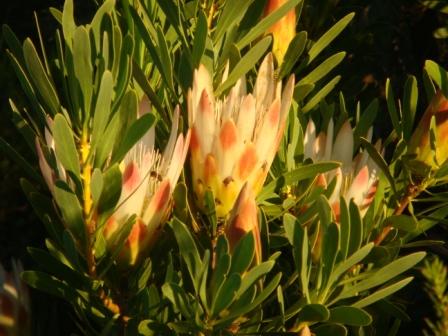
Protea Repens is common on the Du Toitskloof Mountain and is commonly known as sugarbush.  It can be pure cream, or the petals can be tipped with pink.  The flowers are narrow and cupshaped.  The shrubs, here on the farm at least, grow in massive quantities and the spectacle of pink and white flowers is a magnificent sight.

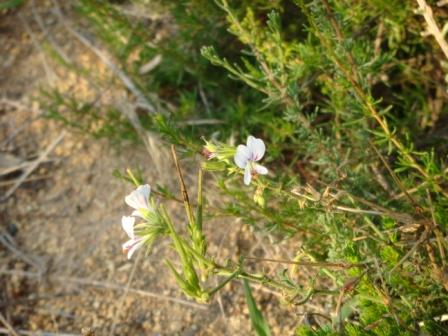
There are hundreds of different pelargoniums, worthy of a book in themselves and we have many different species on the farm.  I couldn’t identify this one.

.Image

ImageImage

Recent Entries »