Category Archives: Fynbos

The Rooi Afrikaner or Gladiolus watsonius – a technical blog

For at least four weeks I’ve been frustrated by this glorious red gladiolus.

Gladiolus watsonius

Gladiolus watsonius

The species is easy to identify, the subspecies has been confusing; our first sighting was at the end of May and the book says it doesn’t flower until August.  Even the more detailed encyclopedia says that it flowers from July to September. Furthermore it grows in clay and granite slopes in renosterveld. We have granite and sandstone slopes which is a subtle but important difference when it comes to fynbos. Over the weekend I got more serious and looked more closely – the only possible suspect was Gladiolus priorii. But Gladiolus priorii has a yellow throat and although I didn’t have a photo of the throat, I was pretty sure it’s not yellow. I couldn’t really bring myself to believe that we have a previously unidentified Gladiolus on the far, tempting though it might be.

Today I picked one.

It had fallen over a bit on the bank above the drive, it’s a bit tatty and it was time to take this whole process of identification a bit more seriously. And I can reveal that Gladiolus watsonius has one particular distinction. The lowermost leaf is narrow and H shaped in cross-section. No I didn’t get the scalpel out – I’m not that much of a geek yet. It’s pretty obvious just looking at it.

The lowermost leaf of Gladiolus watsonius

The lowermost leaf of Gladiolus watsonius

We have a positive identification – it may be the wrong time of year, it may not be quite the right soil-type but there is no doubt: Gladiolus watsonius likes Du Toitskloof and it likes our farm. It flowers when it chooses to and it’s not going to change, so the sages who write the books may need to change a word or two.

Gladiolus watsonius

Gladiolus watsonius

Magnificent Proteas, more water and some new finds

There is a lot to share so today’s blog is all flowers and less about the run.
Up until now I’ve been going by the flowering dates shown in my reference book but I’m now not so sure.  I know from the records I’ve kept over the years that the different weather can mean flowering even in the garden here can vary by a month or six weeks from year to year, so why not the fynbos.
Stachys aethiopica, for instance, is supposed to flower in August and September, in the early spring.  But we saw one in May and there are small groups of them in different areas at the moment.  They are unmistakeable with their flower reminiscent of a pelargonium and distinctive mint-like leaves.  Indeed they are a member of lamiaceae, the mint family
Stachys aethiopica

Stachys aethiopica

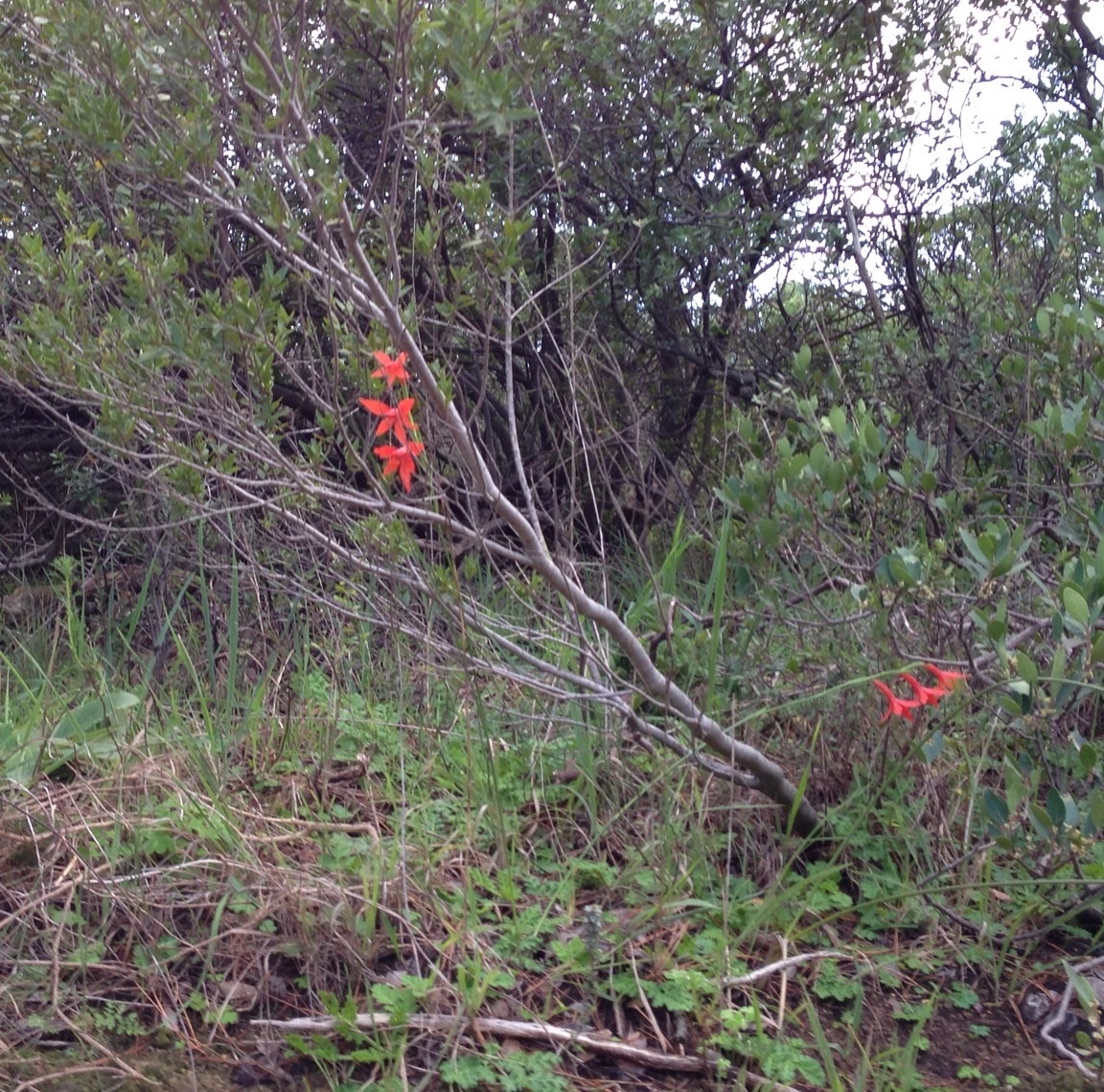
The red gladiolus has cropped up in a few places.  There was one by the road when I left in early May that was easily photographed.  The latest two are high on the bank above the drive, but worth sharing even if the photo isn’t great.  The nearest possibility is gladiolus priorii, though in that case the flowers should be dull red and these are a vibrant scarlet.  It should also have a distinctive and easily visible yellow throat and I can see no evidence of that in our flower. I will look again as the size, shape and flowering season fit.  I need to look a little closer if one appears in a more accessible area.  If not, we’ll have to wait until next year to be sure.
Gladiolus - unamed

Gladiolus – unamed

The dogs and I had a wonderful run today and we visited the weir to see how much water is flowing.  This is always a lovely place; the whitish trunks of the Ilex Mitis or Cape Holly, are magnificent and the permanent water flow makes it a favourite of the dogs.
An ancient Ilex Mitis with its feet in a permanent stream

An ancient Ilex Mitis with its feet in a permanent stream

Jemima Chew enjoying the water in the weir

Jemima Chew enjoying the water in the weir

While I’ve been away the magnificent protea trees have come into flower.  They are tall and have spikey white flowers and silver leaves.  I believe they are Protea nitida.
Protea - probably nitida

Protea – probably nitida

Near them stands this delicate pink protea.  It is probably a nerifolia, though the flowers are barely bearded and a paler pink than most of the nerifolio on this farm.
Protea nerifolia - a very pale pink specimen

Protea nerifolia – a very pale pink specimen

Flowers found in the forest that abutts the farm are included in our blogs as they are on our regular running route.  We’ve seen Ursinia paelacea before and there is lots of it along the forest roads.
Urisinia palaecea

Urisinia palaecea

Not everything is easily identified. This little clump of yellow daisy-like flowers is lovely and quite distinctive but I can find no record of them. Suggestions welcome.

A mystery flower - yellow daisy-like flowers are the hardest to identify

A mystery flower – yellow daisy-like flowers are the hardest to identify


As we ran into the forest the path is lined with Leucadendron salignum.  There are hundreds of these all over the farm.  At this time of year they glow in the dark, another plant that seems to absorb the sunlight and render it back to us on the darker days.  Today was bright and they gleam in the early winter sun.


Leudadendron gleaming in the winter sunlight

Leudadendron gleaming in the winter sunlight

Recent Entries »