Category Archives: Uncategorized

Five metres of Fynbos

So there I was last Tuesday.  Filled with good intentions on a beautiful morning.  I choose to deviate from our usual morning route so that we could go a bit higher and check out some places we don’t always visit for new flowers.  The first bit of that route is a bit steep and being morning, when I’m never at my brightest, I wasn’t paying proper attention.  The thing is, I’ve always had a tendency to sprain my ankles, but they don’t tend to get sprained when you run, it’s more likely when you walk.  I put my foot down on a fallen twig, lying on an uneven bit of road, and… Crunch!!!  Screeech!!!  There are things, many things that are more painful than a sprained ankle but not many that take your breath away quite so much in the first instants of the sprain.  I was hopping, swearing, hoping it wasn’t a really bad one – it’s hard to tell in the first moments.  Feeling sick and cross I hobbled home, followed by some very disappointed dogs.  It wasn’t a very bad sprain.  Experience has taught me that RICE is best.  Rest, Ice, Compression and Elevation.  And lots of anti-inflammatory cream.

A week later it’s still a bit swollen but we’ve had enough of sitting at home and I always feel horrible when I can’t go running, so we are going to strap up tight and head up the mountain tomorrow.

Meanwhile the blog has suffered.  As I couldn’t do a wide ranging run, I thought I would do something different.  I stopped the car on the drive, and in the interest of not walking far, I photographed every single flower on just one side of the drive within a five metre range.  So here you are: five metres of fynbos.

First up is one that I absolutely love.  It’s very common and quite a scruffy little thing at a distant – white or pinkish flowers on spiky leaved stems, it took me a long time to identify it properly.  The thing about it is that if you photograph it in close up, very close up, on a windless day and with a steady hand, the flower heads look like bunches of tiny roses.  It’s called Anaxeton laeve and it’s serruptitiously gorgeous.  I confess that I stopped at just that point of the drive because I’ve been wanting to feature Anaxeton laeve for a while.

Lots of other flowers live nearby.  There is one I haven’t identified, a pretty apricot coloured daisy which I don’t think we’ve blogged before.  And the blue Geissorhiza aspera which is very common.  It’s a lovely flower and this example was a little tatty but they did grow in this five metre stretch.

Eight other species were to be found along this little stretch.  These are all wild, all in flower at just this time of year.  I’m not sure that every five metres on the farm would yield so much – though some sections would yield many more.  We’ll do it again, just for fun.  In the meantime I can’t wait to run tomorrow and I know the run will yield some very happy dogs; I hope it also yields some exiting new spring flowers.

The Colour of Home – with the colour

A few of you who follow The Fynbos Blog commented that the photo of Table Mountain and Paarl didn’t show up on yesterday’s posting when it landed in your inbox.  Here it is again along with the original text – do let me know if it doesn’t appear.

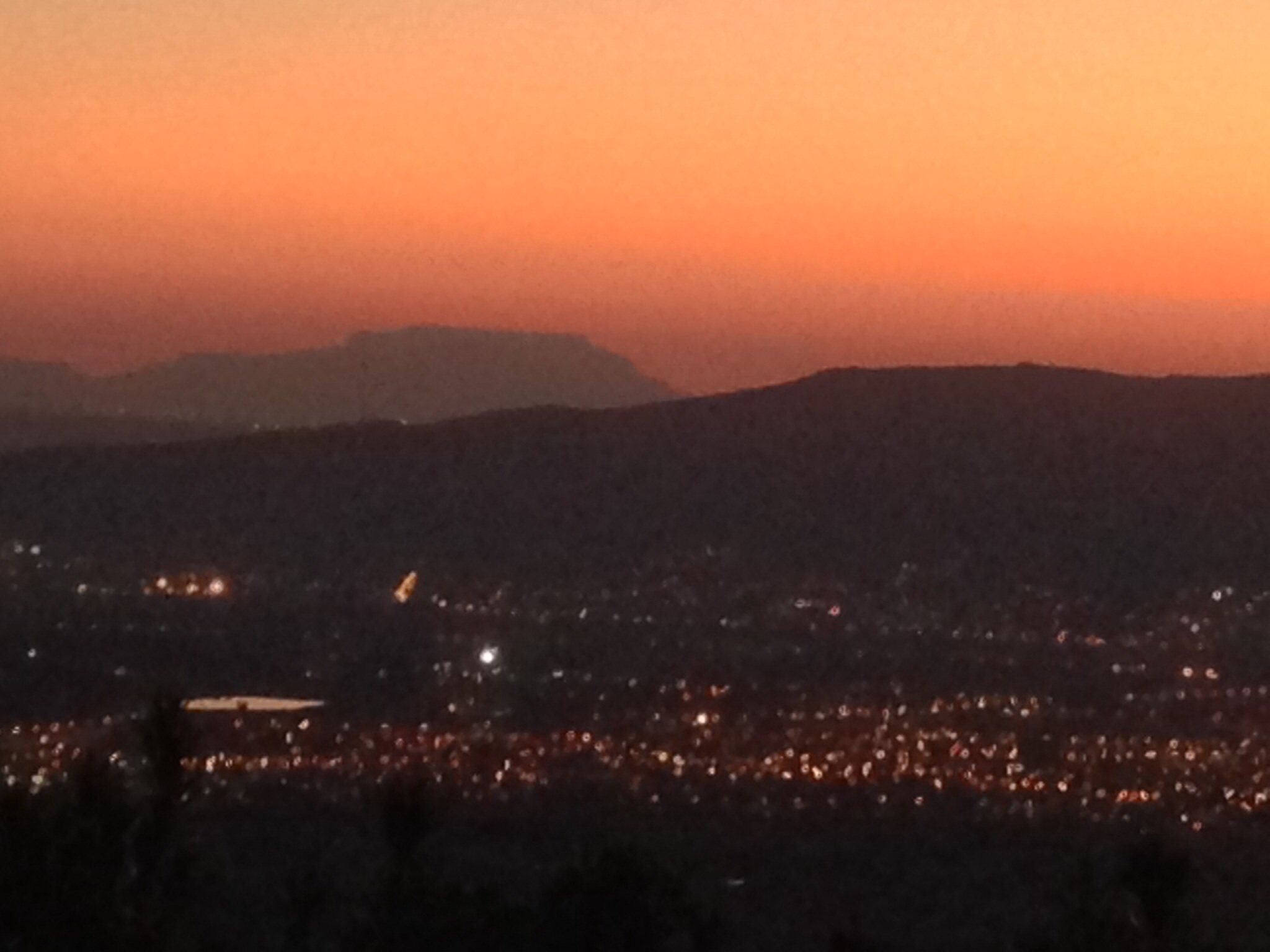
The lights of Paarl below as Table Mountain dominates the evening sky

The lights of Paarl below as Table Mountain dominates the evening sky

Tonight the sky was glorious with colour and for once I’ve posted a sunset shot as the headline picture.  All the photos on this blog are taken with my iPhone 5 and I’m so impressed with what it can do.  This shot is a view of the lights of Paarl, with Table Mountain 60 kilometres away dominating the skyline in the orange light.

A spring morning

On Friday evening the neighbours came to dinner and arrived early for a flower safari. Wonderful to have neighbours who love the mountain as much as we do and who appreciate how special it is. I took them on the old doctors road to see the waterfall which is pounding in its winter splendor. There are hundreds of flowers at this time of year, the wildflower spring commences long before flowers come to the garden. We discovered the old doctor’s road when Peter cleared a veritable forest of wattles along the river; they had overgrown this road and below it, a small but spectacular waterfall. Now this place is a haven for the fynbos which grew back the instant the trees were cleared.

From there we walked up to the weir, a favourite spot and much photographed for this blog because of the magic of the magnificent, ancient, white trunked Ilex Mitis trees, and then on up, above the weir and close to the top of the farm. The sun was setting behind the Paarderberg mountain; a soft mist gathered in the valley below, the evening was completely still, silent, breathless.   The gentle warmth of a mild sunny winter’s day coming from the earth beneath our feet. As it grew darker the full dams in the valley gleamed the reflection of the evening sky into the stillness of the coming night. “It’s like a holy place” said Francois, “there’s something spiritual about it.”

Dinner was companionable, cheerful and as we are in wine tasting mode for Christopher’s wedding in January, a little too much drink was taken. Our guests left us late, very happy, as were we.

Perhaps a little less so the following morning when the full consequences of overindulgence emerged, but not enough to prevent me from donning the running clothes and setting off with the wolfhounds and Jemima Chew into the gloomy grey morning on a serious mission to photograph flowers for the blog. The first Babinia fragrens has appeared which is for me the harbinger of spring, and with it shrubs, little trees and tiny plants have burst into flower. I won’t post the Babinia, as there will be thousands more, I didn’t get a great photo and there is so much else to post. It rained heavily during the night, those very still evenings often indicate a change in weather and flowers were covered in raindrops. To my delight I’ve identified two new flowers that I don’t remember seeing last year and which turn out to be related.  The first is Hermannia saccifera and the second is Hermannia hyssopifolia, a pretty and sizeable shrub with an unusual flower that has a pin-hole throat and this urn shaped body, called a calyx.  Absolutely recognisable when I read the description, there is nothing quite like it.

The Hermannia hyssopifolio grows in an area that Peter cleared last year, cutting through old fynbos and finding a large flat area where we least expected it, evidence of terracing by a farmer long ago.  A stream runs through this area and shrubs and there is prolific growth along it’s banks, including this sprawling shrub with its sticky leaves and tar-like smell.  It’s known as the tar pea, Bolusafra biuminosa, and grows, appropriately enough, along mountain streams.
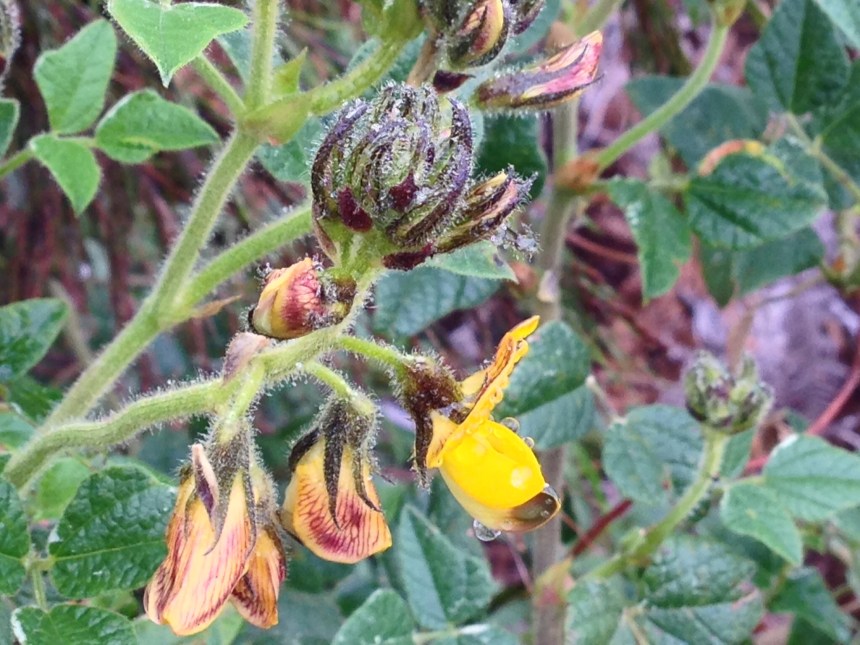
Bolusafra bitumenosa, the tar pea

Bolusafra bitumenosa, the tar pea

Another new identification also grows in this area, Phylica oleaefolia, with these pretty ranks of pale green, cupped flowers.  This is quite a tall elegant shrub.

Philyca oleaefolia

Philyca oleaefolia

We went down to an area where I haven’t been for a while and some of the yellow daisies are still flowering, the Athanasia trifurcata and the Osteospermum spinosum that I mentioned on a blog a couple of months ago.  I love when the flower matches the book’s comments perfectly, particularly as the photos don’t always.  The Athanasia trifucatum, says the book, has wedge shaped grey leaves, 3-5 toothed at the tips.  If you look closely at the leaves in this photo you can clearly see the three teeth.

In the same place grows a tiny pelargonium, one of my favourite flowers which grows all year round in different parts of the farm.  I think it’s Pelargonium myrrhifolium, var. myrrhifolium.


Along the road we walked on Friday night, which I call Erica Alley for the many varieties of Erica that make their home there, are several stunning varieties in flower.  Two beautiful examples of the common Erica plukenetii, showing the range of colour, from white with very pale pink, to coral.  And some with pretty pink bells in many shades, as well as this lovely white Erica where the bells grow in ranked series but which I have never identified.

Another pretty shrub which I have not managed to identify.  The flowers are green and tiny; so tiny that a single raindrop captures several of them.

And a small tree-like shrub flowering in several places on the farm with prolific drooping flower heads, but I can’t find it in the book.

image

More familiar friends include Stachys aethiopica, also known as woundwort with it’s mint shaped leaves and pretty little pinky-white flowers.
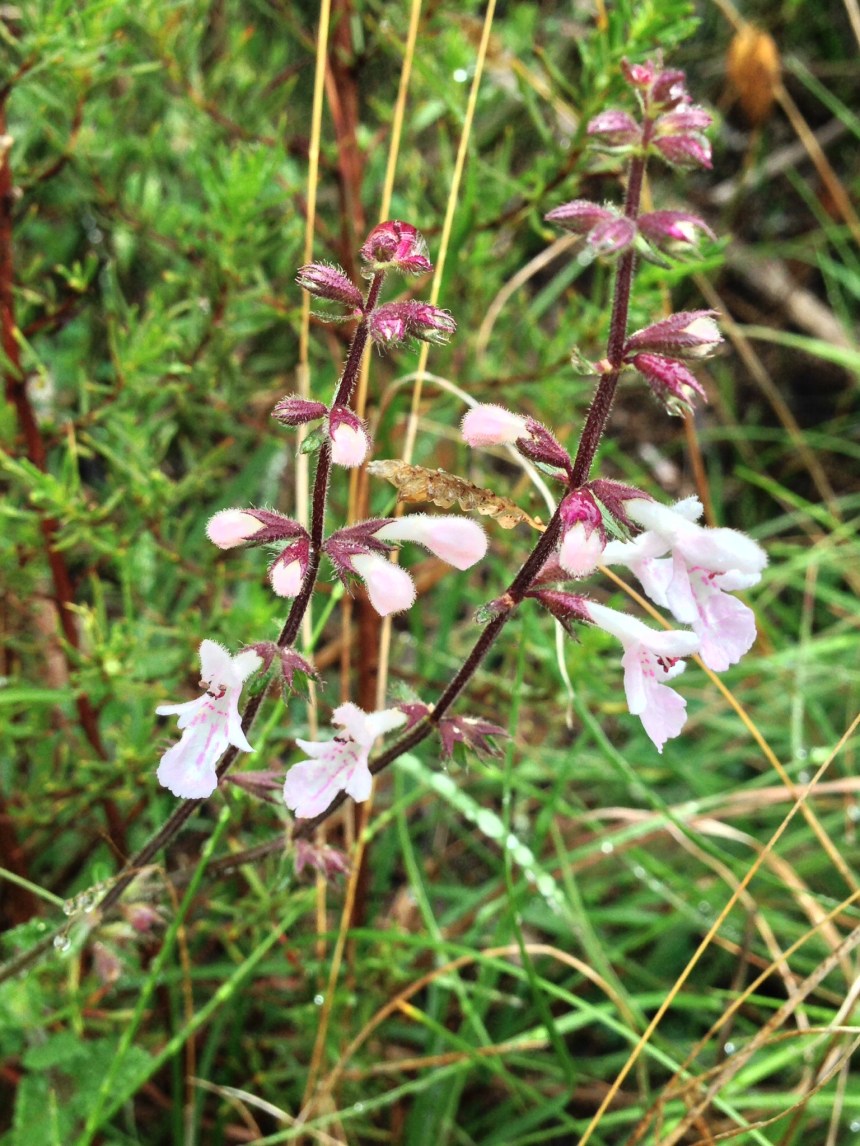
Stachys aethiopica

Stachys aethiopica

All over the farm the buchu is in flower.  Agthomsa, mostly crenulata, or a crenulata hybrid, though we also grow lots of Agthomsa betulina.  Buchu, the common name, loves the sandy mountain soil and especially the north facing slopes on the farm.  The flowers are mostly white but sometimes pretty shades of pink and lilac.


I couldn’t resist capturing Protea burchellii looking stunning in the grey morning light as well as the Leucadendron tinctum.  These yellow flower heads will soon turn the most wonderful shade of coral – they are prolific on the mountain and grow in massed groups in certain areas.

All in all we had a wonderful time, the dogs and I.  As a run it wasn’t up to much but as a morning spent together on the mountain, it was the best of times.  Maebh has boundless energy and was particularly happy to find a mongoose to chase.  He is much much cleverer than she, there was never a chance of her catching him, but she was very pleased with her morning.
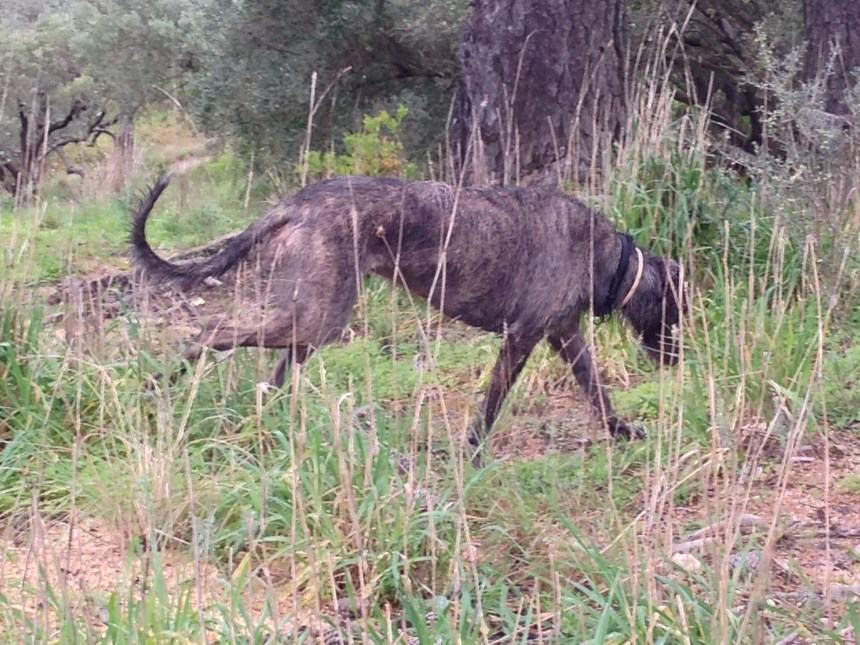
Maebh hunting in the olive groves, her coat dark from running in the soaking wet fynbos

Maebh hunting in the olive groves, her coat dark from running in the soaking wet fynbos


A new look

If you’ve visited the blog before you might notice I’ve changed the theme.  I have been wanting to find out how to improve it for ages and suddenly I have some time to play with it, curled up on the sofa with Maebh while Niall and Peter enjoy the Sunday night movie.

We’ve been having some wonderful runs on the mountain – the weather this week has been warm and sunny and the mornings have been stunning.  Not too cold even first thing; as we run up the mountain the rising sun hits Table Mountain in the far distance.  60 Kilometres away – too far to photograph from here but the human eye is a magical thing and then we see the light flood the entire Western Cape until it catches the Paardeberg and the Simonsberg and finally Paarl moutain opposite us and then climbs the lower hills of this mountain until it reaches us at about 8.30.  By which time we know we are late for breakfast and we tear down the hill as fast as we can.

We are usually late because we’ve stopped to photograph something.  The wild rosemary, Eriocephalus africanus, is in full bloom now.  We were kindly invited to a divine lunch at Overture restaurant today at Hidden Valley where they have a magnificent fynbos garden and this is used to great effect.  There are places on the farm where it looks like it has been planted by a brilliant landscaper – great banks of whiteness.

We always see something interesting as we trot down the drive and this one is a scruffy looking thing – it looks like nothing from a distance but Ericas are deceptive and close up you can see the tiny tiny flowers, the telltale little bells make the identification as an Erica certain, though I can’t say which Erica it is.

I can’t resist taking a photo of Protea nerifolia when I see a particularly beautiful specimen – my favourites are the white variation but this pink flower shimmers in the morning light.

Protea Nerifolio

Protea Nerifolio

I can’t find this one in the book – it is heath-like but not an Erica – will hope an identification pops up and repost if it does.

Unidentified fynbos shrub

Unidentified fynbos shrub

A Flower!

We have had heavy rains over the last few days – up to 40mm in some places which is high for this time of year.  Some years the rains don’t arrive until April yet this year it has rained a little all through the summer.  The farmers are not happy – these are the Cape Winelands and the farmers depend on the heat to ripen their grapes.  This year they have struggled.  The olives on our trees are sparse and slow to ripen, and we hear it is the same everywhere, even with the big producers.

The fynbos isn’t listening.  At least not yet.  After months of daily flowering and the expectation of something new and exciting every time I go out, I haven’t seen anything new for weeks.  The Protea Repens is the one thing that is in flower and it is stunning.  It needs a proper expedition to photograph it and a blog of its own.  But little else.  Until yesterday when I was driving up the drive and saw a tiny little spike.  We are a bit chaotic at the moment what with Peter away, my horses injured and needing nursing twice a day, and the farm truck out of order which means I had to do the village school run today.  But when I got back this afternoon I called the dogs and we went to inspect.  What a stunning little thing.  I have no idea what it is but I was so happy to see it.

Unidentified autumn flower

Unidentified autumn flower

Later this evening we went for a gorgeous run around the farm.  No special light, nothing to photograph in terms of flowers, just cloudy skies and still air.  There is nothing I like more than these moments, the evening run with the dogs, the smell of the mountain and the call of the Cape Eagle Owl in the pine trees as we come back down the road through the half-dark to the house.


Home

The glimmering lights of Paarl

The glimmering lights of Paarl

It’s been a busy week in Johannesburg and London and I returned home this morning a little bedraggled and the worse for wear off BA059. Peter points out that its not all because of work, I took advantage of a quieter week than usual in London to catch up with friends and family which was wonderful, but a very bumpy flight home and little sleep didn’t help today.

It’s hot in Paarl and I spent a quiet afternoon doing some work and catching up on emails in the shade of the big blue gums behind the house. This evening there is not a breath of wind, always rare on the mountain and the sky, the mountains are glowing in the light of the rising moon, nearly full.

I walked down to the dam wall in the stillness and all around the fiery necked nightjar and cape eagle owl called in the dusk. These are the sounds of the African night and I felt utterly at home. There is an autumn coolness in the air but the earth smells slightly burned and spicy from the heat of the day. The lights of Paarl glow down in the valley with Paarl rock silhouetted against the setting sky. The moon rises over the house, reflected in the still waters of the dam.

An almost full moon rises behind the house

An almost full moon rises behind the house

Heat and Dust

As I write this the wind is howling outside, whirling around the mountain, roaring down the natural funnel that our little valley creates; rattling the roof and whistling through the chimneys.  The days are hot, late 30s every day, and the land is dry and cracked.  Typical end of February weather.  A few drops of rain expected at the weekend, but realistically no proper rain until late March.

Hot summer evening with the haze of a summer fire visible in the valley below

Hot summer evening with the haze of a summer fire visible in the valley below, the mountain to the northwest is the Paaderberg

The dogs enjoy a late evening paddle in Fox Pan with the evening sky reflected

The dogs enjoy a late evening paddle in Fox Pan with the evening sky reflected

In Northern Hemisphere terms this is late August, a time when few gardens look their best.  And we don’t know if we’ll see much in the way of flowers for still another month.  Yet we love the summer.  The heat gets into your bones and is a pleasure when you grew up where it’s damp and cold.  We went to a local wedding on Saturday and it was a splendid evening.  Though the wind blew on the mountain in the valley it was still and warm and the reception was held on the lawn, with guests lounging and chatting on sofas and chairs scattered in the shade of the tall oak trees.  A wonderful South African moment.

Last week we had an exceptional cloudy day.  We woke during the night to hear rain hammering down on the roof and by morning we had a grey damp sky and mist.  Of course the dogs and I got up joyously for a cool run.  At last the proliferation of new flowers has stopped and the whole mountain has taken a moment to recover and to start again.  The last two times we’ve been out we haven’t seen anything completely new.  What we do see is new growth for the late summer season when the Protea Repens comes out and the Leucodendron puts on it’s lovely winter foliage the better to glow in gloomy winter days.

New Leucadendron leaves

New Leucadendron salignum leaves


Leucadendon salignum, covered in new growth, glows in the cloudy light

Leucadendon salignum, covered in new growth, glows in the cloudy light

The lovely Protea Repens preparing for a spurt of growth and late summer flowers

The lovely Protea Repens preparing for a spurt of growth and late summer flowers


Protea with new growth.  We shall only be able to identify it once it flowers

Protea with new growth. We shall only be able to identify it once it flowers

A day later it was back to summer.  We had a host of guests to stay and a competition at the weekend.  Tomorrow morning we will get up early, go off for a run and doubtless will report back on more heat and more dust…


The Morning Run

The unseasonal weather continued all last week with pours of rain thundering down for much of it.  Yesterday morning it was dry at last and we woke up early to go running.  At this time of year we are normally sweltering in the heat so it was a joy to be splashing through puddles and smelling the sweet damp morning air.  I was working in Johannesburg for much of the week, missing the rain, but also the dogs and the run, so they were full of joy as we bounded along.  Yes, I did say bounded.  Fewer flowers mean fewer photos so I’ve been running a bit harder and slowly getting fitter.  

I count my blessing every day that we spend on this farm.  We’ve been a bit slow about transforming the garden and today the fabulous Henk Scholz came to give us some advice.  He is incredible, one starts with an idea of course and he’s very kind so he takes it on board, but then comes up with his own idea that is so audacious and splendid it’s completely irresistible.  Peter then came up with a couple of stunning ideas which, if he really is prepared to do the work, will transform the place and make it even more beautiful.  I described the farm to someone the other day as the most beautiful farm in the Cape, which was stupid because there are many amazing farms here.  Ours is unusual and unexpected which gives it a special beauty.

Henk admired elements of the vegetable garden, principally the fact that I’ve managed to get anything to grow at all.  I may love plants and gardens but whatever shade my fingers are, it’s definitely not green.  He gently explained that the reason my plants are not fruiting is because they are completely smothered by weeds.  Oh I can make all the excuses I want, the rain, the fact that I fertilised everything before the rain, which of course the weeds love even more than the plants.  The time, or rather the lack of it that dominates my life.  In the end, after he left, with the earth still soft and yielding after all the rain I dug and weeded for hours and have cleared all those pesky monsters away.  Maebh loves it when I garden, she sniffs around and tries to help, then lies down and observes all the work with great interest.  Finally she curls up in the cool shadow of an orange tree and happily falls asleep. 

Back to the run.  As we bounded up the mountain I couldn’t believe my eyes when I saw this Protea repens.  What?  Now?  It’s far too early!  And indeed the season doesn’t really start until March.  This one clearly decided to get ahead.  It has just opened, perhaps the season starts much earlier than I’d realised and this is the first.  

An early flowering Protea repens

An early flowering Protea repens

One of the joys of the mountain is the magnificent Salvia africana-caerulea.  It flowers prolifically for eight months of the year and particularly seems to thrive at this time of year.  

Salvia africana-caerulea

Salvia africana-caerulea

Another flower that is glorious at this time of the year is this stunning Erica.  I’m pretty sure it’s Erica abietina, simply called Red heath which flowers all year round but seems to relish the dry most of all.  The coral flowers are stunning along the drive and although the strong midday sun was almost too much for this photo I couldn’t resist the way it reflects the flight and glows from within.

Erica abietina

Erica abietina

Despite the cooler weather Seamus still took a dip and a drink in Fox Pan as we climbed higher up the mountain.  Then, graciously deigning to wait for me, he stood and admired the view with the water cascading off his flanks and shining in the morning light.

Seamus after his dip admiring the view

Seamus after his dip admiring the view

I rushed to identify the last blog’s flowering bulb as Watsonia, possibly because it gave me a great title.  But I was a bit bothered by that and not entirely convinced.  The flowering season is wrong, and although that sometimes happens you have to be certain.  So back to the books I went and in fact it is Tritoniopsis, most likely triticea, although burchellii is almost identical and grows in the same places.  The brown leaves, which you can see in this photo, are distinctive and make me confident of this identification.

Tritoniopsis tritecea

Tritoniopsis tritecea

The Large Brown Afrikaner heralds the New Year

We love taking friends for walks on the farm and of course I can’t resist pointing out the fynbos as we go, particularly if we come across something new or interesting. I’ve noticed that while I tend to photograph the flowers, thinking of the blog, friends love to take photos of me getting excited about the flowers. Lots of fun photos of bums in the air as we bend over to view something tiny and exquisite, or jumping up and down as I find something new.

I was jumping up and down the other evening as we walked above the waterfall with Anna and Stefan. If there is one species I love to see it’s the Gladioli. They are all lovely graceful things and we’ve seen five different subspecies in this year of blogging, if you include this one. It has an extraordinary habit: during the day it is quite brown and closed and scentless, and in the evening it transforms, changes colour and issues the most delicious spicey almost clove-like scent. This is Gladiolus liliaceus, known as the Large Brown Afrikaner. The ones growing here on the farm are far lovelier than any photographed in my fynbos books. Identifications is quite easy with the pointed petals, the size and the distinctive change of colour and fragrance.

Gladiolus liliaceus, known as the Large Brown Afrikaner - at sunset

Gladiolus liliaceus, known as the Large Brown Afrikaner – at sunset


Gladiolus liliaceus during the day

Gladiolus liliaceus during the day

In the same area we also came across these little blue flowers. They look like miniature versions of the purple powderpuff we’ve already seen and though they don’t quite match the descriptions in the book, I’m pretty sure they are also Pseudoselago, possibly sublabra but maybe something else. I’m getting much more confident in my identification of flowers now, understanding the lingo and also the major groupings. If nothing else this project is a wonderful way of getting into the vast botannical world and developing an eye and a little knowledge.

Pseudoselago

Pseudoselago

With the heat I take great care to make sure the dogs get water along the route, even if we are on a short run. They have long coats and struggle a bit during the hottest months, so we run early and late and stop for watering and to cool down. One of Seamus’s favourite places is the stream that runs beneath the shade of several magnificent Cape Hollies or Ilex mitis. These beautiful trees are nothing like the European holly (or at least not to me), they have huge white trunks and glossy dark leaves and live with their feet in the stream while their spreading canopies create the most wonderful darkly dappled shade on the hottest of days.

Seamus rests in the stream at the foot of the Ilex mitis

Seamus rests in the stream at the foot of the Ilex mitis

Table Mountain has spent the last few days buried under its tablecloth of cloud. Yesterday the wind picked up and swept the cloud away and the year ended with a glorious sunset right behind the mountain. This photograph was taken from our balcony just before we left for dinner last night. A magical end to 2013 on the mountains of the Western Cape.

image

Gloomy northern skies and dreams of fynbos flowers

Sitting in an office in Stockholm on a gloomy day it is hard to imagine the glories of Saturday morning’s run.  The light, the warmth, the howling wind.  Seamus and Meabh stand face on, heads up, loving the feel of the wind ruffling their coats.  As ever there is something new to see – this gorgeous Tritonia undulata which has emerged in quite a few places.  It’s very distinctive and very lovely, what a treasure to find on a Sunday morning.

Tritonia undulata

Tritonia undulata

I stopped to try and capture a good picture of it of course, and as I trotted on up the hill I reflected on how much less fit I am than I was when I started this blog.  You would think that blogging what I see when I’m out on a run would get me out running more.  But the problem is that my runs are longer – I can never resist a new flower, especially as anything that is a bulb may be gone by tomorrow, and each picture takes a few minutes as I try to find the best angle and the best light.  Sometimes, perversely, that even puts me off from going out at all because I don’t have the time I need to do a proper run and photograph the flowers as well.  It will be an ongoing dilema and really, as with so many problems in one’s life could probably be solved if I got up earlier…

One of the flowers that inspired me to start the blog has suddenly emerged.  It’s known as the comb flower, Micranthus junceus, and is one of the first that I identified because of its distinctive shape and pretty blue flowers.

Micranthus junceus, the Combflower

Micranthus junceus, the Combflower

As I do the research and leaf through the books hunting for flowers, inevitably one passes stunning flowers in the book and thinks – “never seen that one, I wonder if it grows on this mountain.”  This Roella ciliata is such a flower with its gorgeous lilac-blue and inky collar.  I spotted it out of the corner of my eye as we ran down one of the paths in the forest and felt like an excited hunter who has finally found a screcretive and exclusive quarry.

Roella ciliata

Roella ciliata

Much more common is this butterfly lily, the splendidly named Wachendorphia paniculata I posted it not long ago, but can’t resist posting this lovely example which is growing along the drive and which looked particularly fine against the sandstone wall.

Wachendorfia paniculata

Wachendorfia paniculata

Finally a couple of flowering bulbs that I haven’t identified, one blue, one yellow.   The blue one has a twisting spike out of which the flowers grow and the yellow one grows tightly out of its stalk like a delphinium.  I haven’t been able to identify them in the general fynbos books and I really need a night in with the encyclopaedia of fynbos bulbs to see if I can identify these and a couple of others that we still have not named.  Sometimes it’s just a matter of a better photograph and all is revealed.  A good project for hot summer nights when the pressure of new flowers has eased and we will start a job of identifying and cataloging what we’ve found.

Unidentified blue flowering bulb which has a distinctive twisting flowerhead

Unidentified blue flowering bulb which has a distinctive twisting flowerhead

Unidentified yellow flowering bulb that is suddenly flowering all over the farm, particularly on damp roads

Unidentified yellow flowering bulb that is suddenly flowering all over the farm, particularly on damp roads

« Older Entries Recent Entries »