Glorious Gladiolus

In winter, usually round about July, I check out a certain patch of land in the hopes of seeing the beautiful Brown Afrikaner, Gladiolus maculata.  Now in the early summer it is a spot above the waterfall, where we cleared a lot of alien trees a few years ago and where the fynbos is now thick and healthy.  There flourishes the lovely Large Brown Afrikaner Glaiolus liliaceus.  The amazing thing about this flower is that it’s quite dull and boring when we run past in the morning, and easy to miss.  But towards sunset the flower opens dramatically, develops a mauve tinge and exudes the most divine, delicate spicy scent.  Yesterday morning we saw one on the run.  Yesterday evening Peter and I went up there together to see its evening display.  We are having a gorgeous early summer with balmy days and cool windy nights.  The light in the evenings is spectacular and the last rays of the setting sun caught the petals of this elegant flower just as I took these photos.  This isn’t the prettiest specimen, one of the flowers is a bit tatty, but it is still an absolute beauty and a treasure to be discovered anew every year.

Skipping up the mountain

After a week of howling wind that has distressed the garden and stripped the leaves and lots of baby olives off the trees, we finally had a quiet, damp, cloudy morning today.  This kind of weather is much more conducive to flower photos so we managed to capture a few we’d missed.

The Christmasberry, Chironia baccifera is in flower all over the place.  It has these pretty pink flowers now, and later in the year it will be covered in beautiful red berries.

As I’ve been running up the mountain in the past week I realised a sad truth.  We went to the bush for a few days at the end of November.  I love everything about the bush except for the fact that going running would make you a nice, easy, soft pink target for the predators.  So you can’t run.  A few years ago I realised the solution was to bring a skipping rope and this time I was quite good about skipping in the mornings.  It’s very boring, but it does work and to my amazement when I got home I ran quite effortlessly up the mountain.  Next time I’m struggling with fitness I’ll get that rope out.  Tiresome with amazing results.

Another tiresome thing is that I’ve missed some flowers.  I caught these comb flowers, Micranthus alopecuroides at the beginning of their flowering and this morning caught the end of the flowering, they are a little tatty but still very pretty.

Something happened while we were in the bush and it was funny enough to be worth the telling.  We came back from a game drive and I did my skipping, followed by a lovely brunch.  Tired from the early morning start, the exercise and the indulgent brunch, I decided to go for nap.  Off I went to our room, the last little cottage along the river, and lay on the bed.  It was hot; at this point I have to admit I was naked.  I duly fell asleep. A noise woke me.  I looked up.  Sitting on the balcony, lined up in rows as if in a cinema, the babies sitting on the shoulders of the adults, staring in at me through the huge windows, was an entire troop of baboons.  Just watching me sleep.  It was the most bizarre feeling.  I sat up.  They didn’t move, just stared.  It was rather unnerving.  Then quite quietly I said “go away” and equally calmly they all left.  I watched them go, en famille, off along the river bed.  We didn’t see them again for a couple of days.

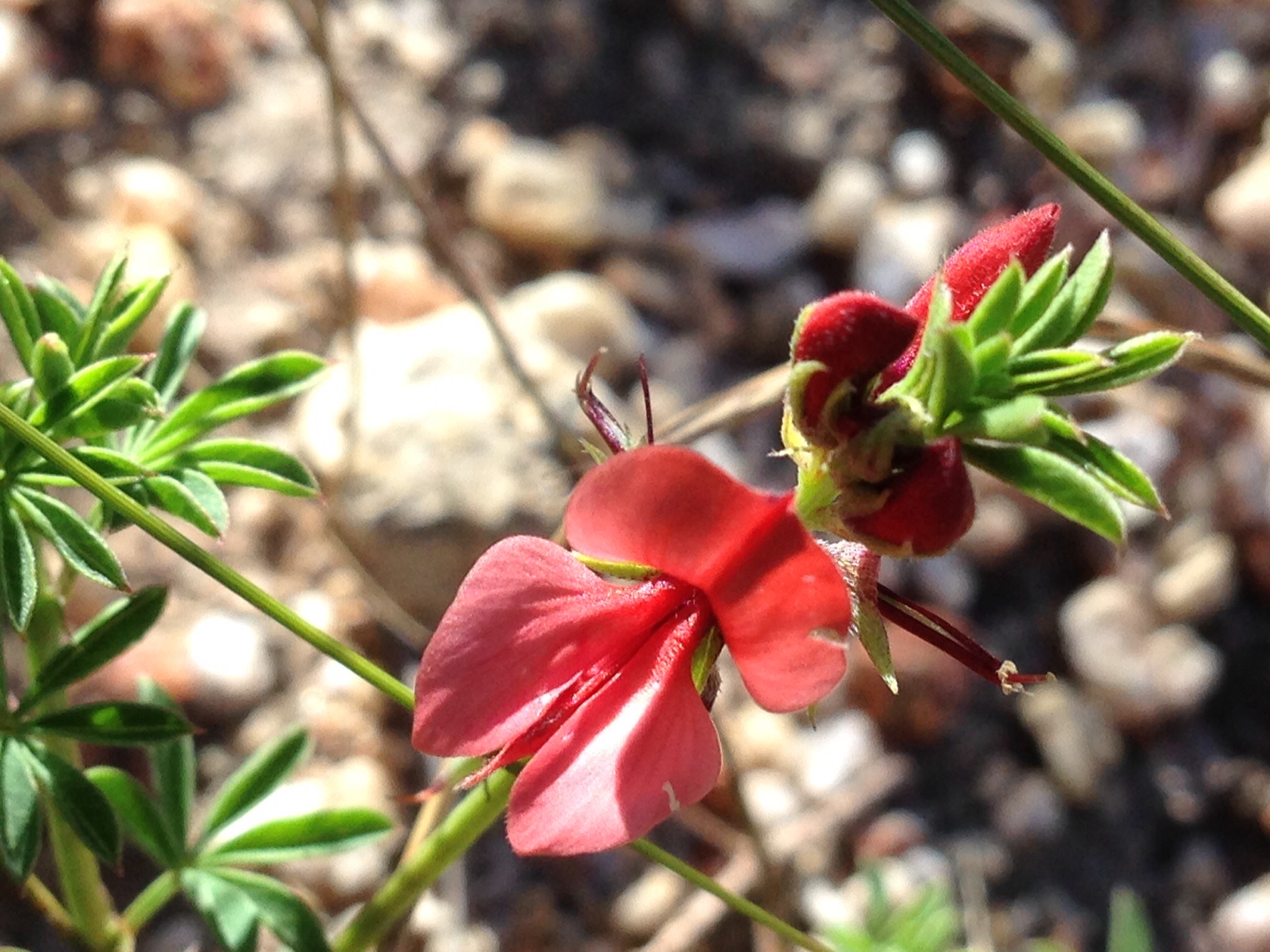
Back to the flowers.  I have no idea what this pinky red pea is.  I’ll post it on ispot and see if we can find out.

Unidentified pinky red pea

Unidentified pinky red pea

These are an old friend, Selago corymbosa, quite common and very charming.

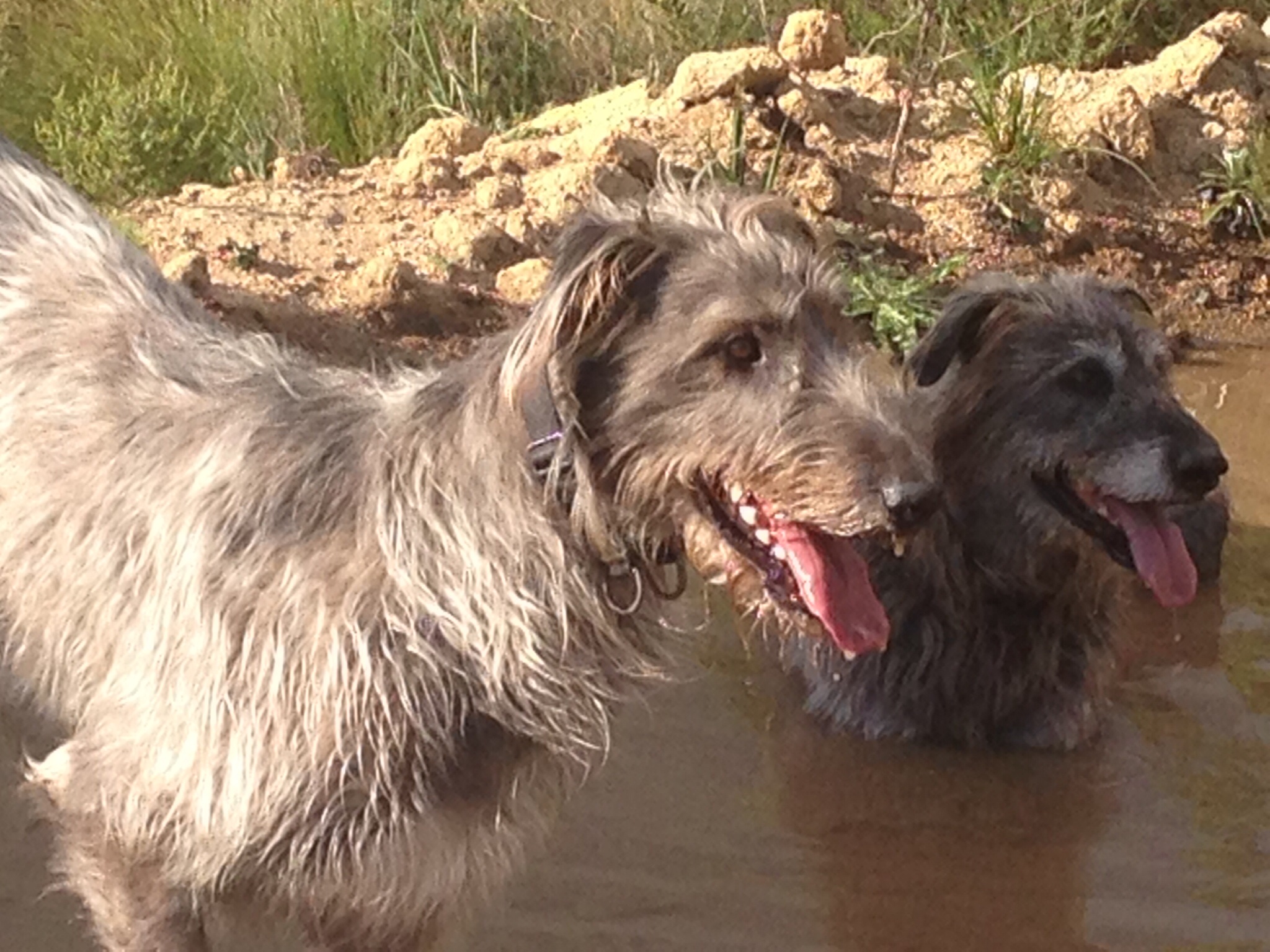
I went for a walk the yesterday evening.  I’d missed the morning run and when the wind dropped in the evening I thought the dogs would like a walk.  They certainly did and I took a couple of beautiful photos of Maebh.  The focus isn’t perfect her coat looks great in the evening light.

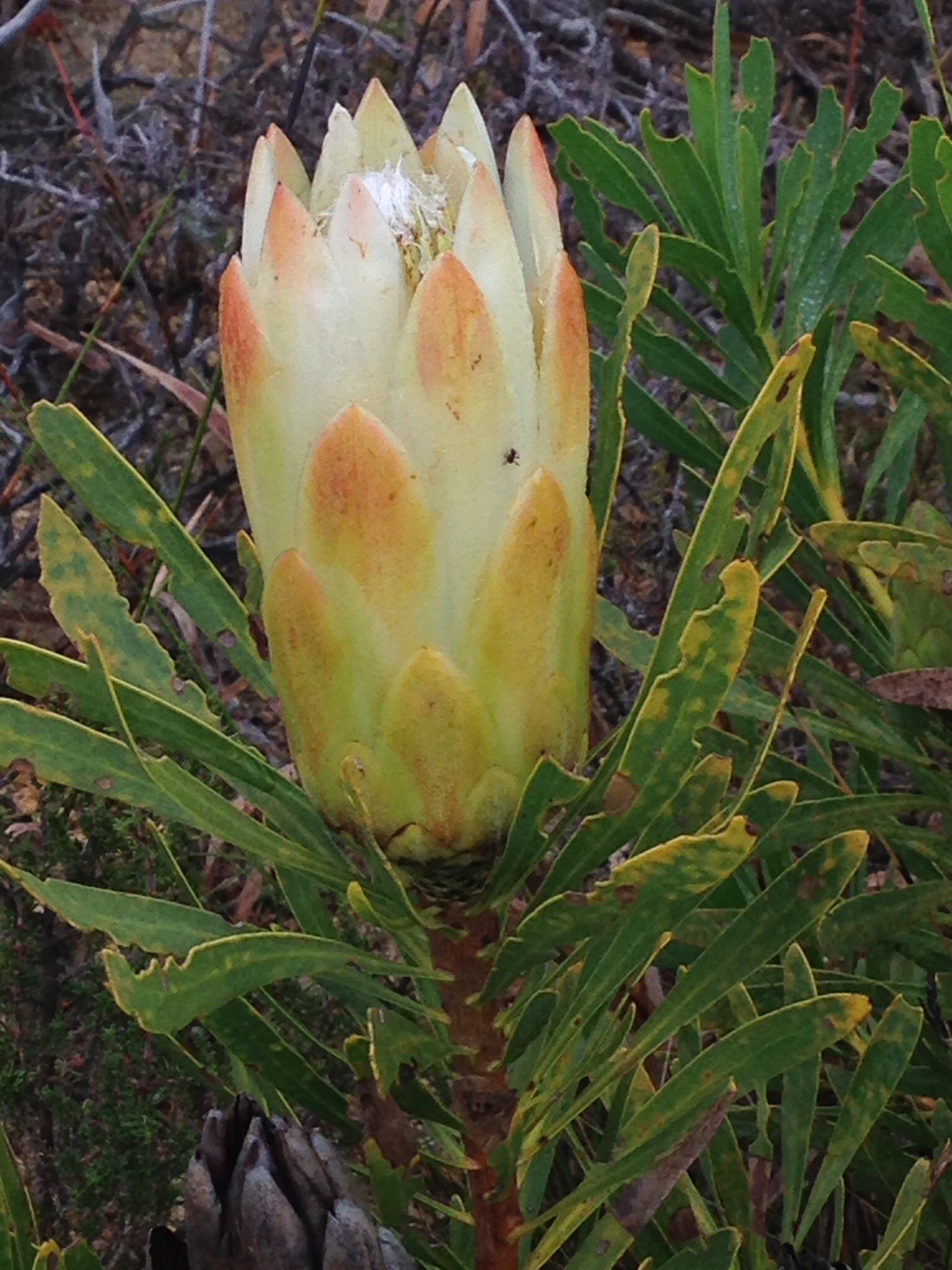
One of the first things to flower at the end of summer is the Protea repens and I think this might be a second flowering, it’s unusual to see them at this time of year.

Protea Repens

Protea Repens

I think this one is a Crassula but I’m not sure which one so once again I will ask the iSpot experts to identify it for us.

Gone with the Wind

So there I was only a couple of weeks ago feeling triumphant and even rather pleased with myself.  Then it struck me.  Not a brilliant idea; a tummy bug.  At first I hoped it was a 24 hour tummy bug but then I realised it didn’t have a time frame.  It took me a few days to realise I was actually really quite ill and by then I was already bored of it so I went to see the fabulous Dr Shelley and explained that I had to be on a plane to Plettenburg Bay in the morning.  “Have to?” says the Doc.  “Well, want to” says I.  She sharpens up her needles and gives me 5 injections, or was it 6?  I lost count.  “Now you’ll be able to travel if you want to,” says she “but if you do this will just go on for longer.”  She’s better at prediction than the weatherman; it took me another full week to be over it completely and back on the mountain again.

Everyone always says that the great thing about tummy bugs is that you lose weight, and while it’s true while you’ve got the bug, I always worry about compensating afterwards.  So I got back out on the mountain as soon as I could and after two or three runs I’m feeling pretty good out there.  I know I’ve missed some flowers though, which is always a bit sad – will have to wait until next year.  Fynbos bulbs can come and go in a day, but the shrubs are amazing – they will flower for months.  One example is the Lobostemon Fruticosus which is such a friend, I posted a photo of it in August and it is still flowering now.  On a bright hot day the flowers dim but a little grey and a dash of rain and they glow on the mountain.

It’s wonderful to recognise some special flowers that I identified last year and this is one of the them.  I notice them more this year, scattered all over the place and in partiular in one small shady area where a whole clump of them grow, but where the light didn’t lend itself to a good shot of the clump and we may try for a better photo of this charming Tritonia undulata the next time we are out.

Tritonia undulata

Tritonia undulata

A rather dark photo on a bright day – it’s almost impossible to get a good shot of a blue or white flower in bright sunlight.  I was glad I caught this Walhenbergia capensis on a run just before the flu hit, they are all gone now.

Wahlenbergia capensis

Wahlenbergia capensis

And isn’t this one absolutely gorgeous?  Another one that I captured on the run just before I had to stop and I’ve completely forgotten where I saw it and of course it has disappeared now.  I think it’s Geissorhiza exscapa.

Geissorhiza exscapa

Geissorhiza exscapa

I promised a better photo of the fabulously named lily, Wachendorfia paniculata.  This one grows along the drive and I was feeling so well on Sunday that at the end of our run the dogs and I trotted all the way down to find and photograph it while the light was dappled and it was still looking good.  Look how it glows against the yellow-grey sandy wall.

The flowers are amazing and really, that’s the point of the blog yet there are so many other special things, it’s just that flowers look great in pictures.  The grasses are absolutely gorgeous and I often try to capture their whimsical or even dramatic charm.  The iPhone doesn’t usually get it, but this one was a good attempt and I think these are Willdenovia incurvata.

As we bounced up the mountain the morning before I fell ill the wind was howling and I had decided not even to try and take a photo.  Then we came across this gorgeous Gladiolus angustus.  Luckily I decided that despite the wind I’d take a photo.  When I finally passed the same way 12 days later there was not the tiniest sign of it.

And finally – there is always a sunset.  I don’t capture them every day.  This one was special.

Sunset in the Western Cape

Sunset in the Western Cape

Diet and Exercise – The Truth of the Matter

I reached a target today.  This weekend I’m riding in a competition and I really wanted to lose the extra couple of kilos before the show.  I weighed myself this morning.  Wow, I actually made my target!

And as I was out running this morning it occurred to me that I’ve never talked about diet.  Or, let’s call a spade a spade, dieting.  This blog is about the run and the flowers.  But why run at all?  I saw a brilliant ad once, for Reebok shoes called “Belly gonna get you!”  A man was chased around New York city by the fat belly he’d have if he didn’t run.  That’s why I run; I’m afraid that belly will get me.  I run away from the fat person I don’t want to be.  The trouble is, I like to eat.  Not in an unconsidered full fat sugar chocolate driven way, more a fine dining, excellent and delicious food kind of way.  And as Peter said when I mentioned that his daughter complains that we don’t keep treats in the house, “our treats come in bottles”.

Perhaps it’s time for a flower, captured on this morning’s run, before I continue this little dietary indulgence.

This is an absolute favourite, if only for its splendid name.  Not the best photos, they were captured early this morning and I was more focused on the run and my thoughts about weight and fat than flowers.  There will be a few of them to come all over the farm and I’ll capture a better shot of this lily named Wachendorfia paniculata.

Back to the diet.  All my life I have struggled.  My family, on both sides, survived the Irish Famine in the mid-19th century for a reason.  If we were horses we’d be called good doers.  We do terribly well on terribly little.  Most of my cousins have struggled as I have.  If you stop the struggle, woah, clothes sizes accumulate with terrifying speed.

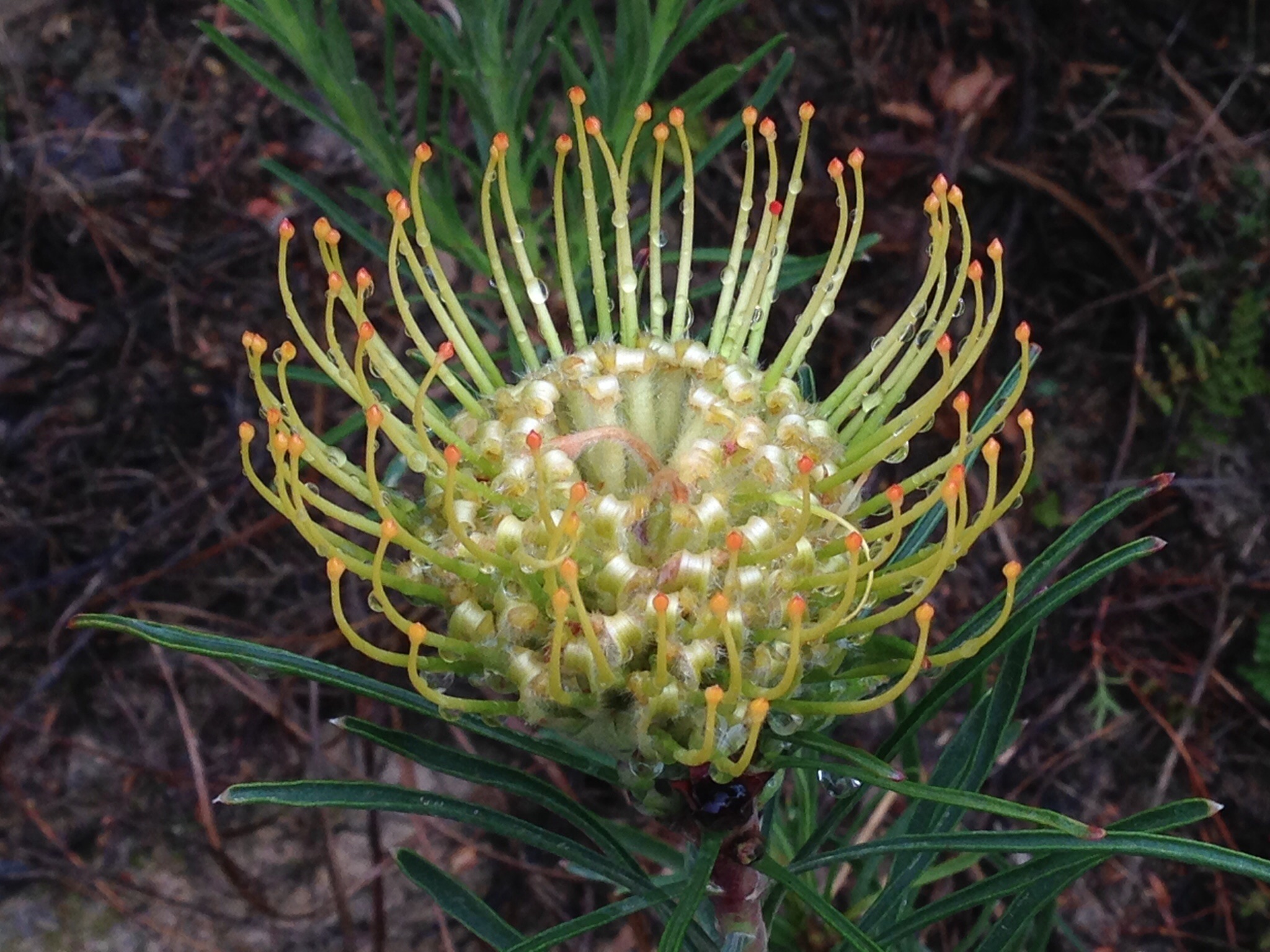
So I run away from the fat person I don’t want to be.  And as I was running away down the drive this morning I couldn’t resist a shot of this Leucospermum lineare, the Vulnerable, from a baby plant on the drive.  This endangered and quite rare member of the protea family is thriving here on the farm.
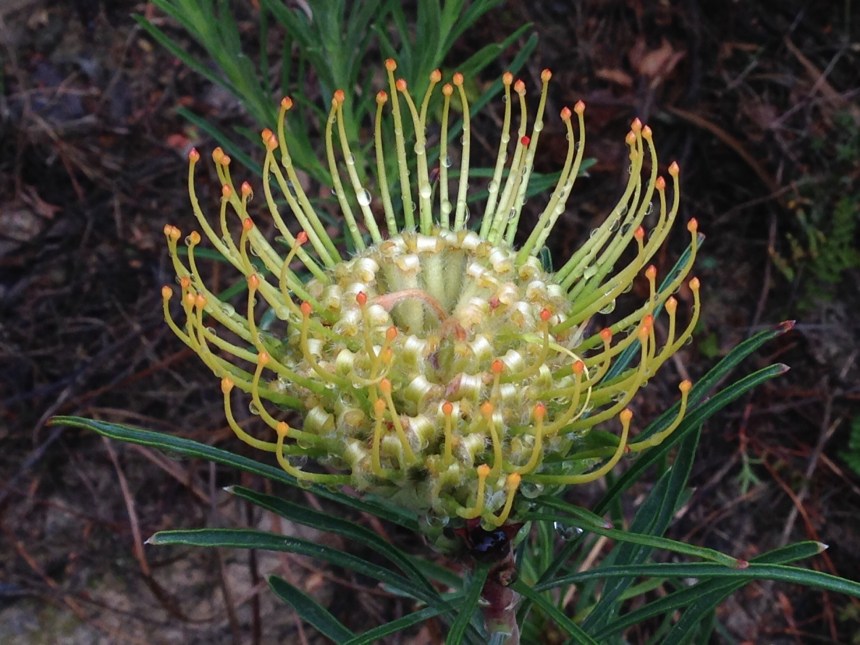
Leucospermum lineare

Leucospermum lineare

Here in Cape Town everyone is Banting. This is the name a doctor called Tim Noakes has given his diet which is a kind of super-powered Atkins.  High fat, medium protein, very low carb.  I think it’s rather revolting but I do have to admit that people who stick to it, really stick to it, religiously stick to it, do lose weight.  Some of them have got quite thin.  But as he says in his book, if you don’t stick to it, you’ll balloon.  Now I’ve tried most diets; I really mean that, you name it I’ve done it; a lifetime of diets.  It’s been my constant, rather boring obsession.  But one thing I know is that if I’m required to cut out major food groups, I’m not happy.  I might lose weight, but I’m not happy.  I can tell you from experience that the best diet is abject misery, really proper, grieving kind of misery, like after a break up, or when someone you adore dies.  That’s no way to live but unfortunately being happy makes you fat.  I believe certain drugs can be fabulous, but again, not a way to live.  Smoking was marvellous, but… once again, not a great option for life and I gave it, and control over my weight up when I was 28.  I put on that stone that I’ve never really lost.  I’ve lost weight on Weightwatchers and on the Dukan diet, but not really on any other, until now.  Running is great for controlling weight, but not so much for losing it.  Every holiday, every time I travel on business, a sneaky kilo or two is gained and oh, the dread of getting it off.   Yet I’m not interested in never having another slice of bread, never baking a cake again, never eating an amazing dinner, all five courses, with absolute pleasure.  And I do like a vodka and soda with a splash of Campari after a long day as I make dinner, usually a very healthy dinner during the course of a normal week.  And a glass of wine, or two.

So I run.  Three times a week, pretty much every week.  Sometimes four times.  If I run at the weekend I’ll do 5K or 6K, but otherwise it’s 4K.  And I do Pilates twice a week.  Vainly hoping that I may have my cake and eat it too, with a glass of champagne.  Worrying about my weight has probably occupied more of my waking hours than any other single subject.  You’d think that all that worry would mean I’d take control and just eat less, but it doesn’t seem to work like that.  Those famine genes want feeding, but the famine’s over, so delicious things preferred, please.

In August 2013 I picked up a book, rather randomly, in an airport and read it on the plane.  A colleague I’d been working with in Qatar was looking fantastic and told me about this diet.  It is called 5:2 and I immediately knew it was for me.  The logic is divinely simple.  Two days a week you eat 500 calories, that’s 2000 kilojoules.  The rest of the time you eat normally.  And where before you might slightly overeat on a weekly basis and gradually gain weight, by cutting out 1500 – 2000 calories a week, every week, you gradually lose weight.  I’ve always found it easy not to eat for a day, it’s following dietary restrictions day after day after day that I struggle with, especially with a lifestyle where we travel a lot, socialise a good bit and love to eat out. Never mind the “treats in a bottle”.  The book also described huge health benefits that the diet provides – when your body doesn’t have to worry about digesting food, it finds all sorts of useful repair jobs to do instead.  Intermittent fasting turns out to be amazingly good for you.

Peter doesn’t do it with me and is kind enough to fend for himself on my “2” days.  He doesn’t love it, but he loves the result.  It works.  I haven’t become skinny but my average has come down.  It’s not a totally steady loss.  The closest way I can describe it is if you look at a one year chart of the FTSE, the London Stock Exchange.  Take out the big plunge this October and that’s been my dieting year.  In line with the FTSE, except we want the FTSE to go up and the weight to go down!  The point is, the peaks don’t go up and up and the control has been stable.  A trip, or a heavy social agenda, a kilo creeps on here and there.  With the regular “2” days, once normal eating and exercise are established, off it comes.  If I make a bit more effort, it comes off quite easily, never quickly, about 250g to 500g a week.  But off it does come.  And I don’t have to think about it.  Just do it.  It took me a while to get used to eating so little so little in a day, but now I enjoy it – I just don’t have to think about food.  As for being hungry, that’s ok, for a day.  Tomorrow I can have what I want.  It’s no longer a diet, it’s a way of life.

I’ve told all my friends about this wonderful diet and only one has really got it, loves it and does it as a habit as do I.  I don’t know why, everyone wants to lose, or at least control their weight, and this is the easiest, most pain free way I’ve ever found that achieves just that.

We went out one evening this week to run up the mountain and saw the glory of another sunset.  The light in the olive groves, the view of the sun setting behind Paarl Rock with Table Mountain in the background.  I may only be running away from my genes but at least I get to run here, on the mountain, with the wolfhounds, in the glory of the light.

An auspicious day

A lovely run last night at the end of an auspicious day.  My nephew Beckett James Grey Mulhern was born in New York.  Birthday the 21st of October; an autumn child, harvest festivals and pumkins, the trees in Ireland wonderful shades of red and gold as you drive down Wexford roads to the Opera Festival.  The huge full moon.  October has always been a happy month in our family.

I remembered to take a couple of whiffs of the inhaler before we left the house which meant the lungs were clear to convert oxygen as needed and we fairly bounded up the mountain in the fading evening light.  As we climbed higher I could hear the baboons calling in the forest.  Maebh and Jemima Chew heard them too and shot off to explore.  Luckily they decided not to go too far and quickly came back to Seamus and to me as we climbed higher.  I have a new weapon against wandering wolfhounds – you can see it in this photo of Leucadendron tinctum in which Meabh elegantly arranged herself in the background.

The cones of Leucodendron tinctum with Maebh in the background

The cones of Leucodendron tinctum with Maebh in the background

The white you can see on her collar is a tracker.  I found it online, it’s German, works brilliantly in South Africa and tracks your dogs live when they go missing.  When the wolfhounds wander we get incredibly worried; we know they can travel a long way and dogs have been lost on this mountain more than once. Shouldn’t happen with this cute little piece of technology which links to the iPhone.

The baboons used to come down into the olive groves and even as far as the gum trees behind the house.  I haven’t seen them for quite a while, they really hate the wolfhounds.

One of my favourite flowers, Aristea capitata is in full flower at the moment.  There is a colony on the driveway and the blue spikes are a joy to behold.

This was one of the special evenings.  No wind, the end of a hot day with a dampness in the air that cooled us as we ran higher.  Lovely light.  When we stopped for a drink at the weir Maebh, who was in a modeling mood today, stood in front of the Ilex Mitis as I took a photo of the white trunks gleaming in the evening light.  With her dappled coat she almost disappears.

Maebh and the Ilex Mitis

Maebh and the Ilex Mitis

Paarl holds an iconic place in the South Africa psyche and the two huge granite rocks that stand above the town to the west are unmistakable to anyone who knows the Cape.  Maebh, once again, stood for a moment to watch as the sun slipped away behind the rocks, which happens just at this time of year.  Soon it will be setting well to the west, over Table Mountain.

Maebh watches the sun setting over Paarl Rock

Maebh watches the sun setting over Paarl Rock

There are so many flowers in bloom that it’s hard to know where to begin.  One is this tiny Pelargonium, I don’t know what it’s called but I do like the pink tinge to the end of the petals.

Another is a favourite, the spikes of Microdon dubium.

Microdon dubium

Microdon dubium

Talking of dubiums, some new bulbs have emerged.  This is Ornitholagum dubium.  It flowers in just one place on the farm and there it flowers copiously.

Ornitholagum dubium

Ornitholagum dubium

This one I’m less sure of – Bobartia I think, possibly Bobartia indica.

Bobatia indica

Bobatia indica

The farm is covered in this one, charmingly known as Lady’s Hand, because the petals, bent back in greeting, resemble the hand of a delicate girl waving a hello.  Cyanella hyacinthoides.

There’s a plethora of peas on the go at the moment and this is Aspalanthus cordite, unmistakable with its grumpy spiky leaves.

Aspalanthus cordite

Aspalanthus cordite

I love this shrub – Passerina cormybosa.  They are supposed to be pink and yellow, while we have some that some that seem to be white as well.

There is masses of Lobelia along the roads, this one I think is Lobelia coronopifolia.

image

Lobelia coronopifolia

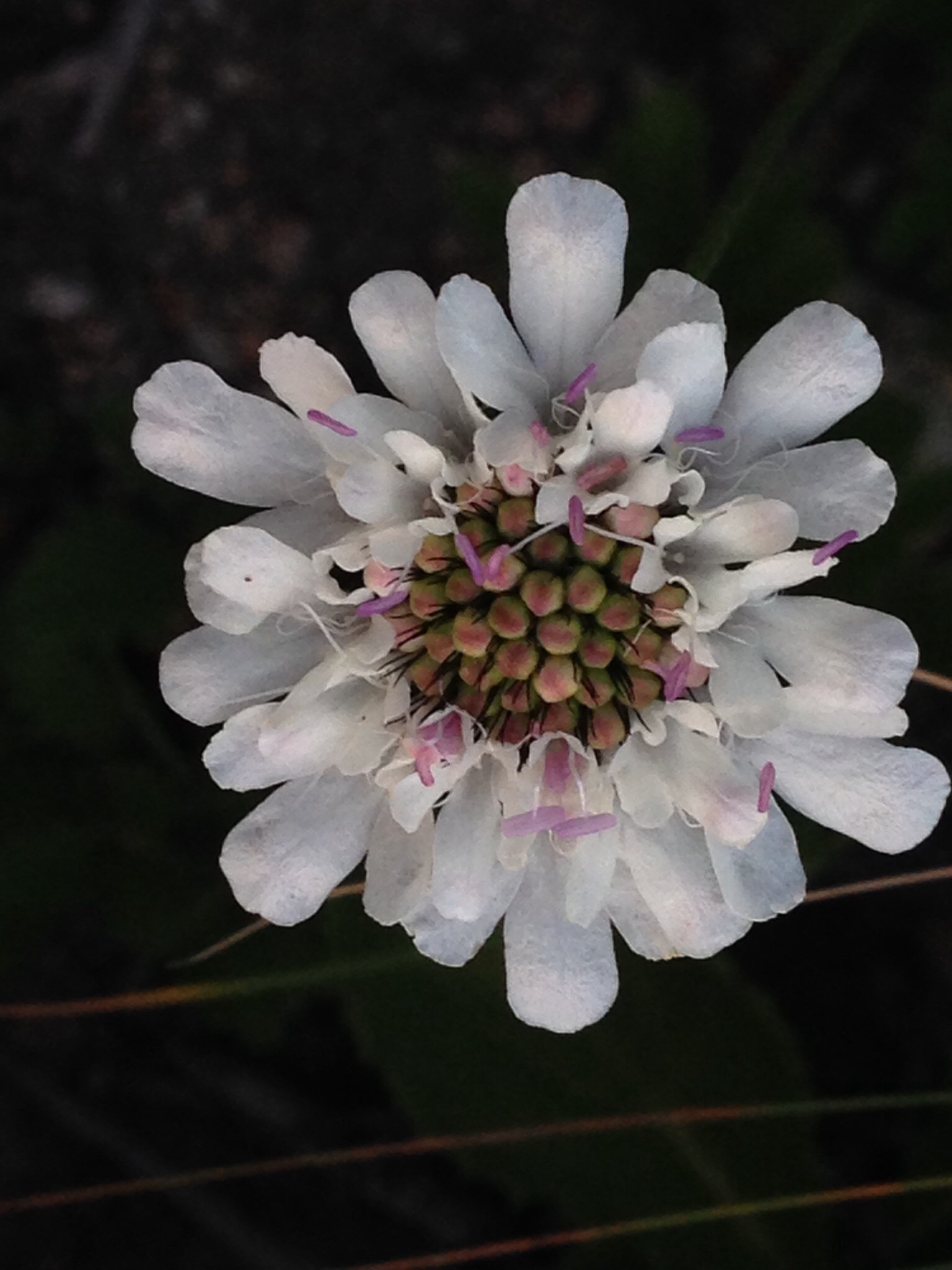
Another flower that is to be found absolutely everywhere and is flourishing in the garden as well is Scabious africana.  This one is particularly pretty.

Scabious africana

Scabious africana

Windy Mountain

Spring is turning into summer on the mountain and the wind is howling at night and most of the day.  There is an afternoon lull but already, at 7 o’clock in the evening, I can hear it picking up outside the office and later it will whip around the house and rattle the roof.

I spent the weekend in George, along the famous Garden Route at a Horse Trials, the Western Province Championships.  We had fun, didn’t win any big prizes, but spent the weekend with our friends and got to gallop fast over solid fences which is the most fun you can have on a horse.

On Friday morning I went for a run in the suburbs of George and enjoyed sightings of fynbos flowers that have adapted to the urban environment.  Here on the farm I know only of one place where the Gladiolus maculatus blooms and that’s in July.  Looking at the book I see they are winter flowering but I saw them, or something very similar, in a spot of suburban wasteland as I ran past.  Perhaps I should have taken a closer look.

When I don’t take them running often enough the dogs get bored and take themselves off for their own runs.  Sometimes they are gone for hours and we get increasingly worried about them until they come home, panting and joyful, terribly pleased with themselves and usually soaking wet as they’ve stopped for a cooldown in the dam on the way back to the house.  Several dogs have disappeared on the mountain that we know of and we worry and worry when they are gone, we go looking for them and calling them for hours and never see a sign.  Last time I checked there was no tracker available that would work here in South Africa but recently I heard of one, so I searched again and found it in Germany.  It arrived today and has now been attached to Maebh.  She and Jemima Chew often go for a quick hunt in the evening, and sometimes Maebh and Seamus go off together, but for some reason, never the three together.  If Maebh has a tracker, we’ll know where to find them.
I know better than to think I will get any photos in this wild wind, but I’ll see what’s there and where to go when the wind drops.  They say in Cape Town that if you don’t like the weather today, don’t worry because it will be different tomorrow and the change in weather is heralded by the wind dropping to that incredible stillness on the mountain that I’ve so often written about.  When that happens we will pick a moment of good light to catch the latest spring flowers. In the meantime there is much to catch up on.  Last year I failed to name this blue flower so I posted it on ispot.  The experts suggest it might be Aspalathus cephalotes subspecies obscuriflora.

Another pretty thing I couldn’t identify is this white “flower” which is tiny and turns out to be the seedhead of Ursinia anthemoides which I photographed in August but hadn’t posted, much more interesting to post the two together now.

I love these fluffy heads that must be Stilbe, I think vestita.

The other fluffy flowers that I photographed some time ago and never posted are the wild buchu plants that grow on the farm.  Our crop is buchu, Agathomsa crenulata and hybrids thereof, and Agathomsa betulina.  These are used medicinally and in the food flavouring and perfume industries because of the powerful essential oils that have an intense note of blackcurrant.  I occassionally post photos of the buchu we farm which is indigenous to the area.  This is a genuinely wild buchu, probably either Agathomsa imbricata or capensis.

As I was running down one of the roads I noticed that it was bordered by shrubs of Salvia africana all in flower and would make a wonderful photo.  Being in a hurry I put it off only to find when I returned that a spring wind had blown the flowers to shreds.  They are tough and they flower all year but the best display is in a wet spring.  They are stalwart friends on the mountain with an exceptional colour and fortunately enough remained for me to capture some of the flowers.

Summer is Helichrysum season and it begins with this Helichrysum patulum.  We have several subspecies of this wonderful and resilient plant on the farm and they deserve a page of their own.

Helichrysum patulum

Helichrysum patulum

Along the drive the Crassula fascicularis has come into flower.

Crassula fascicularis

Crassula fascicularis

Finally, one of my top favourite flowers has emerged, the lovely spikes of Aristea capitata, unmistakable and one of the first flowers I identified when we bought the farm and I started running here.  These are prolific in damp areas and I hope they will be spectacular this year after the wet winter.  We’ll have more photos of them over the next month.

Bulbs and a Couple of Peas and an Irish Wolfhound or two

What a busy week it has been. I must apologise to friends who prefer the chatty blog to the technical botanical blog.  At this time of year there is so much to share, so we have a botanical phase for now and more chat will inevitatably follow.

Although I have been wanting to post a collection of flowering bulbs for some time there was a small problem with identifying one or two.  The best way to get help is to post on ispot, where the South African flora and fauna geeks all post their sighting and help one another out with identification.  Sure enough, within a couple of days I’ve had some help and can now happily identify a paricularly pretty apricot flower as yet another Moraea, this time miniata.

The other one is our most common gladiolus, which the experts identify as the famous and common Painted Lady, Gladiolus carneus, known as the White Afrikaner.  This must be right yet it is also frustrating as the books insist on the red splash on the lower petals while mine splash yellow.  Everything else fits though and they are just coming into flower now so I’ll be on a determined hunt for red splashes and I’m sure over the next few weeks I’ll post a few more photos of this really stunning Gladiolus.

Running last week was great from a running point of view as the weather was dry and windy and I have learned that taking pictures of flowers is best left for days with little or no wind.  The dogs loved the faster pace and once again we had a photogenic moment when Seamus and Maebh stopped at Fox Pan for a drink as we ran up the dry side of our farm.

image

There is such an abundance of flowers this year and every step of the run means another group or another flower.  There are shrubs I haven’t stopped to photograph because I think, they’ll still be there in a couple of weeks.  Flowering bulbs are different, they have a short life and you only get a few days to capture them.  I know I don’t see them all, for example last year I completely missed this dramatic Moraea bellendenii and this lovely Aristea spiralis which both flower at the same time, when I was away.

Other bulbs that flower at this time of year include Geissorhiza aspera, which opens when the sun shines and covers the lands in blue stars.  And yet another Aristea, the pretty Aristea africana, which is often used in gardens.   The pink Wurmbea punctata is much less common and easy to miss, it’s snuggled up to several shrubs along a busy road and there are very few of them.  The Baeometra uniflora which is not very prettily known as the Beetle Lily, it is choosy about where it lives and grows prolifically in one specific spot.

There are a couple more I don’t have names for, I’ll see if the geeks can help.  This first one is tiny – the flowers are less than half the size of the nail on my little finger.  I really should be able to name the second one, but there are quite a few flowers that look like this, so I’m not sure.  And the third one is the most exquisite little thing – also tiny.

Finally, two distinctive peas.  One is simply known as the Blue Pea, Psoralea aphylla, found in marshy places and along streams, which is exactly where we saw it. image The other is prolific at the moment along the top road and very distinctive; I’m pretty sure it is Lotononis of which there are 40 odd fynbos varieties and only two are covered in my book.  It isn’t either of those but the tri-foliate leaves and solitary flowers on slender stems are a bit of a giveaway.

All about Ericas

An interesting question came from a follower of this blog:  where does the inspiration come from?  How do I sit down and write 500 – 100 words every week or so?  I’ve never thought about it – the inspiration comes from the run, the beauty of the place, sometimes, wild, sometimes spiritual, always theatrical.  Every time it’s the same story, I took my dogs, we went for a run on our farm, we saw flowers.  Like Heraclites’s river it’s always the same and always different and there is another tale to tell.  I do my best thinking on the run.  I don’t listen to music and my mind is free to wander and ponder.  Mostly I think about work or about what I’m going to put in the blog.  The thought about Heraclites and his river, fished out from the bubbling spring of knowledge that was my first philosophy lecture at Trinity, came to mind on a run.  By the time I actually sit down and write, the words are clamouring to be put on the page and it’s only a matter of deciding how to present it.  The titles are another matter – I read somewhere that titles matter a lot when you blog, so I have to consider my theme and find an elegant arrangement of words that will capture the reader’s interest and make them want to read further.

At this time of year the sheer volume of flowers on the mountain is overwhelming.  We went for a run on Saturday evening; the air was calm and still and the run was about 60% photos and 40% run.  Luckily by Sunday morning a wind had picked up and I’ve learned there’s no point in trying to photograph flowers when their long stems are being blown by the wind; much better for my fitness!  I took just one photo, of Seamus  loving the feeling of the wind in his coat.

Seamus enjoying the wind as he trots up the mountain with Paarl visible in the valley below

Seamus lets the wind stream through his coat with Paarl visible in the valley below

Last year some readers complained that bacame a bit obssessive about the flowers and they missed the bit of chat that goes with the blog.  So this year I shall do some frequent posts and place the flowers in groups, starting with the Ericas.  I’ve mentioned before that one of the interesting things about the Cape Floral Kingdom is that it is the most diverse in the world, accounting for the hundred of species growing on our small farm.  And Ericas are the most diverse of all, with around 860 subspecies and 660 of those are fynbos.  So it’s not a surprise that they are not always easy to identify. I’ve included here some Erica’s that we haven’t posted yet – there are many many more in flower and I will try and add an Erica page when I have time to do some cataloguing.

One particular favourite grows at the top of the waterfall, on the other side of the stream.  If you look closely you can just see it at the top of the fall.  In reality it’s a vibrant splash of pink.  It’s quite far from the road; I risked a soaking and my still recovering ankle to bring you these photos of the perfectly named Erica multumbellifera in full bloom.

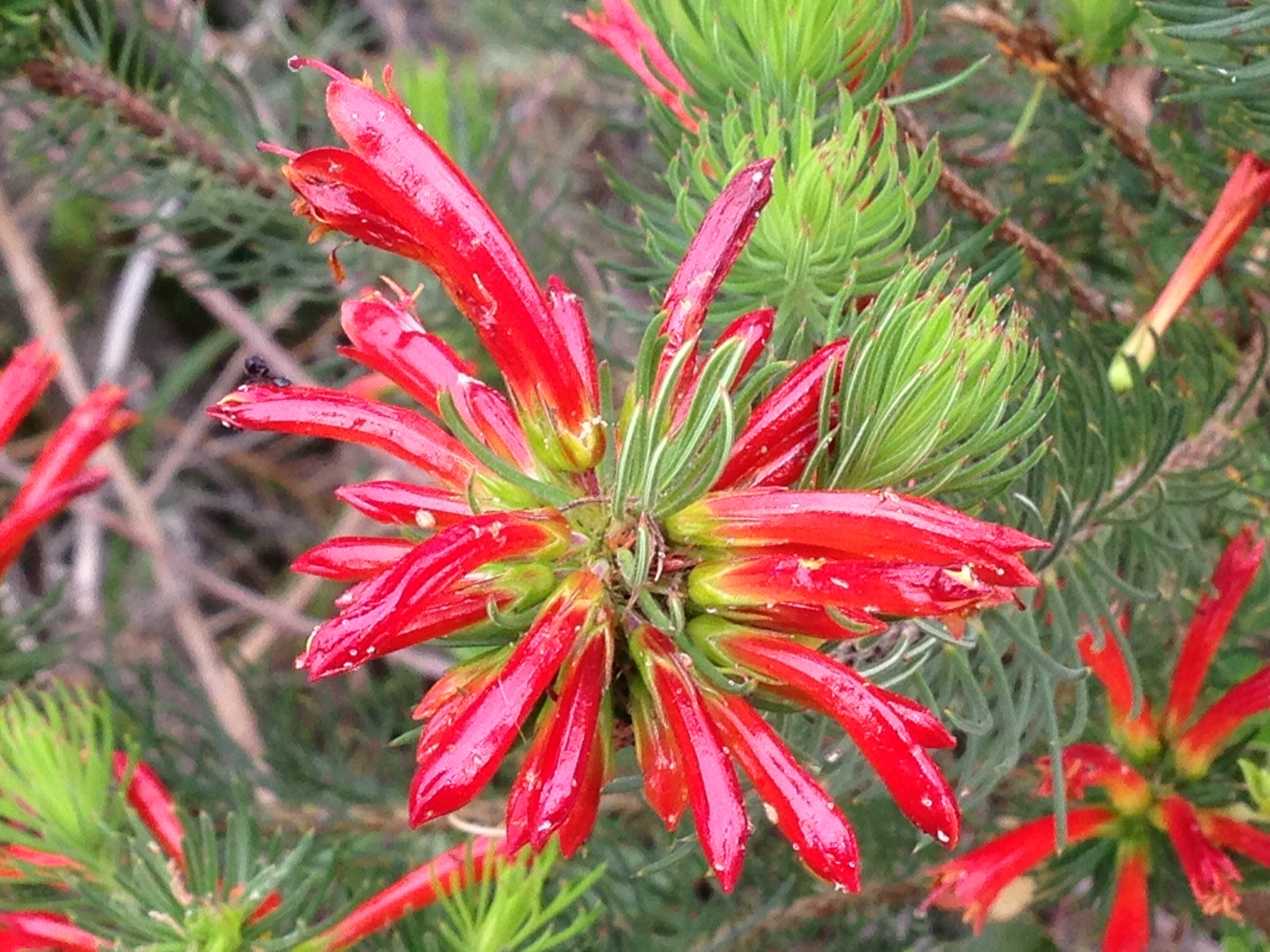
Erica abietina comes in many colours: yellow, orange, red or magenta.  Those on our farm are all this fabulous scarlet, quite often hard to photograph because the shiny flowers reflect the light intensely.

Erica Abietina

Erica Abietina

Another charming pink Erica has emerged higher up at the very top of the farm where the damp and little used road encourages lots of fynbos growth.  This one has little pinky-white bells.  There are lots of subspecies with little pink bells which makes them hard to identify – even in the book the descriptions are almost exactly the same.  The flowers are almost too tiny to be seen with the naked eye, the iphone camera does a great job of enlarging them.

Even smaller is this white-flowering rambling Erica.  Seamus helpfully stood beside the plant so that you can get an idea of just how very tiny the flowers are.  Then I used the iphone camera with a microlens to get a decent image of the flowers which are very white with little teeth on the edges.  When this shrub finds a place it likes it spreads and spreads and swarthes of land are covered in it in sections.

Five metres of Fynbos

So there I was last Tuesday.  Filled with good intentions on a beautiful morning.  I choose to deviate from our usual morning route so that we could go a bit higher and check out some places we don’t always visit for new flowers.  The first bit of that route is a bit steep and being morning, when I’m never at my brightest, I wasn’t paying proper attention.  The thing is, I’ve always had a tendency to sprain my ankles, but they don’t tend to get sprained when you run, it’s more likely when you walk.  I put my foot down on a fallen twig, lying on an uneven bit of road, and… Crunch!!!  Screeech!!!  There are things, many things that are more painful than a sprained ankle but not many that take your breath away quite so much in the first instants of the sprain.  I was hopping, swearing, hoping it wasn’t a really bad one – it’s hard to tell in the first moments.  Feeling sick and cross I hobbled home, followed by some very disappointed dogs.  It wasn’t a very bad sprain.  Experience has taught me that RICE is best.  Rest, Ice, Compression and Elevation.  And lots of anti-inflammatory cream.

A week later it’s still a bit swollen but we’ve had enough of sitting at home and I always feel horrible when I can’t go running, so we are going to strap up tight and head up the mountain tomorrow.

Meanwhile the blog has suffered.  As I couldn’t do a wide ranging run, I thought I would do something different.  I stopped the car on the drive, and in the interest of not walking far, I photographed every single flower on just one side of the drive within a five metre range.  So here you are: five metres of fynbos.

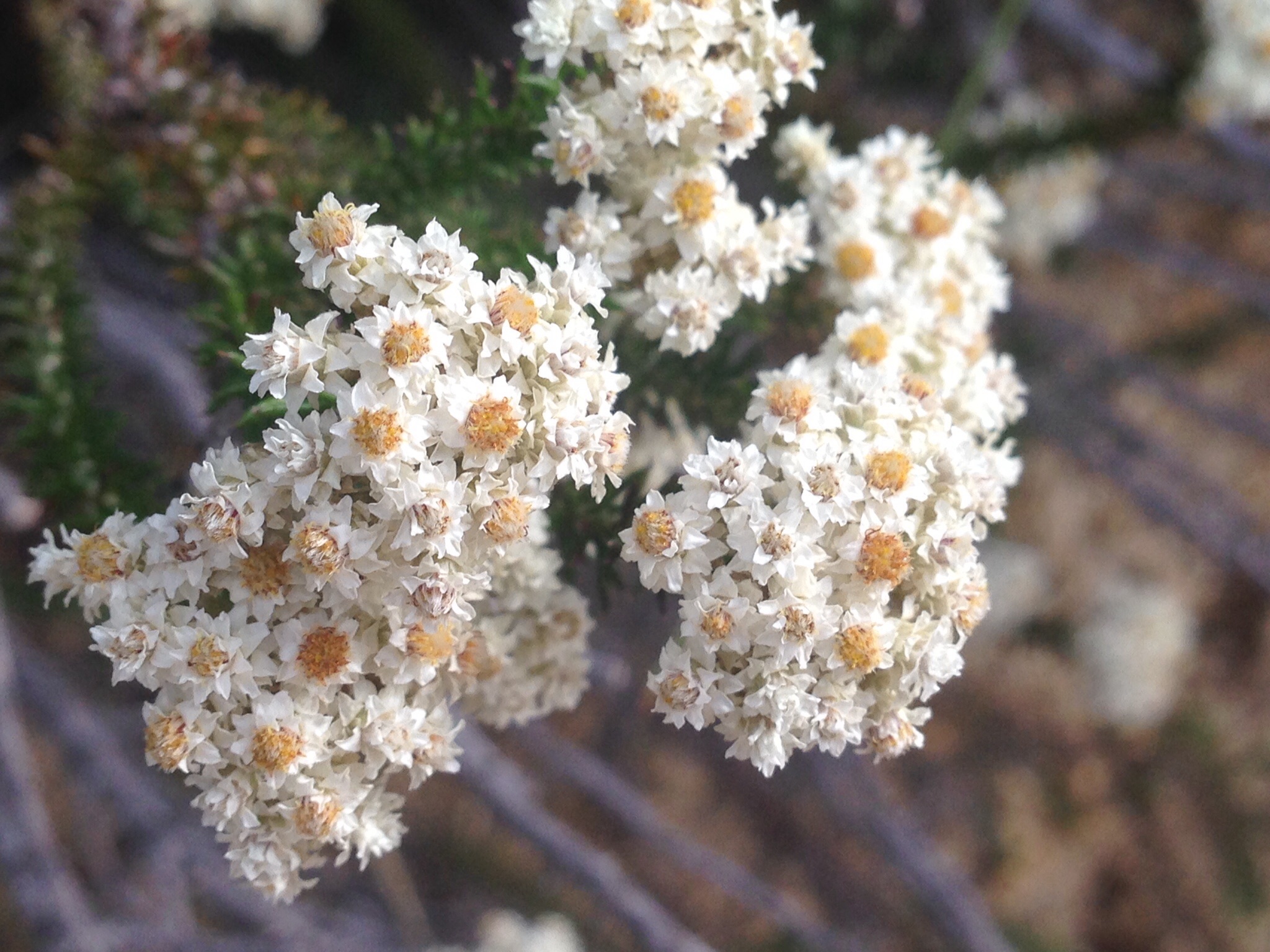
First up is one that I absolutely love.  It’s very common and quite a scruffy little thing at a distant – white or pinkish flowers on spiky leaved stems, it took me a long time to identify it properly.  The thing about it is that if you photograph it in close up, very close up, on a windless day and with a steady hand, the flower heads look like bunches of tiny roses.  It’s called Anaxeton laeve and it’s serruptitiously gorgeous.  I confess that I stopped at just that point of the drive because I’ve been wanting to feature Anaxeton laeve for a while.

Lots of other flowers live nearby.  There is one I haven’t identified, a pretty apricot coloured daisy which I don’t think we’ve blogged before.  And the blue Geissorhiza aspera which is very common.  It’s a lovely flower and this example was a little tatty but they did grow in this five metre stretch.

Eight other species were to be found along this little stretch.  These are all wild, all in flower at just this time of year.  I’m not sure that every five metres on the farm would yield so much – though some sections would yield many more.  We’ll do it again, just for fun.  In the meantime I can’t wait to run tomorrow and I know the run will yield some very happy dogs; I hope it also yields some exiting new spring flowers.

The Colour of Home – with the colour

A few of you who follow The Fynbos Blog commented that the photo of Table Mountain and Paarl didn’t show up on yesterday’s posting when it landed in your inbox.  Here it is again along with the original text – do let me know if it doesn’t appear.

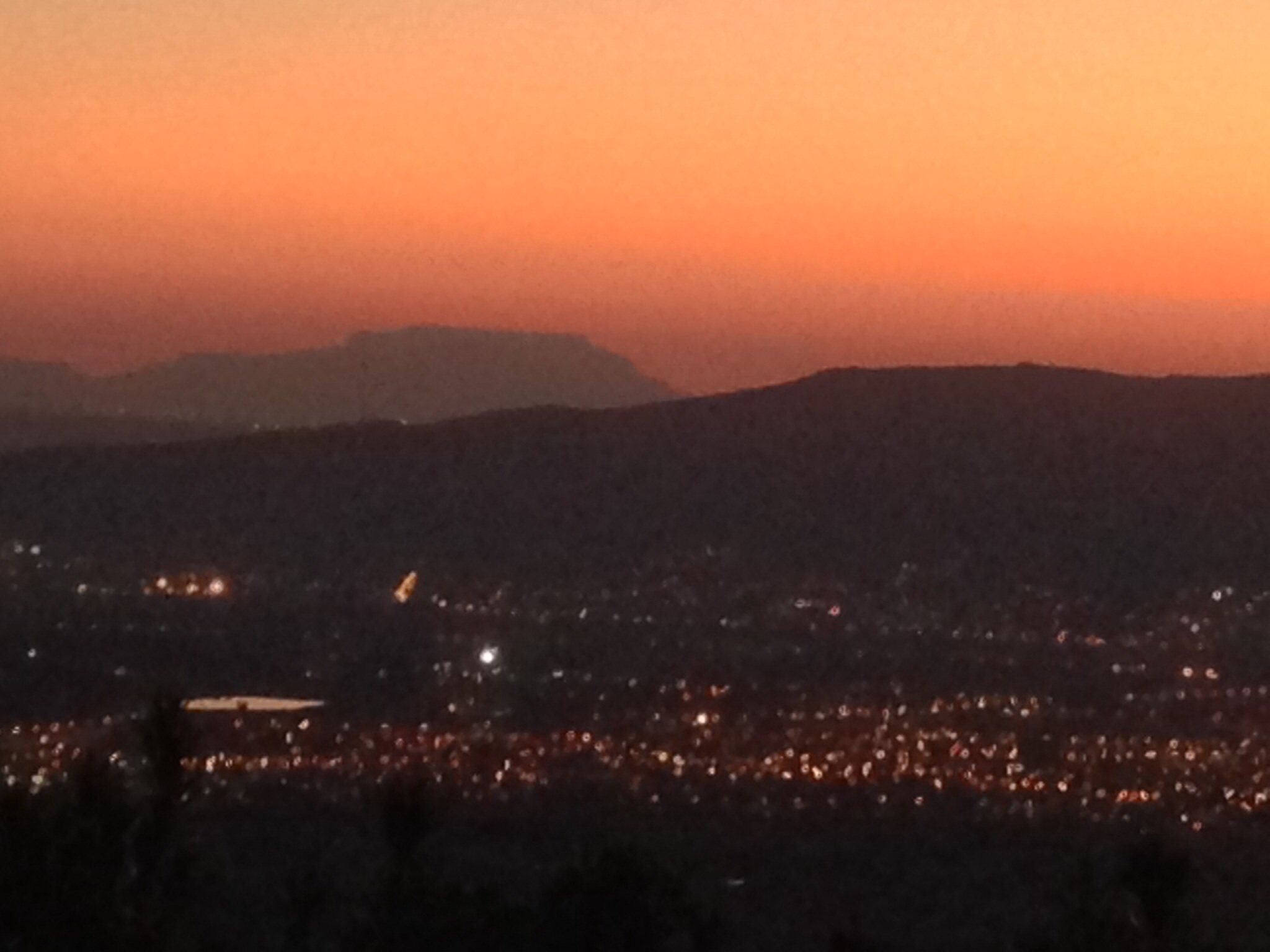
The lights of Paarl below as Table Mountain dominates the evening sky

The lights of Paarl below as Table Mountain dominates the evening sky

Tonight the sky was glorious with colour and for once I’ve posted a sunset shot as the headline picture.  All the photos on this blog are taken with my iPhone 5 and I’m so impressed with what it can do.  This shot is a view of the lights of Paarl, with Table Mountain 60 kilometres away dominating the skyline in the orange light.

« Older Entries Recent Entries »