Tag Archives: Cape Floral Kingdom

The colour of home


What a welcome home.  We arrived back from a 10 day trip from Europe and for once it was a holiday and not work, so instead of feeling shattered and grumpy we arrived to a perfectly glorious spring day, full of joy and looking forward to getting home to the farm and the dogs.  This evening, at sunset, I put on the running shoes and went out onto the mountain with the dogs.  Since we left it has poured with rain; it must have been one of the wettest August’s ever which might be a bit miserable but produces perfect conditions for the fynbos to flower.  The mountain has exploded into life since we left and we are in for a bonanza season.  Any reader of The Fynbos Blog who would like to visit the farm and do a ‘flower safari’ is welcome to contact us and we will welcome you.  We are in Paarl, the best time of day is sunset in good weather, though mornings are also good if we have time.   You must like dogs.

Tonight the sky was glorious with colour and for once I’ve posted a sunset shot as the headline picture.  All the photos on this blog are taken with my iPhone 5 and I’m so impressed with what it can do.  This shot is a view of the lights of Paarl, with Table Mountain 60 kilometres away dominating the skyline in the orange light.

Peter had been up to the weir earlier today and he took the new road by the waterfall.  As we set off he told me it was covered with tiny white flowers and we ran up that way to find the road, and indeed much of the farm covered with Hespertha and Geissorhiza ovate, they can look quite similar in a photo but are quite different in real life.  Another common flowering bulb in the lands at the moment is the Grass lily, Chlorophytum – I’m not quite sure which subspecies this one is.  When the plants are strong it looks like a tiny tree growing from the lily-like leaves.  

There are so many flowers at this time of year that it can be a struggle to comment on each of them.  Being on the mountain is amazing; it is covered in flowers; I post only the new things I see, or if I get a particularly lovely shot of an old friend.  I’ll group all the flowering bulbs together, they are always particularly lovely, and shrubs, daisies and so on separately.  

This is today’s collection – not all of which I have identified yet.


And some shrubs and daisies


Balmy days and foggy nights

We’ve been having exceptionally warm and sunny weather for the time of year.  Although we quite often get an early burst of spring in August, this is really warm – 28 degrees or even higher yesterday and we are still in t-shirts today.  The combination of warmth and damp in spring often means foggy patches and a favourite sight is the view from the farm on a foggy morning.  We had one breathtaking dawn moment as the full moon set behind Paarl mountain and the fog lapped at the foothills.  The moon is never as spectacular in a photo, this one was huge and round and dominated the morning sky.

Moon setting over Paarl

Moon setting over Paarl

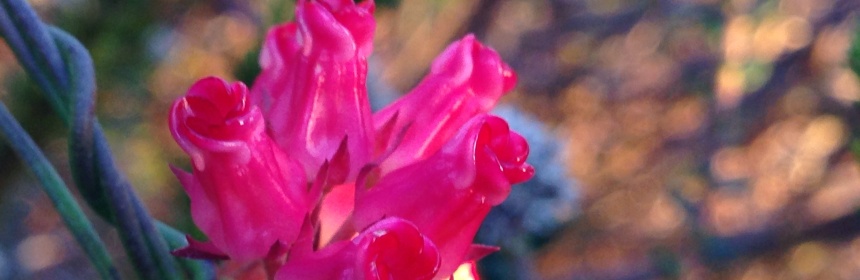
The Lobostemon fruticosus has burst into flower.  The dull light brings out the best in it; it has a luminous glow.  And sometimes the very first rays of sun just catch the flowers so they are lit from within.   The colour ranges from pink to pale blue and the small shrubs are covered in a mass of flowers.  We have them everywhere.  I have tried to transplant them into the garden but even the small ones have a deep deep tap root that I haven’t succeeded in transplanting intact, so they shrivel and die.  Never mind, they clearly prefer the mountain.

It quite often happens that I notice something in a particular area and think of it as rare and special only to find out a few days later that it is all over the farm.  This pretty yellow shrub is one of those.  I initially didn’t recognise it, and then was quite excited to realise when I had a good look at the photos that it was probably another Hermannia, like the ones we saw last week.  Rushed to the book, looked up the Hermannias and sure enough it’s Hermannia althaeifolia, quite a common plant in the region and also used extensively in gardens.  Not surprising, it’s a lovely thing.  The photo in the reference book isn’t very good though, so I went to iSpot for some clarification and checking those images there can be no doubt.

iSpot is the place for geeks when it comes to fynbos.  They ask us to post what we see and I don’t do it enough, but if I can’t identify something, there is always a far more knowledgeable person on iSpot who will.  This little white flowering bulb for instance, which I posted a couple of blogs ago, has been identified as Ixia.  They were not sure which subspecies, and I can’t find it in any of my reference books, but reading into the more detailed description of the Ixia, I can see what they mean.

Ixia

Ixia

I don’t know what this absolutely charming white Erica is.  There are some serious Erica experts on iSpot though, so I shall post it and see what we come up with.

White Erica

White Erica

A couple of pelargoniums – the first one is not really spectacular as the photo isn’t very good – but it’s one I haven’t posted yet this year.  The other is another, pelargonium myrrhifolium varr myrrhifolium, a pelargonium I posted a couple of weeks ago, from a different plant on a different part of the farm.


The Vulnerable – Leucospermum lineare

Delicate, tumbling down the slopes beside the drive, the Vulnerable as Lucospermum lineare is known, is one of the sights of winter and early spring.  It is rare and endangered and safe with us.

What a weekend!  Why do we think: let’s do a dinner party on Thursday, and then, yes, another one on Friday, leftovers on Saturday but oh my goodness a long long Sunday lunch at the gorgeous and delicious Overture Restaurant in the Hidden Valley where we plumbed the depths, the deepest depths, of their wine cellar?  And got home at 9pm.  From lunch.  Personally I blame the wonderful and very talented Niall who has been here coaching dressage and who likes the good life just as much as we all do and is thoroughly good company, so everybody wants to spend time with him when he’s here and we like to entertain him.

So I didn’t get out on the farm this morning, but I managed to stagger out with the dogs for a lovely time on Saturday afternoon which was much more about the flowers than the running.  The Babinia fragrans are all over the place now – one of the prettiest and commonest flowering bulbs on the farm.  Once they flower everything else seems to start bursting with life.

On the drive, growing now among the Morea tripelata is a delicate little flower which I have not identified.

And talking of Morea, as we ran down the path to the waterfall I saw this, which made me stop and look twice.  It looks very like an oxalis, but the colour is darker than most, the leaf not the same and it lacks the common yellow throat.  Also, the Oxalis petals grow in an Escher-like (would that be Escherian?) spiral, where this has three top petals and three bottom petals.  As I flicked though the Encyclopedia of bulbs I suddenly recognised it – Morea veriscolor.  Lovely to find something new and learn a new flower as well.

We stopped for a drink of course and Seamus took his usual spot in the stream, peeking at us through the ferns.

Seamus peeking through the leaves

Seamus peeking through the ferns

All over the farm and probably all over the country the tickberry is in flower.  This is one of those plants that has been renamed – it used to be known as Chrysanthemoides monilifera but now has been reclassified as Osteospermum moniliferum.  It grows wild all over South Africa and is found in lots of gardens as well.

Another very common shrub is known as the climber’s friend, cliffortia ruscifolia.  Quite a stocky and strong rooted shrub, which must be why it is known as the climber’s friend, it certainly can’t be much fun to have to grab these brutal prickles.

We’ve cleared lots of lands over the winter and although I always worry about how much fynbos we take off it creates room for new growth.  The iPhone does a brilliant job of photographing flowers but not the delicate massed scattering of daisies and Babinia fragens in a field of buchu.  At the top of the field are masses of little yellow daisies.  I couldn’t find them in the book until I realised that the buttonwood daisy can have yellow petals as well as white.  This is not a great photo of this tiny flower as the light was hot and yellow.

Cotula turbinata

Cotula turbinata

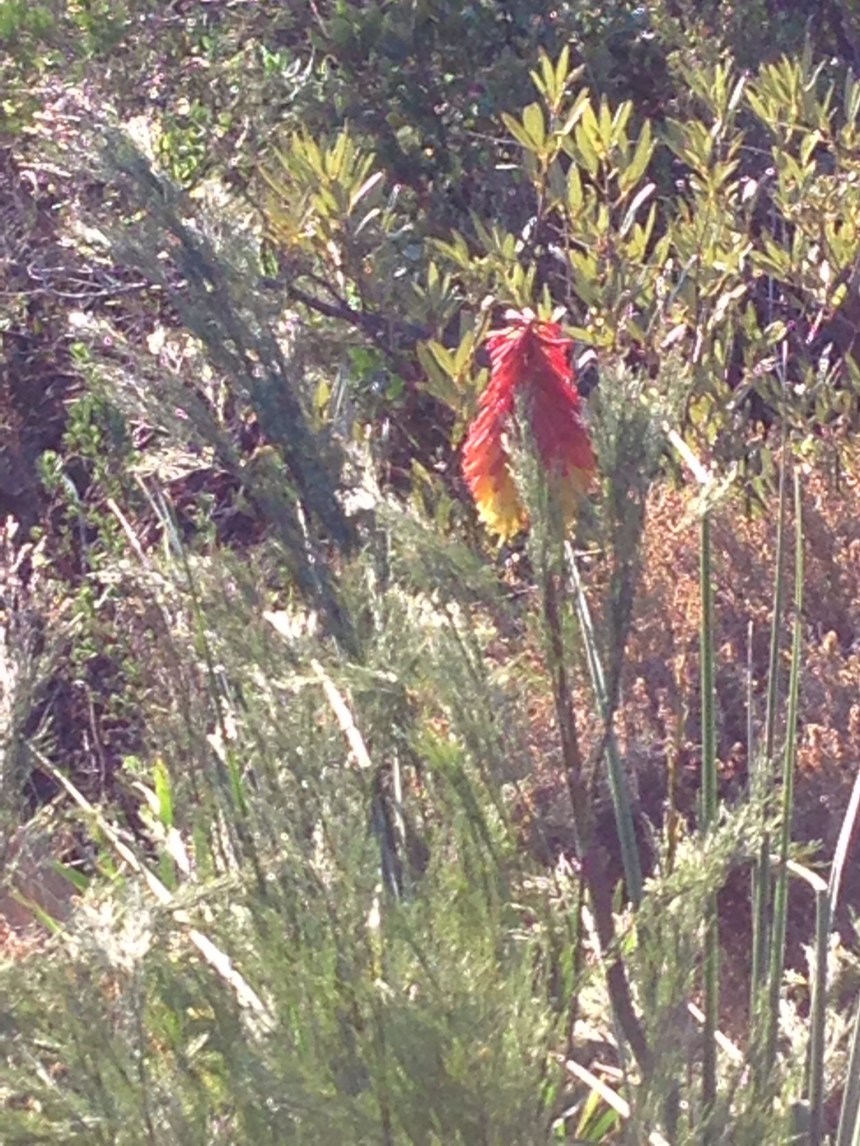
Just at the top of the waterfall a single Red Hot Poker, Knophofia uvaria has emerged.

image


And along the road I saw this flower that I didn’t recognise at all but it was on the first page that I opened in one of my books.  It is Metalasia divergens.

Metalasia divergens

Metalasia divergens

And one last flower seen on this run.  I’ve spotted some new Pelargoniums that I don’t think I’ve documented before and we’ll be off in the morning if the light is good to see if we can get some shots of them.

Meanwhile this pretty Erica is different from all the others I’ve documented so far this year.  Pretty soft grey leaves distinguish it from others, as does the slightly different shape of the pink bells.  It’s gorgeous.

Erica with soft grey leaves

Erica with soft grey leaves


A spring morning

On Friday evening the neighbours came to dinner and arrived early for a flower safari. Wonderful to have neighbours who love the mountain as much as we do and who appreciate how special it is. I took them on the old doctors road to see the waterfall which is pounding in its winter splendor. There are hundreds of flowers at this time of year, the wildflower spring commences long before flowers come to the garden. We discovered the old doctor’s road when Peter cleared a veritable forest of wattles along the river; they had overgrown this road and below it, a small but spectacular waterfall. Now this place is a haven for the fynbos which grew back the instant the trees were cleared.

From there we walked up to the weir, a favourite spot and much photographed for this blog because of the magic of the magnificent, ancient, white trunked Ilex Mitis trees, and then on up, above the weir and close to the top of the farm. The sun was setting behind the Paarderberg mountain; a soft mist gathered in the valley below, the evening was completely still, silent, breathless.   The gentle warmth of a mild sunny winter’s day coming from the earth beneath our feet. As it grew darker the full dams in the valley gleamed the reflection of the evening sky into the stillness of the coming night. “It’s like a holy place” said Francois, “there’s something spiritual about it.”

Dinner was companionable, cheerful and as we are in wine tasting mode for Christopher’s wedding in January, a little too much drink was taken. Our guests left us late, very happy, as were we.

Perhaps a little less so the following morning when the full consequences of overindulgence emerged, but not enough to prevent me from donning the running clothes and setting off with the wolfhounds and Jemima Chew into the gloomy grey morning on a serious mission to photograph flowers for the blog. The first Babinia fragrens has appeared which is for me the harbinger of spring, and with it shrubs, little trees and tiny plants have burst into flower. I won’t post the Babinia, as there will be thousands more, I didn’t get a great photo and there is so much else to post. It rained heavily during the night, those very still evenings often indicate a change in weather and flowers were covered in raindrops. To my delight I’ve identified two new flowers that I don’t remember seeing last year and which turn out to be related.  The first is Hermannia saccifera and the second is Hermannia hyssopifolia, a pretty and sizeable shrub with an unusual flower that has a pin-hole throat and this urn shaped body, called a calyx.  Absolutely recognisable when I read the description, there is nothing quite like it.

The Hermannia hyssopifolio grows in an area that Peter cleared last year, cutting through old fynbos and finding a large flat area where we least expected it, evidence of terracing by a farmer long ago.  A stream runs through this area and shrubs and there is prolific growth along it’s banks, including this sprawling shrub with its sticky leaves and tar-like smell.  It’s known as the tar pea, Bolusafra biuminosa, and grows, appropriately enough, along mountain streams.
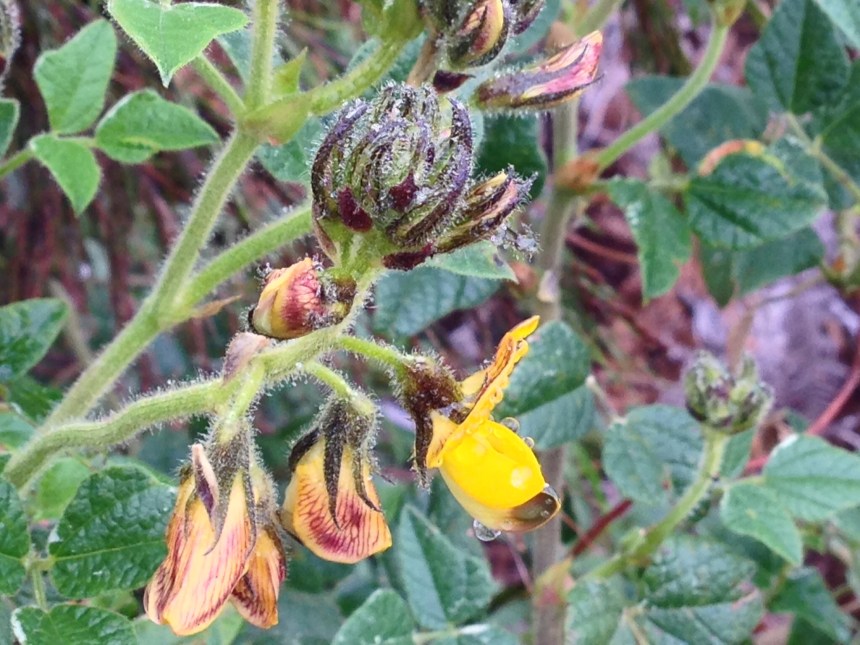
Bolusafra bitumenosa, the tar pea

Bolusafra bitumenosa, the tar pea

Another new identification also grows in this area, Phylica oleaefolia, with these pretty ranks of pale green, cupped flowers.  This is quite a tall elegant shrub.

Philyca oleaefolia

Philyca oleaefolia

We went down to an area where I haven’t been for a while and some of the yellow daisies are still flowering, the Athanasia trifurcata and the Osteospermum spinosum that I mentioned on a blog a couple of months ago.  I love when the flower matches the book’s comments perfectly, particularly as the photos don’t always.  The Athanasia trifucatum, says the book, has wedge shaped grey leaves, 3-5 toothed at the tips.  If you look closely at the leaves in this photo you can clearly see the three teeth.

In the same place grows a tiny pelargonium, one of my favourite flowers which grows all year round in different parts of the farm.  I think it’s Pelargonium myrrhifolium, var. myrrhifolium.


Along the road we walked on Friday night, which I call Erica Alley for the many varieties of Erica that make their home there, are several stunning varieties in flower.  Two beautiful examples of the common Erica plukenetii, showing the range of colour, from white with very pale pink, to coral.  And some with pretty pink bells in many shades, as well as this lovely white Erica where the bells grow in ranked series but which I have never identified.

Another pretty shrub which I have not managed to identify.  The flowers are green and tiny; so tiny that a single raindrop captures several of them.

And a small tree-like shrub flowering in several places on the farm with prolific drooping flower heads, but I can’t find it in the book.

image

More familiar friends include Stachys aethiopica, also known as woundwort with it’s mint shaped leaves and pretty little pinky-white flowers.
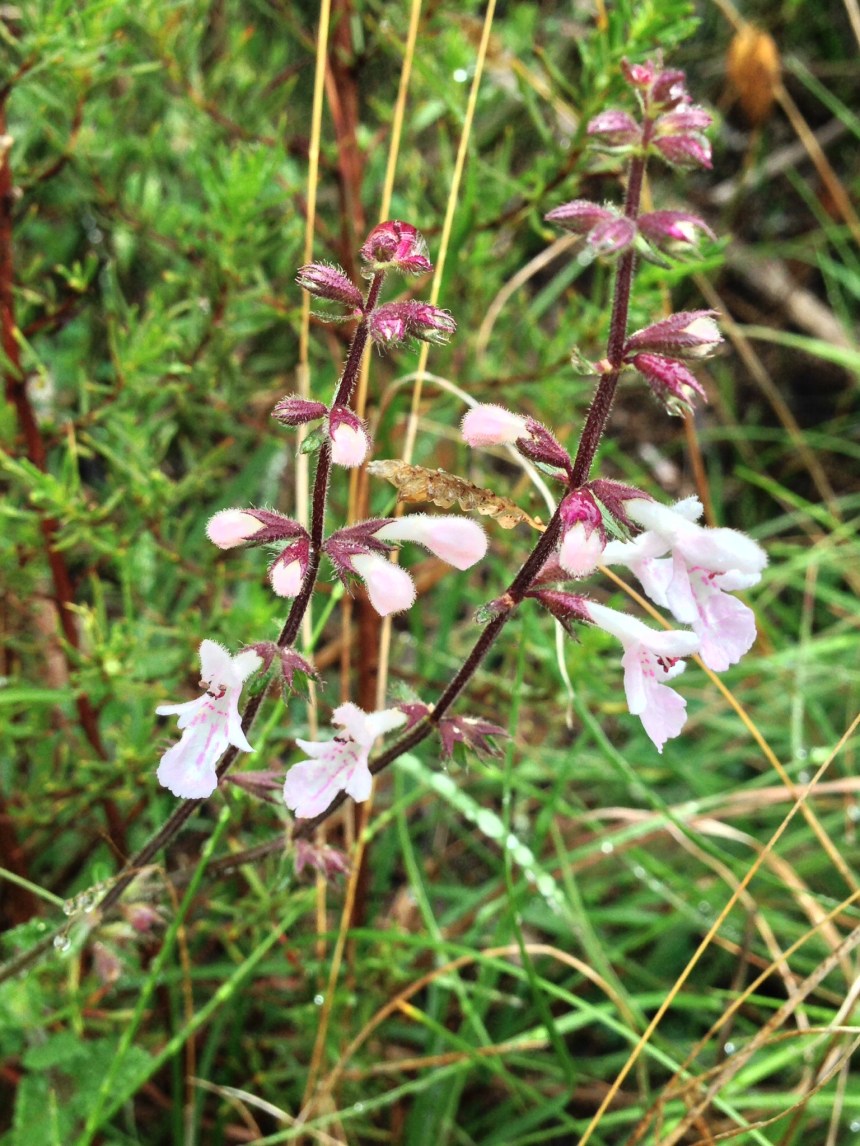
Stachys aethiopica

Stachys aethiopica

All over the farm the buchu is in flower.  Agthomsa, mostly crenulata, or a crenulata hybrid, though we also grow lots of Agthomsa betulina.  Buchu, the common name, loves the sandy mountain soil and especially the north facing slopes on the farm.  The flowers are mostly white but sometimes pretty shades of pink and lilac.


I couldn’t resist capturing Protea burchellii looking stunning in the grey morning light as well as the Leucadendron tinctum.  These yellow flower heads will soon turn the most wonderful shade of coral – they are prolific on the mountain and grow in massed groups in certain areas.

All in all we had a wonderful time, the dogs and I.  As a run it wasn’t up to much but as a morning spent together on the mountain, it was the best of times.  Maebh has boundless energy and was particularly happy to find a mongoose to chase.  He is much much cleverer than she, there was never a chance of her catching him, but she was very pleased with her morning.
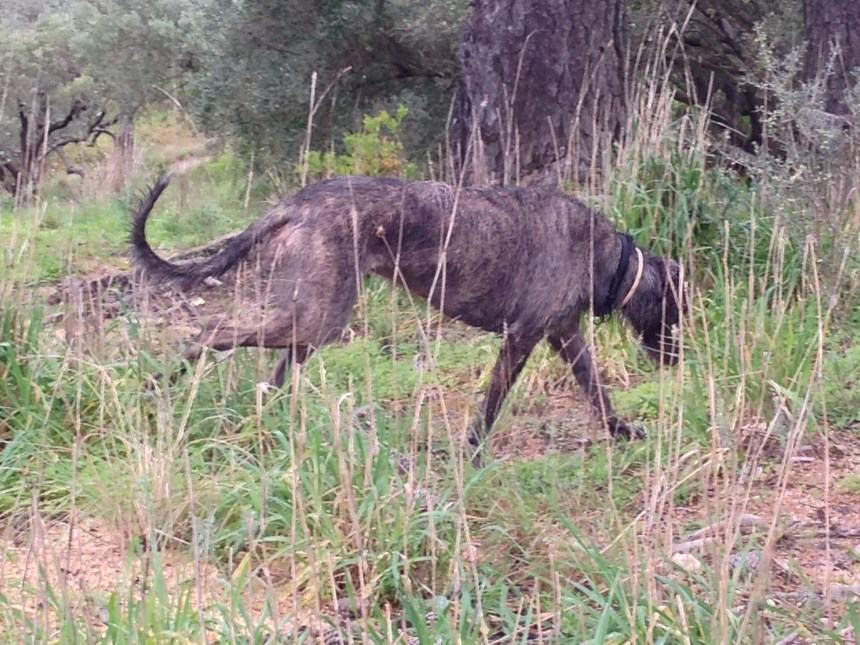
Maebh hunting in the olive groves, her coat dark from running in the soaking wet fynbos

Maebh hunting in the olive groves, her coat dark from running in the soaking wet fynbos


Aliens and Ericas

This storm was promised; the weather forecasting in this part of the world is so good that they predicted the first drops of rain almost to the minute.  And here it is, cold, wet, miserable weather so that when I look out of the window I can’t even see the dam, never mind the lights of Paarl in the valley below.  We are holed up in the study, watching 24 with Jemima Chew curled up before the fire snuffling and squeaking and hunting in her dreams.

I am getting carried away again and the point of tonight’s blog is to catch up with some flowers that I haven’t posted yet.  First of all two different Ericas.  I’m not sure which ones they are – both have tiny tiny flowers, several would fit on my little fingernail.


The next is the gorgeous Moraea tripetala.  These little Iris-like flowers grow on the driveway and are a joy to see when they emerge each year.  Typical bulbs, one day there is nothing and the next, stunning flowers emerge in their full glory.

Moraea tripetala

Moraea tripetala

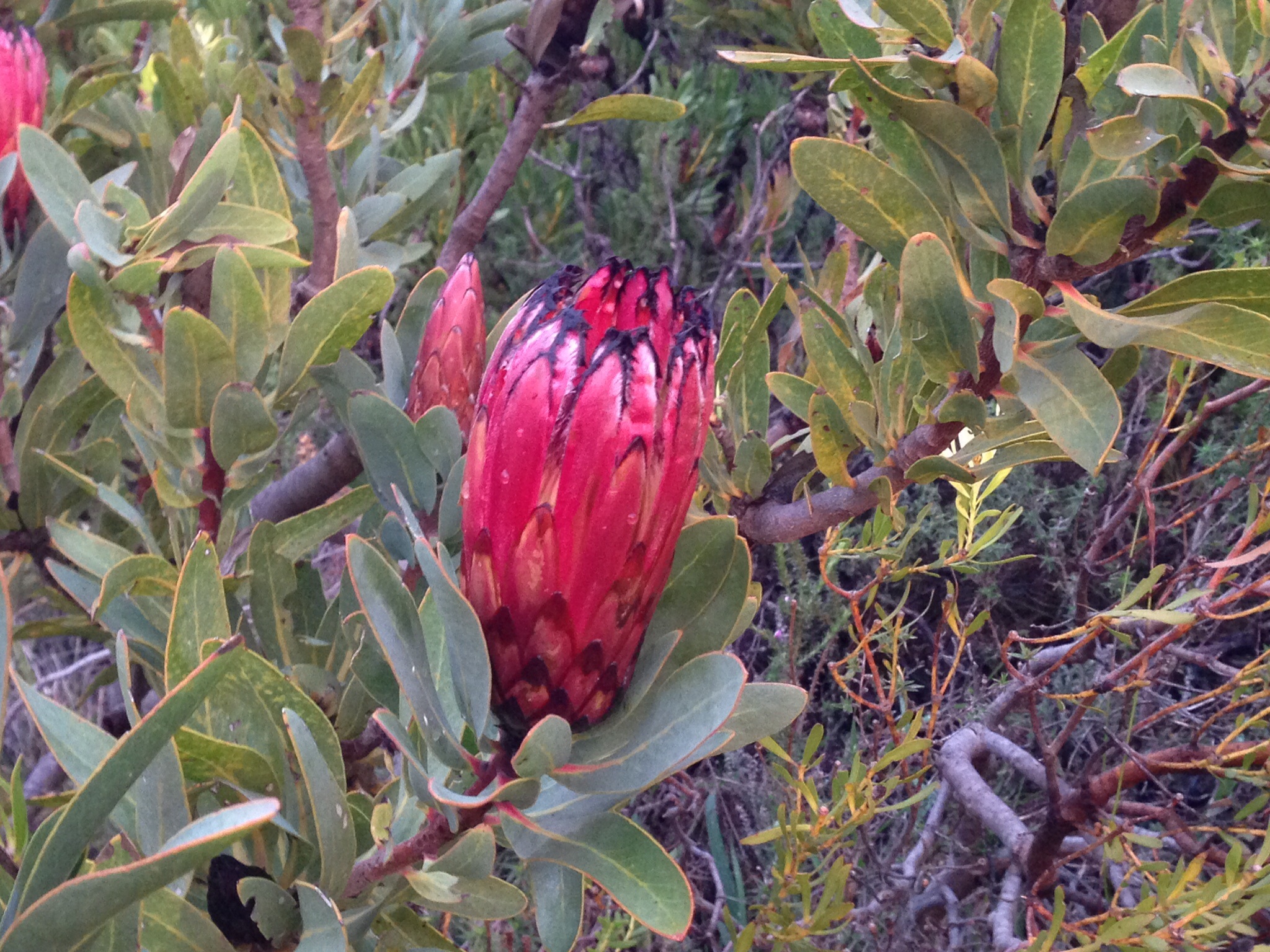
After the floods of rain last week we went out on a dark damp evening for fresh air and an evening run.  After so much rain a lot of flowers were ravaged and new ones hadn’t yet emerged but this rain-soaked Protea nerifolia glowed a rich red-pink in the gloom.

Protea nerifolia

Protea nerifolia

The driveway is one of the most prolific areas on the farm, or at least the one that I see the most.  Another shrub in flower at the moment is this Felicia filifolia.

Aliens!

We spend a lot of time and money taking out aliens.  Some are pines from the forest next door and here is one in flower – they might be aliens but these are pretty flowers all the same.

Another is this elegant tree.  It is a type of wattle I think – but far prettier than most.  The leaves are silvery grey and in summer I use them in flower arrangements and to decorate the house at Christmas.  At the moment it is in full flower and makes an elegant flowering tree.

Finally I can’t resist posting this particularly splendid sunset from last week.

image


Roaring waters

We had some turbulent weather last week and I lay in bed morning after morning listening to the rain battering the roof and feeling no desire whatsoever to leave my warm, wolfhound laden bed to go running in the wet coldness outside. Thus is the road to perdition paved with good intentions. Night after night I go to bed and promise myself a morning run. Morning after morning I lie in the snug warmth and don’t go anywhere. Paths go untrodden, flowers unphotographed, dogs unexercised

On Saturday the rain stopped and in the evening we finally ran up the soaking wet mountain in poor light with little to see and charming only to us. We ran via the waterfall, roaring white in the dull evening light.

Today dawned grey once more, but no rain. We were taking the young horse to a show, so there was no chance of a morning run, but after a happy day of showjumping at Noordhoek, I came home to glorious sunshine and enthusiastic dogs. The only possible answer was to go out on the mountain. I’m not sure it could entirely be described as a run. I walked most of the uphill and we made several detours into wilder bits of fynbos to examine and inspect. The dogs were delirious with happiness, noses a-quiver and constantly dashing off into the bush after wild things, real or imaginary.

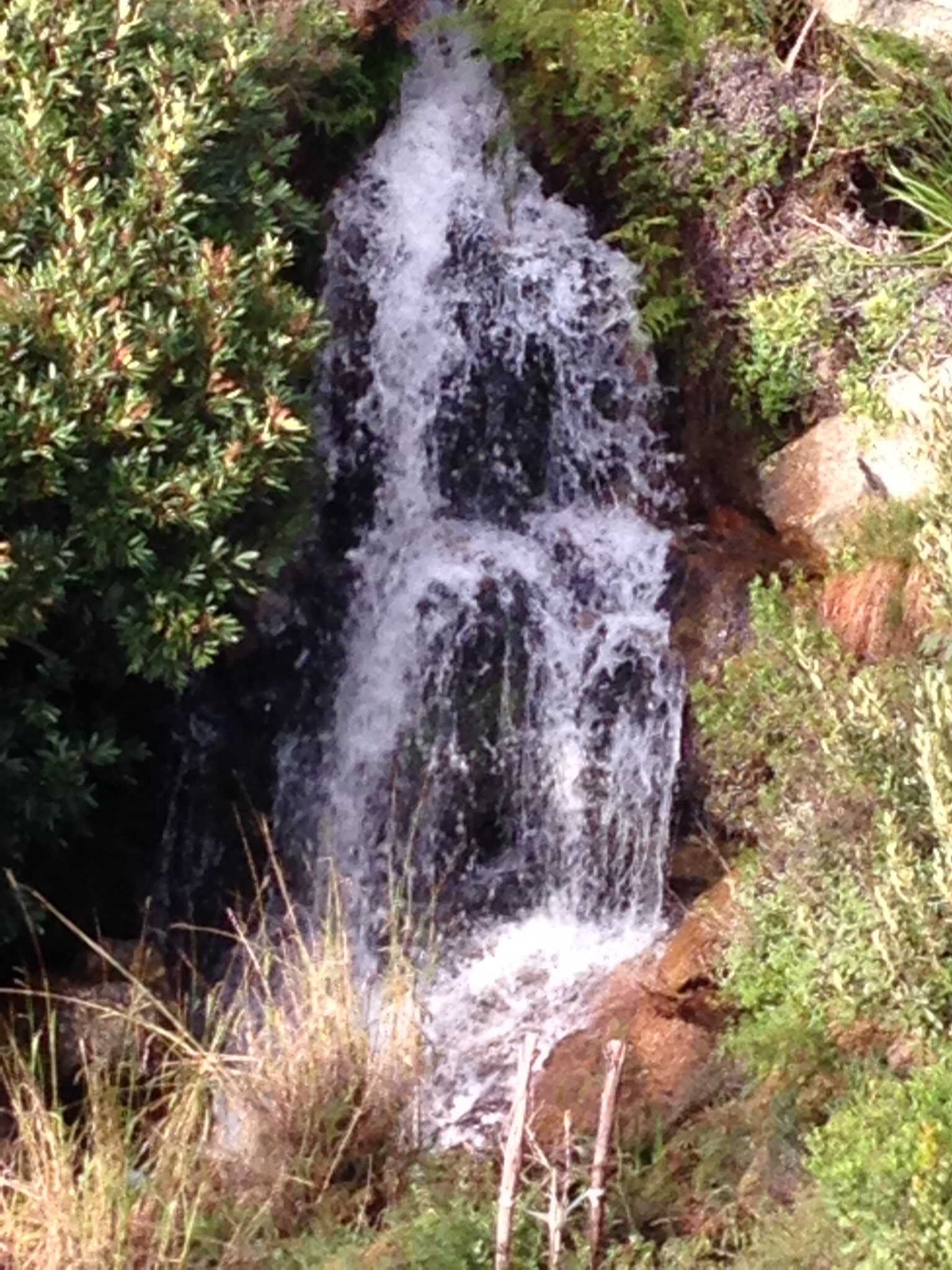
There was a lot to see: first the pounding waterfall, white with pounding roaring water.

image

We stopped at the weir for a drink (for the dogs, not me) and I took a series of strangely beautiful photos of Seamus. The sun was shining through the trees and catching his coat, confusing the camera. He lay in front of the magnificent Ilex Mitus, the Cape Holly with its gleaming silvery green trunk.


Higher up the mountain we ran into fynbos as the light became ever more golden. The pink Protea burchellii and the first Protea nitida of the year. We had to bash through some bush to get to Protea nitida. This colony scatters an area of the mountain on top of the farm and they tend to flower quite late. This is the first of these graceful silver trees to flower.


We took a little detour to the stream that leads off our land to the forest and came across some Microloma tenufolia. Never easy to capture, it somehow works well against the lime green leaves of the Lucadendron salignum and you can see the tenuous climber’s twisted stem quite clearly. The colour is amazing, always pinker in a photo than its more coral reality.


The Buchu that we grow commercially on the farm is in full flower and on the way down the mountain we stopped and in the perfect light just after sunset caught this flower-spangled shrub by the road.


Agthomsa crenulata

Agthomsa crenulata

We had wonderful weather before the rains this week and there is a backlog of blog photos to post, along with splendid tales of the morning light as it hits the Simonsberg, the Paarderberg and Paarl Mountain and of the evening sun as it catches the water in the dams below us and they gleam golden, pink or red and orange. But those are tales for another day.

The Polecat and the Porcupine

We were having dinner with my stepdaughter Robyn in Johannesburg earlier this week and she said “we can always tell when you are busy, Sarah, because you don’t write your blog.”  She’s right, it’s been a busy few weeks.  The runs continue but the blog has been neglected as I’ve travelled all over the place, and now a ton of reports need writing and people, horses and dogs have taken priority over the calm pursuit of blog writing.  So this blog is a bit of a mixed one, with several runs and bits of farm life all mixed up.

We share the mountain with many creatures that we never see, none more nocturnal and furtive than the African Striped Polecat.  Sadly we met one the other day, sad because she was deceased, Peter found her on the road and brought him home for a respectable burial.  I didn’t have the heart to take a photo of her, so I have taken this one from google images, with apologies to the photographer for the lack of a credit.  Of interest is that of all mammals, this is the stinkiest, stinkier even than a skunk.  Perhaps it’s a good thing that they are secretive and nocturnal.


African Striped Polecat

African Striped Polecat

We saw evidence as we ran up the mountain a week or so ago of another, less rare, nocturnal resident:  a porcupine quill on the road.  We quite often see the quills, and very occassionally the porcupines themselves and we love to think of them, snuffling around in the dark, happily digging up fynbos bulbs, of which we have plenty on the mountain.  Apparently this is the biggest porcupine in the world.  The photo of the quill is mine, the one of the porcupine also downloaded from google images.

Cape Porcupine

Cape Porcupine


Porcupine Quill

Porcupine Quill found on our morning run

The weather has been all over the place in the last few weeks.  We’ve had a wet but mild winter so far and now, suddenly, the temperature has dropped.  The water has been magnificent – as you can see from this photo: the mountain in the background is the Paarderberg and the full dams and the Berg River gleam in the last light of the setting sun.

The sun sets behind the Paaderberg

The sun sets behind the Paaderberg

On the same evening I went deeper into the thick fynbos above the house to see if there was anything new or exciting flowering   There was but I need to do a bit of research before I post it.  Meanwhile I took this charming evening view of the farm buildings.

image

Another evening found us higher up the moutain and Jemima Chew is clearly enjoying being out on the mountain.

image

Runs have also been early in the day when the light is poor, or at sunset.  I love how the Leucodendrum salignum glows in the gloom, a yellow-lime green colour, they shine on the mountain when nothing else stands out.

Leucadendron salignum Male

Leucadendron salignum Male

Leucadendron salignum Female, shining in the gloomy morning

Leucadendron salignum Female, shining in the gloomy morning

And the magnificant King Protea, Protea cynaroides, is in flower at the moment.  This is the South African national flower.

Protea cynaroides, The King Protea

Protea cynaroides, The King Protea

At the top of the farm, close to where we found the Gladiolus watsonius, is a flowering white shrub.  It looks like a Selago, but not any of the ones I find in my book, so identification is uncertain.

Selago

Selago

Finally a morning shot – with the Leucodendron salignum luminescent in the foreground, Paarl Mountain with the morning sun on it in the mid-distance and the Paaderberg in the background, covered in cloud.  This is a magical time of year in this part of the world, the soaking rain promises a great spring flowering season and good crops for us on the farm.  The light is magnificant, the days are getting longer and spring is getting closer.

image

The Magnificent Gladiolus maculatus – Flower of the Day once again

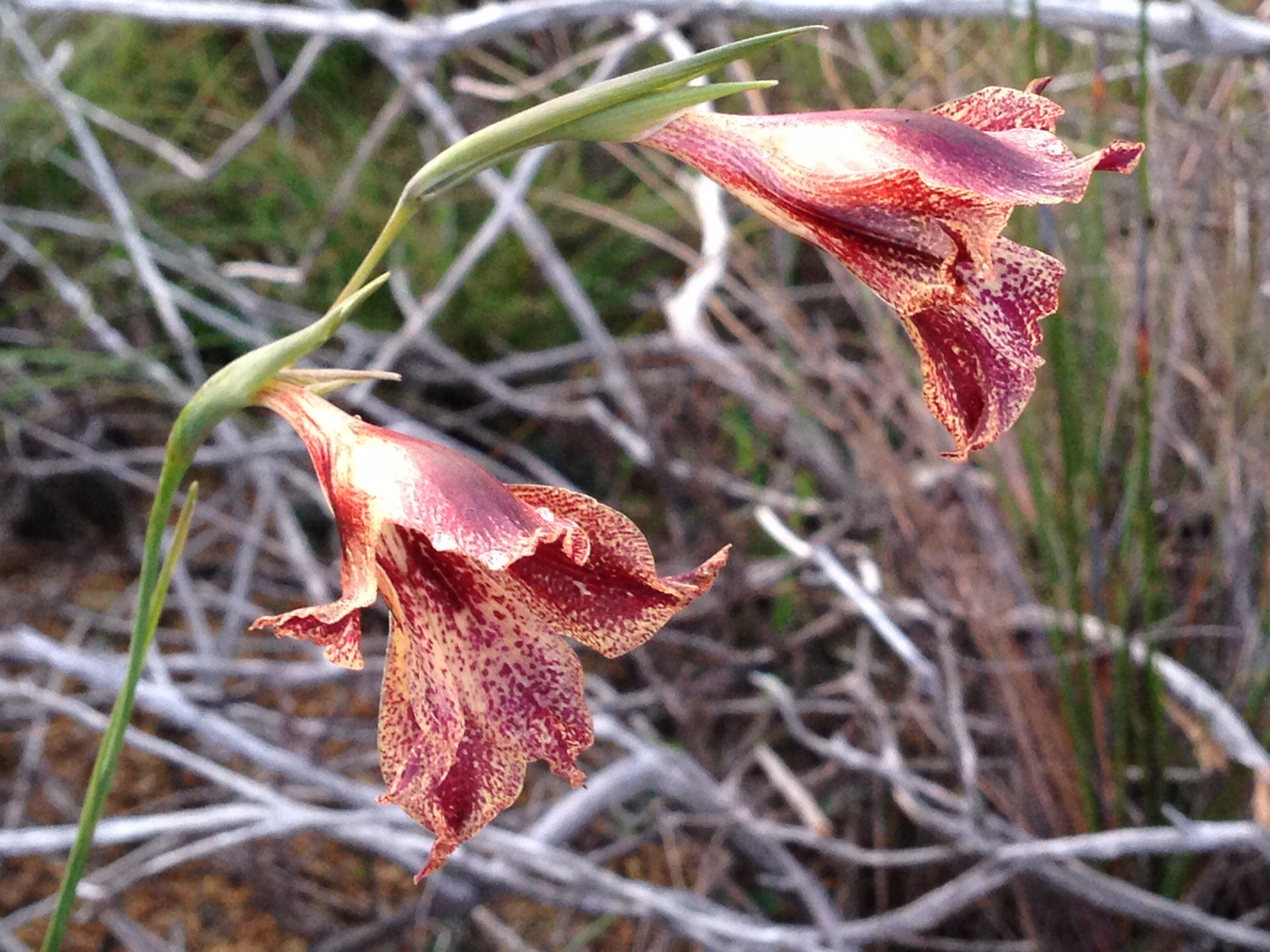
Although I posted a couple of pictures of Gladiolus maculate, the Brown Afrikaner, the other day, I was not sure I had done full justice to this exquisite and delicate flower, with its lovely flowers perched atop a long stem and somehow withstanding the most violent wind and rain.  And although I’ve only ever seen one I thought it might be worth exploring if there were not more in the same area.  So on Friday the dogs and I walked up in the evening light to see if we could find them.  And we did, one other, a little less bedraggled looking.  I don’t know if these are rare but they are special indeed.

Gladiolus maculata in the evening light

Gladiolus maculatus in the evening light

Gladiolus maculata, two flowers atop a long, fine stem

Gladiolus maculatus, two flowers atop a long, fine stem

The setting sun shines through the petals of the Gladiolus maculate, the brown afrikaner

The setting sun shines through the petals of the Gladiolus maculatus, the brown afrikaner

Running in between the flying

When I got home from Nairobi last week little Jemima Chew was not looking her usual self. She’s what the South African’s call a ‘pavement special’, an SPCA rescue dog who arrived in our lives shortly after Seamus. Although quieter than the attention seeking wolfhounds, she’s a lovely dog and often ends up a favourite with guests. She also gets bullied by Maebh as a result of which she now sleeps on our bed at night while the hounds sleep in the kitchen.  A perfect outcome from her point of view.

Jemima Chew (named for the Jimmy Choo boots she very nearly destroyed as a puppy) is always alert, always ready for action and always hungry. So when she was down in the dumps, refusing food and clearly off colour we were quite worried. Especially when Peter told me she’d been that way for a couple of days. She didn’t have a temperature, but in our part of the world you worry about biliary and I found a couple of ticks on her. We rushed her to the vet and although she didn’t have biliary she did end up on a drip for 24 hours. Poor girl, she’s so tough that in six years its’s the first time she’s ever had to go to the vet. By Sunday she was home, feeling much better, wagging her tail and demanding dinner.

Here she is in the misty afternoon light a week later. It poured with rain all last weekend but stopped early enough on Sunday afternoon for us to go for a quick run before I had to leave for the airport. This blog is being written on a plane between London and Frankfurt.

Jemima Chew, fully recovered

Jemima Chew, fully recovered

The light was fantastic and made the grove of Ilex Mitis by the weir look like a scene from The Hobbit. Seamus and Maebh put on their best performances for this photo.

Scene from The Hobbit, starring Seamus and Maebh

Scene from The Hobbit, starring Seamus and Maebh

The waterfall, which I posted only a few days ago, is now white with pounding water – we must have had 30mm of rain at least and the farm is soaking wet.

Water!

Water!

One lovely result of a few days of rain is all the bird activity when it stops, especially as this is the mating season for most of our birds. We took a different route through the fynbos today and saw lots of Cape Sugarbirds having battles over the girls. The iphone which I used for all my flower photos is much less good at caputuring fauna but I did manage to get one image of the sugarbird inspecting his territory from the top of a Protea repens.

If you look closely you can see the Cape Sugarbird with his long tail

If you look closely you can see the Cape Sugarbird with his long tail

Not so many flowers on this run – the rain, followed by some sun, means there should be some new things to see next weekend when I get home. This is a new protea gleaming in the soft winter light.  I have promised myself I will be stricter on identity this year, but I’m not sure what this subspecies is.

Unidentified pink Protea

Unidentified pink Protea

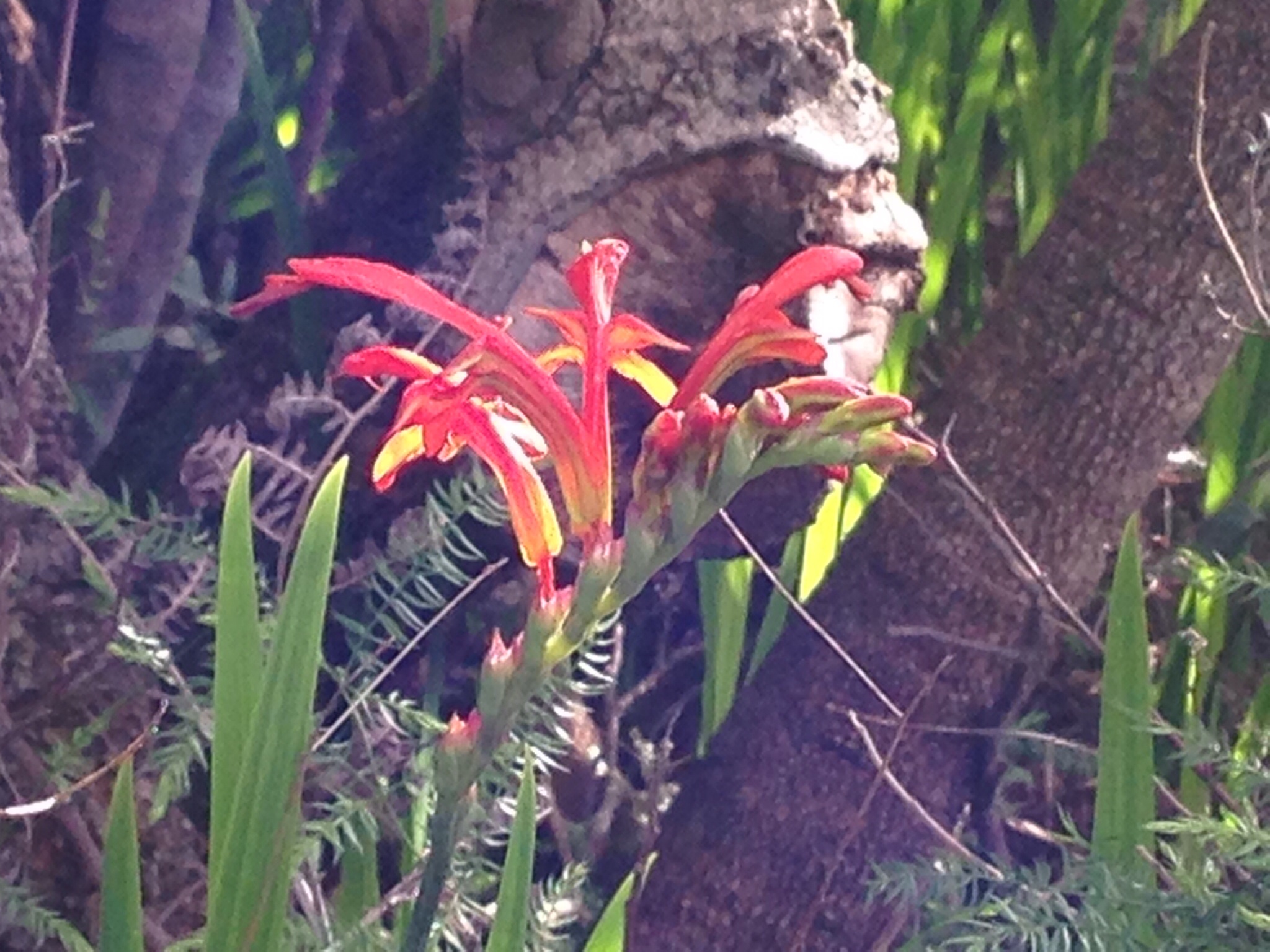
No problem identifying Chasmanthe aethiopica which we have posted before.  This group grows higher on the mountain on a different part of the farm – a damp shady area just below the weir. Such a lovely flowering bulb and reliably reminds me of the damp sweet smelling Irish spring where it grows wild on the verges and in the hedgerows.

Chasmathe Aethiopica

Chasmathe aethiopica

Another shot of the graceful and beautifully coloured Chasmanthe Aetheopica

Another shot of the graceful and beautifully coloured Chasmanthe aetheopica

« Older Entries Recent Entries »