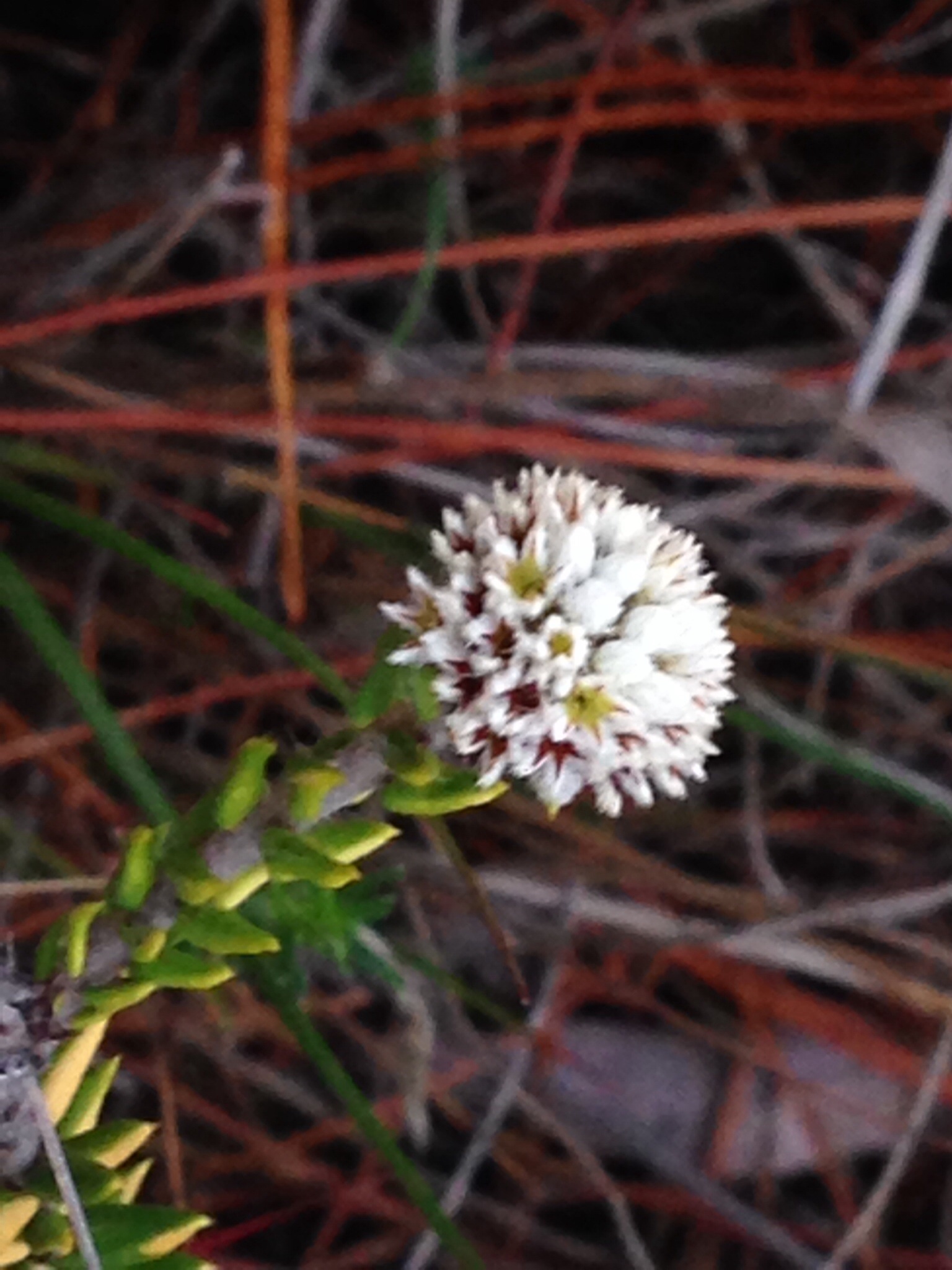
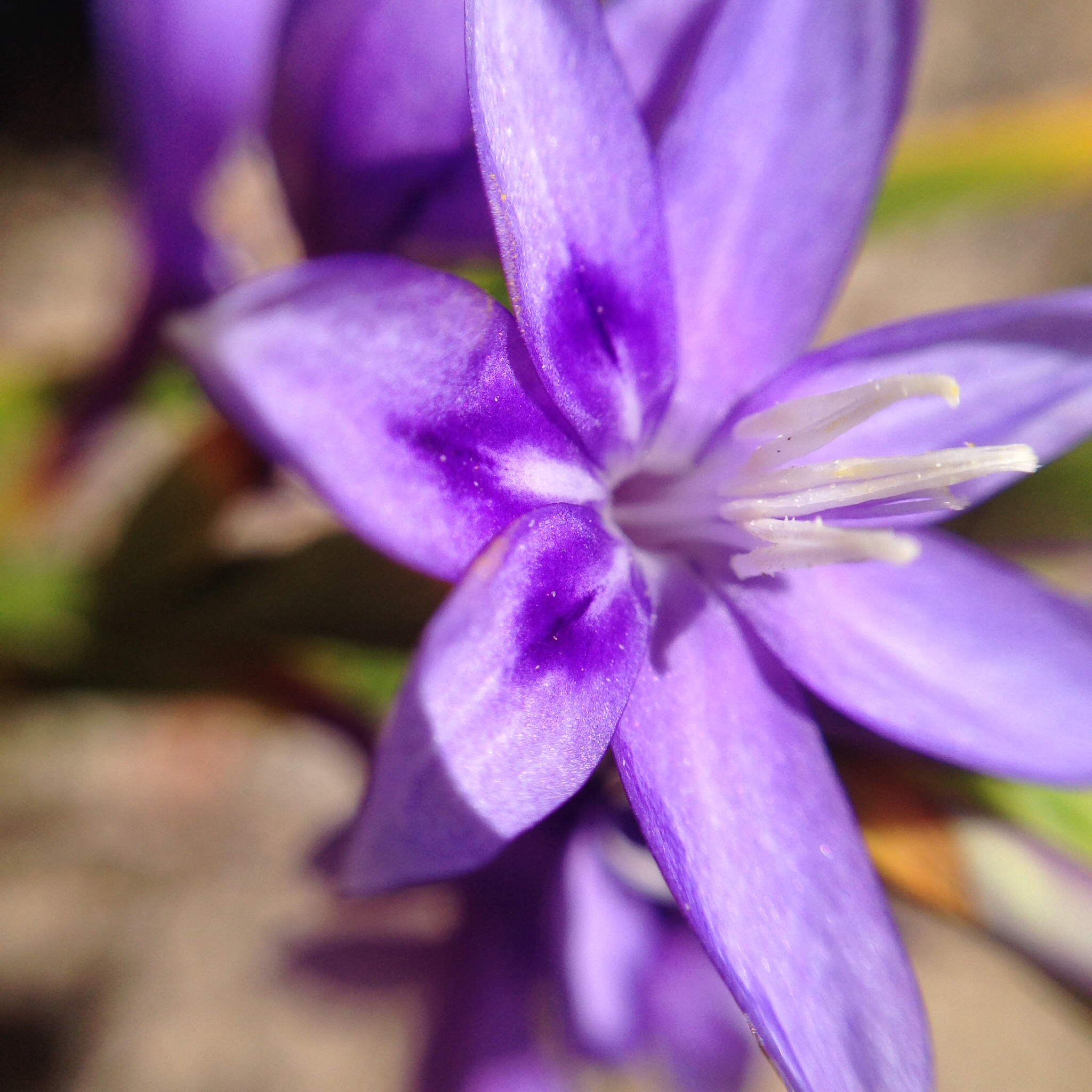
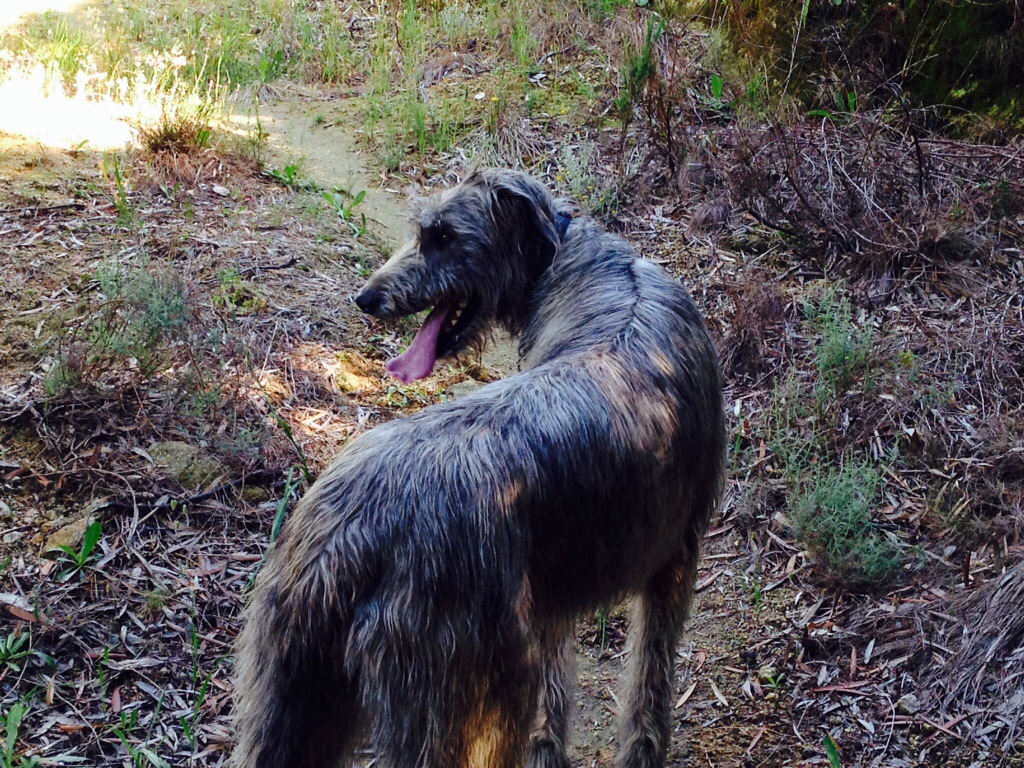
Tag Archives: fynbos bulbs

Running in between the flying

When I got home from Nairobi last week little Jemima Chew was not looking her usual self. She’s what the South African’s call a ‘pavement special’, an SPCA rescue dog who arrived in our lives shortly after Seamus. Although quieter than the attention seeking wolfhounds, she’s a lovely dog and often ends up a favourite with guests. She also gets bullied by Maebh as a result of which she now sleeps on our bed at night while the hounds sleep in the kitchen.  A perfect outcome from her point of view.

Jemima Chew (named for the Jimmy Choo boots she very nearly destroyed as a puppy) is always alert, always ready for action and always hungry. So when she was down in the dumps, refusing food and clearly off colour we were quite worried. Especially when Peter told me she’d been that way for a couple of days. She didn’t have a temperature, but in our part of the world you worry about biliary and I found a couple of ticks on her. We rushed her to the vet and although she didn’t have biliary she did end up on a drip for 24 hours. Poor girl, she’s so tough that in six years its’s the first time she’s ever had to go to the vet. By Sunday she was home, feeling much better, wagging her tail and demanding dinner.

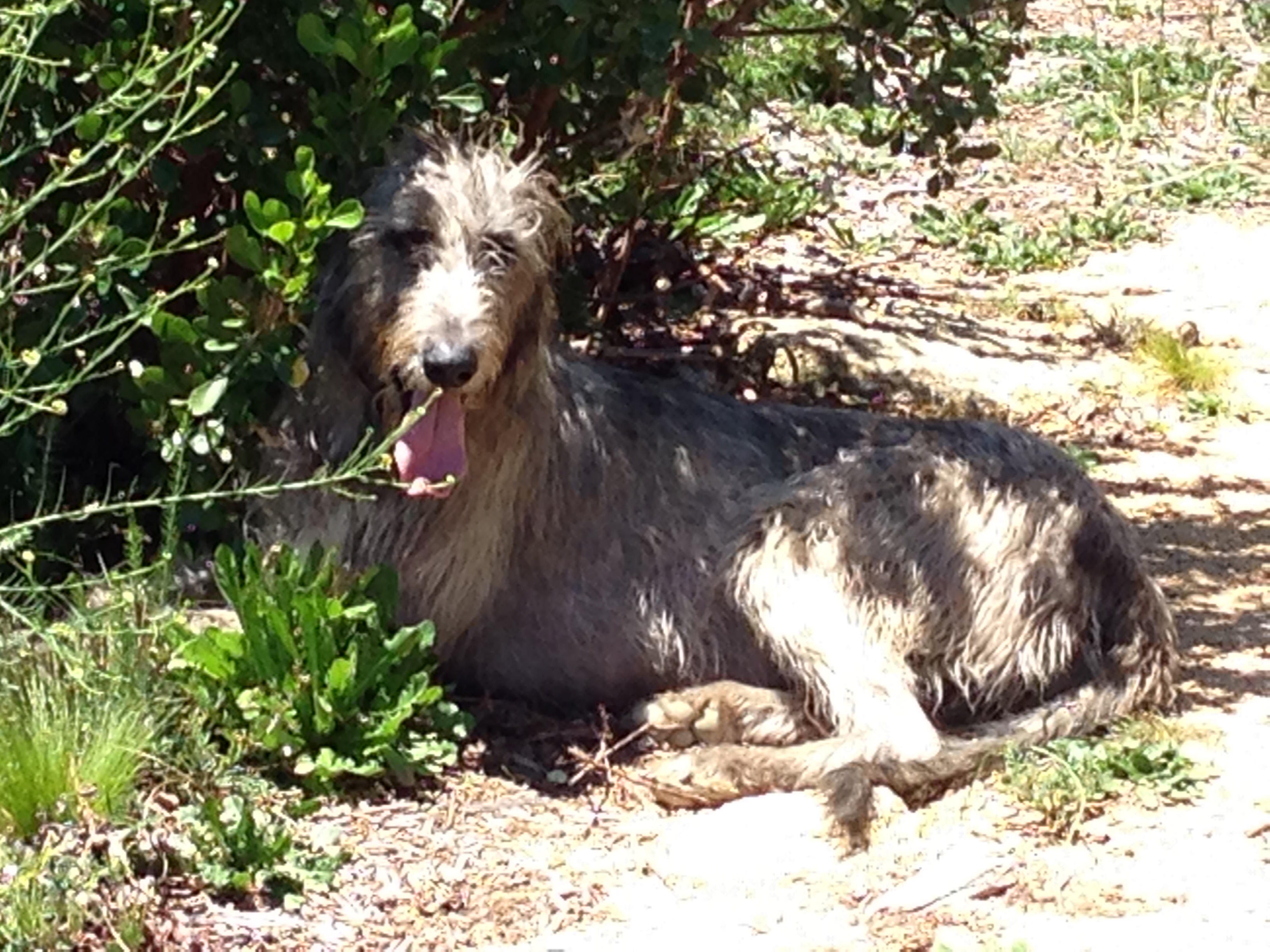
Here she is in the misty afternoon light a week later. It poured with rain all last weekend but stopped early enough on Sunday afternoon for us to go for a quick run before I had to leave for the airport. This blog is being written on a plane between London and Frankfurt.
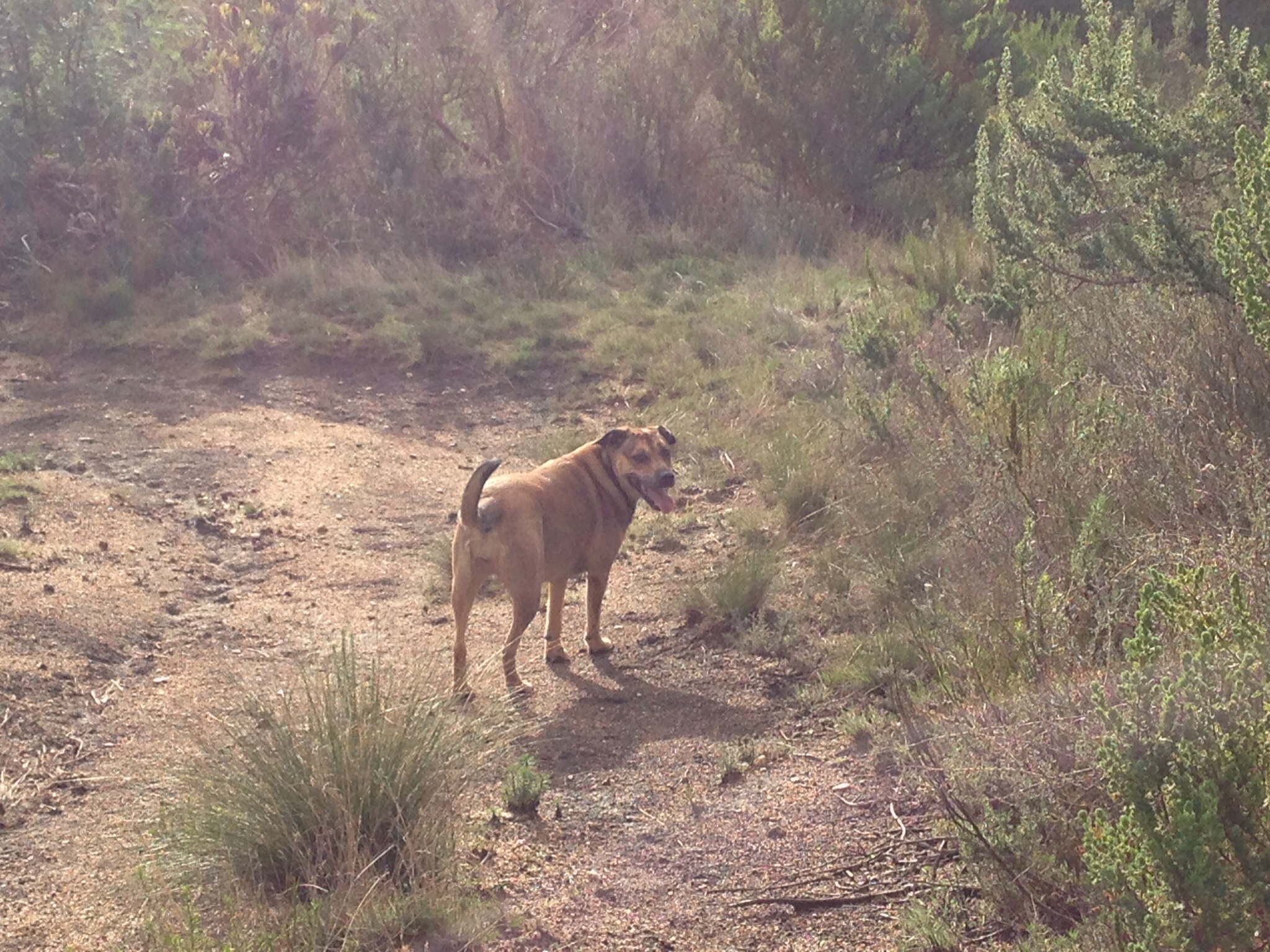
Jemima Chew, fully recovered

Jemima Chew, fully recovered

The light was fantastic and made the grove of Ilex Mitis by the weir look like a scene from The Hobbit. Seamus and Maebh put on their best performances for this photo.

Scene from The Hobbit, starring Seamus and Maebh

Scene from The Hobbit, starring Seamus and Maebh

The waterfall, which I posted only a few days ago, is now white with pounding water – we must have had 30mm of rain at least and the farm is soaking wet.
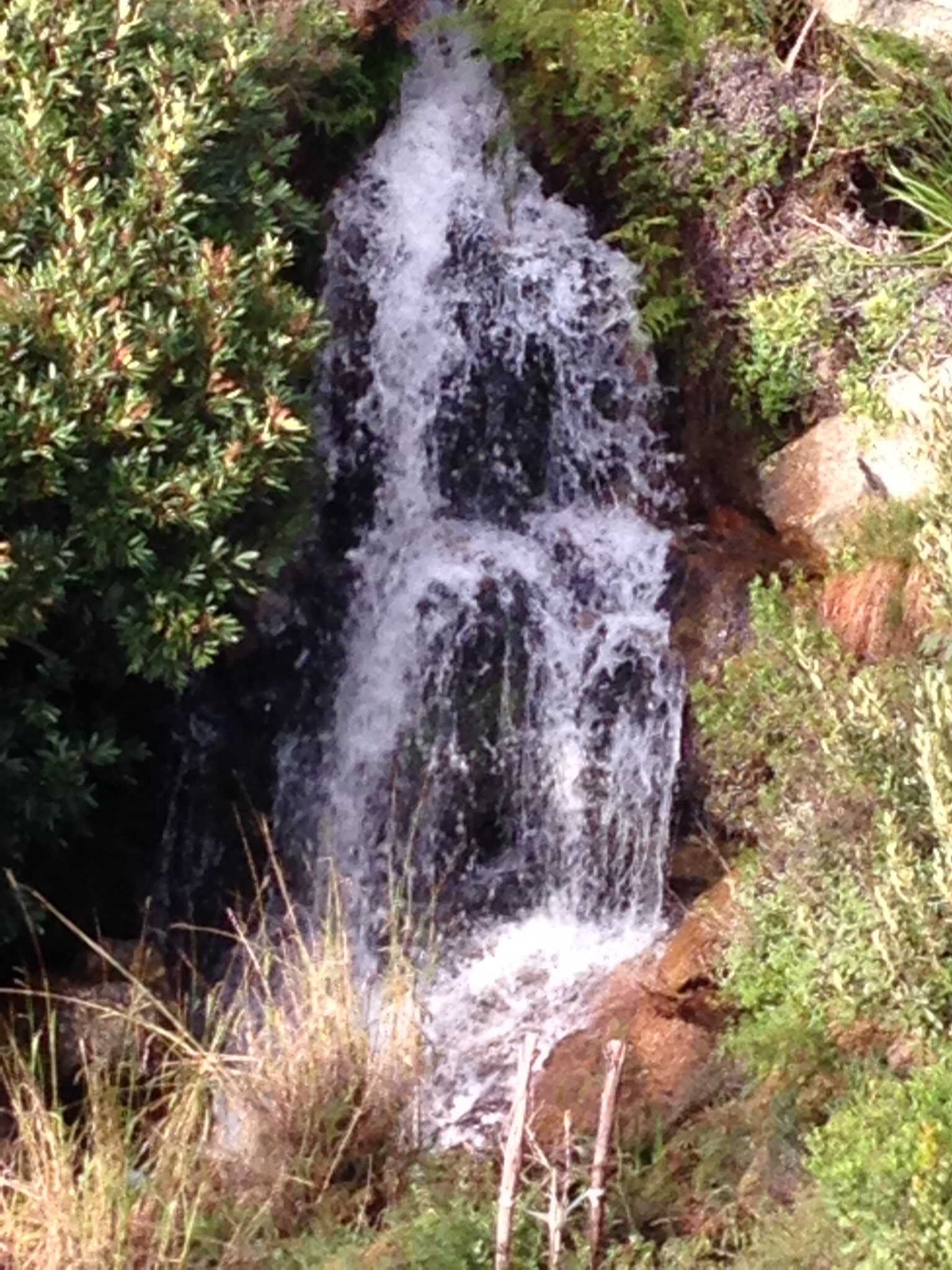
Water!

Water!

One lovely result of a few days of rain is all the bird activity when it stops, especially as this is the mating season for most of our birds. We took a different route through the fynbos today and saw lots of Cape Sugarbirds having battles over the girls. The iphone which I used for all my flower photos is much less good at caputuring fauna but I did manage to get one image of the sugarbird inspecting his territory from the top of a Protea repens.

If you look closely you can see the Cape Sugarbird with his long tail

If you look closely you can see the Cape Sugarbird with his long tail

Not so many flowers on this run – the rain, followed by some sun, means there should be some new things to see next weekend when I get home. This is a new protea gleaming in the soft winter light.  I have promised myself I will be stricter on identity this year, but I’m not sure what this subspecies is.

Unidentified pink Protea

Unidentified pink Protea

No problem identifying Chasmanthe aethiopica which we have posted before.  This group grows higher on the mountain on a different part of the farm – a damp shady area just below the weir. Such a lovely flowering bulb and reliably reminds me of the damp sweet smelling Irish spring where it grows wild on the verges and in the hedgerows.
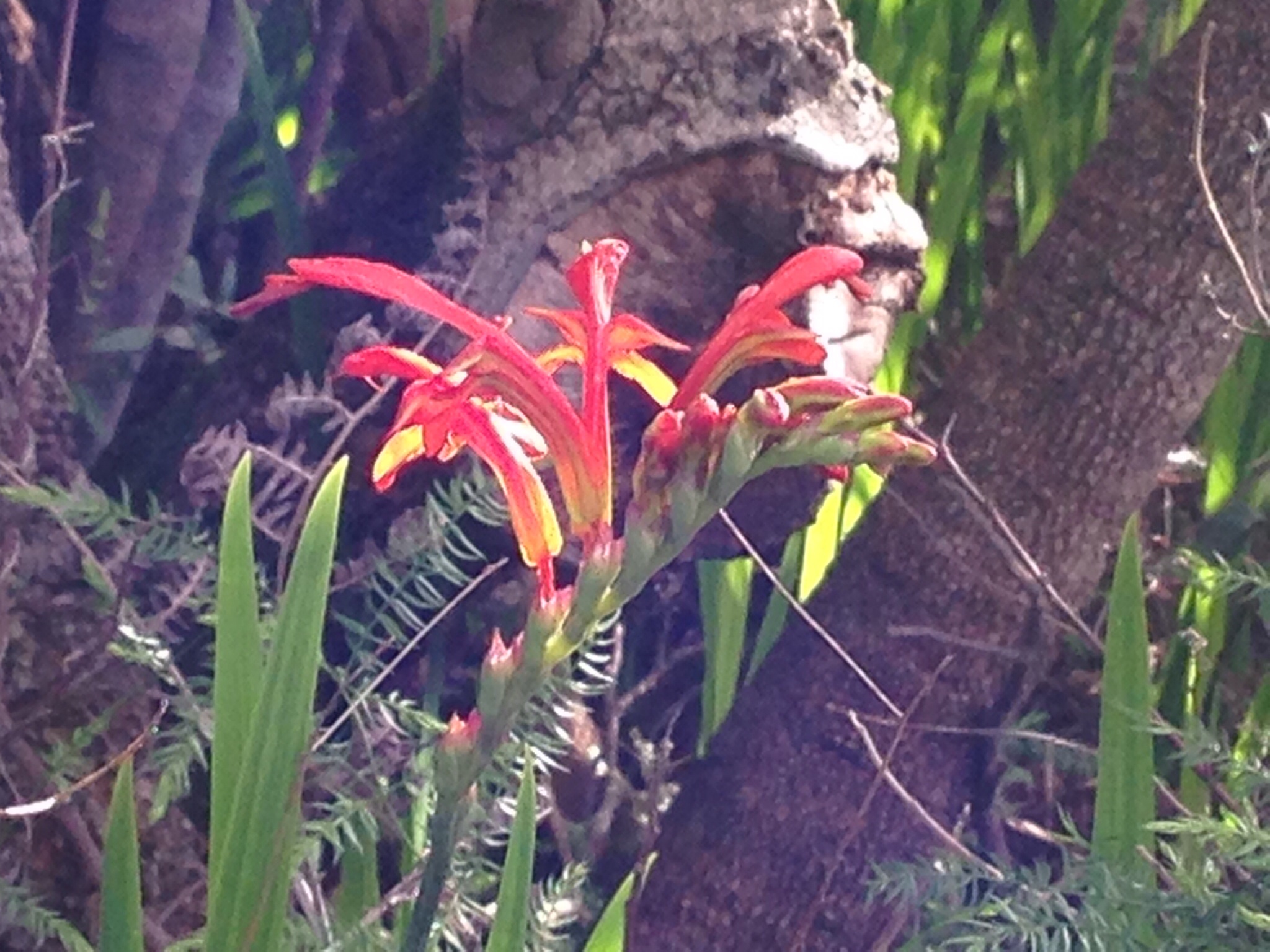
Chasmathe Aethiopica

Chasmathe aethiopica

Another shot of the graceful and beautifully coloured Chasmanthe Aetheopica

Another shot of the graceful and beautifully coloured Chasmanthe aetheopica

Jemima Chew and the francolin

It’s been a while since I’ve posted a blog and I think I may be struggling with a little writer’s block. There has been so much travel, work, report writing, negotiating still more work, over the last few weeks, to say nothing of trying to keep a semblance of normal life, that the runs and the flowers have faded to the background. Back on a plane now, headed to Nairobi, not a destination that’s particularly attractive at the moment, Time to write a blog. The lovely thing about this time of year is that every day is so different.

Unlike most of the continent we do have four proper seasons and now we are headed from autumn to winter. I’ve talked before about how our autumn is more like spring in the Irish world I come from. Here it is the relentless heat that stifles growth and shrivels the landscape. So once the rains fall and the temperature is mild, the landscape becomes green, birds start courting and building nests and though winter is cold and damp, it is also fecund and bears the promise of life to come.

One silly Cape Francolin (a partridge-like bird) decided to build her nest on the shores of the dam, where the undergrowth is thick and a willow tree grows overhead. Jemima Chew found her, of course, and she flew into the willow tree and refused to budge; presumably reluctant to leave her eggs (it is a little too early for chicks). Jemima spent the entire day barking at her, running around the willow tree, ferreting in the damp waters and generally causing havoc. The bird still didn’t budge. At one point, when Peter and I went to inspect the cause of all this commotion, Jemima Chew had actually managed to climb onto the lower branches of this willow tree, defying both gravity and the limitations of her portly figure. I had left my iphone in the house so we have no evidence of this unlikely event.  Luckily night brought the irresistible temptations of a warm fire and a good dinner and the by next morning the francolin had learned some sense and was gone. Birds are not stupid.

While we were there we saw the first arum lilies of the season. These lovely lilies are indigenous here and will grow all winter long anywhere damp, the wetter the better. Roadside verges are covered in them, a joy to behold. The gleaming whiteness is quite hard to photograph, but these are the first.

The first Aurm Lily of the year

The first Aurm Lily of the year

Another fynbos bulb that likes damp places is Chasmanthe floribunda. I grew up knowing this as Montbrecia – it grows wild in the hedgerows of Ireland (a damp, mild climate if ever there was one). Oddly in Ireland it also flowers in May and June, justifying my claim that the Cape autumn is a kind of spring. Botannical names get changed to bring more global consistency and perhaps this is one that has been changed.  When I look up Montbrecia it shows up as Crocosmia and looks exactly the same, so I’m a bit confused.  Not an uncommon feeling when it comes to naming fynbos with pinpoint accuracy.

Chasmanthe floribunda, or Montbrecia or Crocosmia

Chasmanthe floribunda, or Montbrecia or Crocosmia


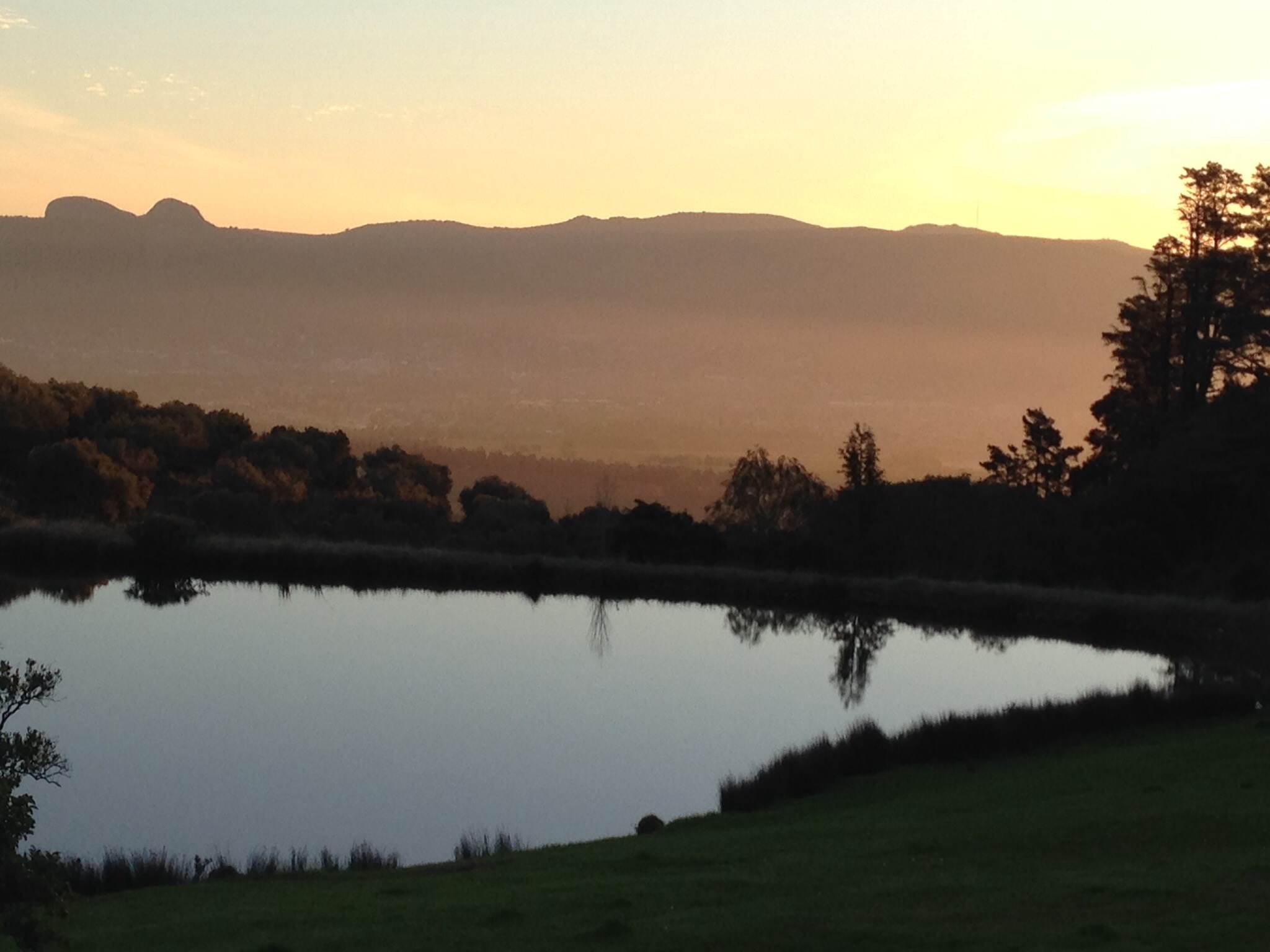
There is a particular light we see here in winter that charms me most of all. It happens when the sun is setting in the West/North West and a mist comes off the river down in the Paarl valley on a perfectly still evening. At a certain moment the setting sunlight catches the mist and turns the whole valley into gold. I only ever see it once or twice a year and it is enthralling. Last week we had such an evening and this photo is taken from the balcony. Hard to catch the magical glimmering golden light in a photograph, yet there is something of it captured here.

A golden evening

A golden evening

The next morning greeted us with cool cloudy weather pierced by the odd shaft of sunlight and a double rainbow.

image

As we ran up the mountain we saw the first wild rosemary – Eriocephalus africanus. This stunning herb grows commonly all over the farm and soon the air will be scented with its flowering. The tiny while flowers are a delight to behold and we’ll see many more of them in the months to come.

Eriocephalus africanus, wild african rosemary

Eriocephalus africanus, wild african rosemary

The Phylica is now in full flower everywhere and I noticed that the tiny flower heads have opened, each one a little flower in its own right. So pretty.

Phylica eriocoides
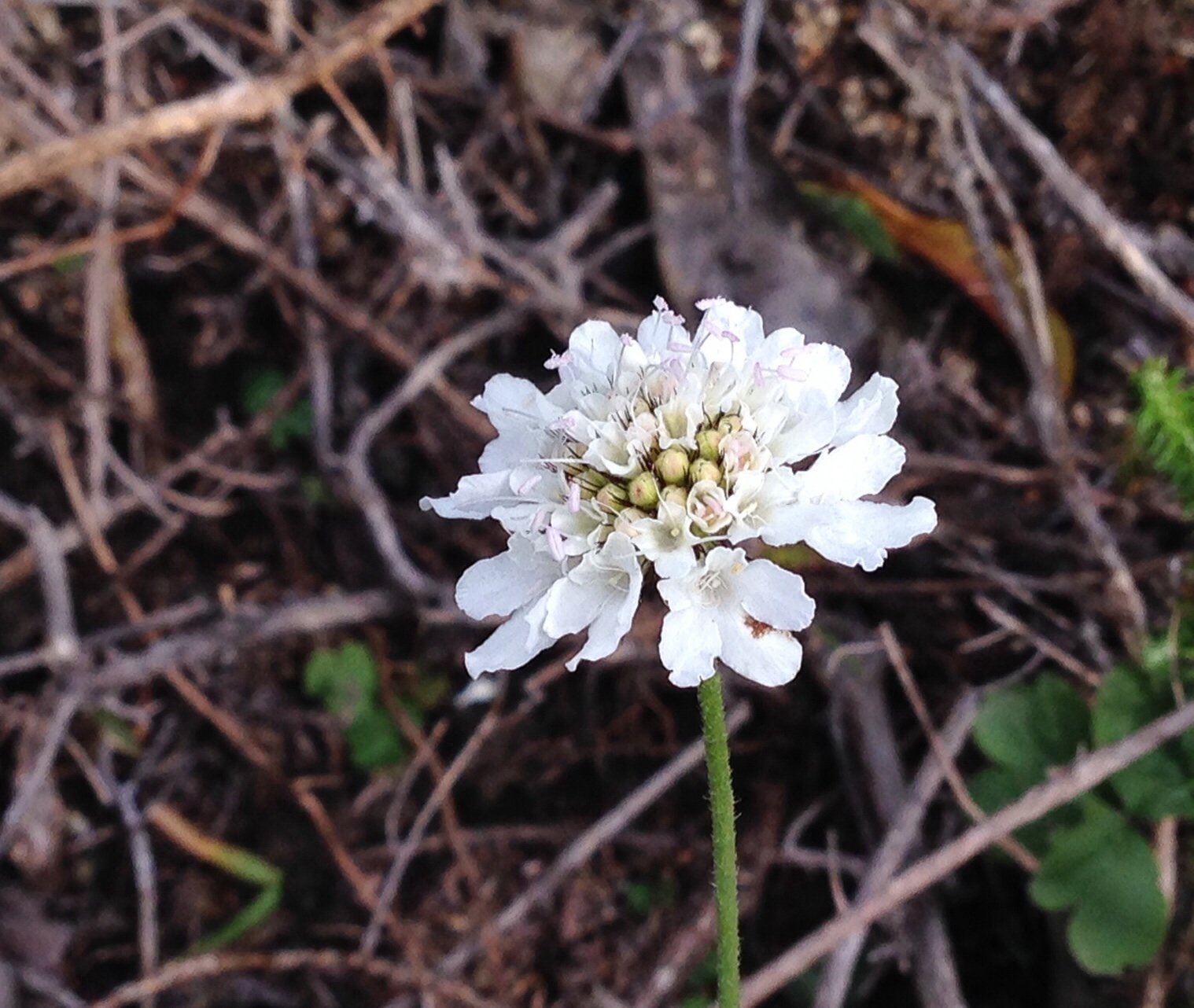
Phylica eriocoides
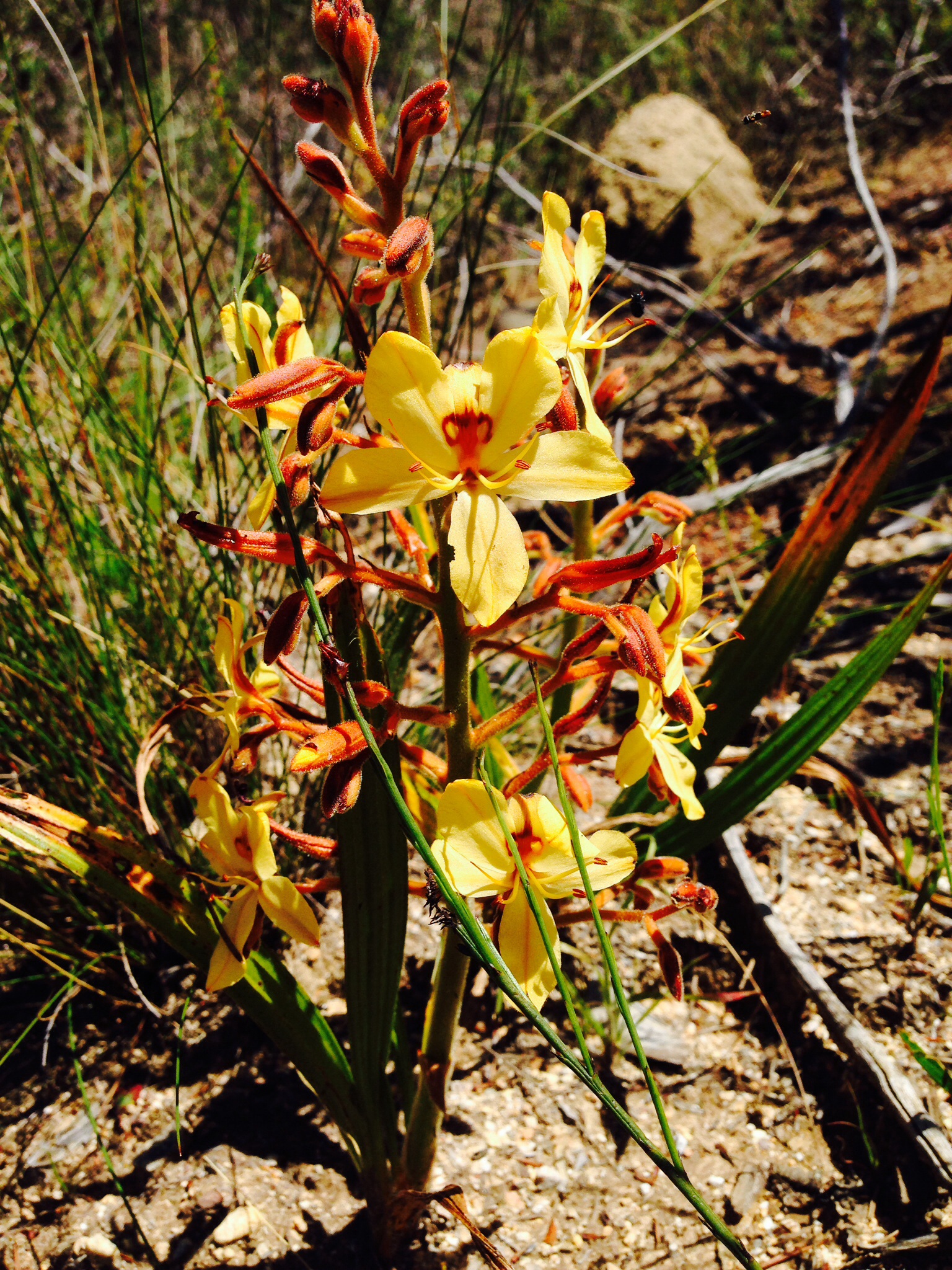
The Morning Run

The unseasonal weather continued all last week with pours of rain thundering down for much of it.  Yesterday morning it was dry at last and we woke up early to go running.  At this time of year we are normally sweltering in the heat so it was a joy to be splashing through puddles and smelling the sweet damp morning air.  I was working in Johannesburg for much of the week, missing the rain, but also the dogs and the run, so they were full of joy as we bounded along.  Yes, I did say bounded.  Fewer flowers mean fewer photos so I’ve been running a bit harder and slowly getting fitter.  

I count my blessing every day that we spend on this farm.  We’ve been a bit slow about transforming the garden and today the fabulous Henk Scholz came to give us some advice.  He is incredible, one starts with an idea of course and he’s very kind so he takes it on board, but then comes up with his own idea that is so audacious and splendid it’s completely irresistible.  Peter then came up with a couple of stunning ideas which, if he really is prepared to do the work, will transform the place and make it even more beautiful.  I described the farm to someone the other day as the most beautiful farm in the Cape, which was stupid because there are many amazing farms here.  Ours is unusual and unexpected which gives it a special beauty.

Henk admired elements of the vegetable garden, principally the fact that I’ve managed to get anything to grow at all.  I may love plants and gardens but whatever shade my fingers are, it’s definitely not green.  He gently explained that the reason my plants are not fruiting is because they are completely smothered by weeds.  Oh I can make all the excuses I want, the rain, the fact that I fertilised everything before the rain, which of course the weeds love even more than the plants.  The time, or rather the lack of it that dominates my life.  In the end, after he left, with the earth still soft and yielding after all the rain I dug and weeded for hours and have cleared all those pesky monsters away.  Maebh loves it when I garden, she sniffs around and tries to help, then lies down and observes all the work with great interest.  Finally she curls up in the cool shadow of an orange tree and happily falls asleep. 

Back to the run.  As we bounded up the mountain I couldn’t believe my eyes when I saw this Protea repens.  What?  Now?  It’s far too early!  And indeed the season doesn’t really start until March.  This one clearly decided to get ahead.  It has just opened, perhaps the season starts much earlier than I’d realised and this is the first.  

An early flowering Protea repens

An early flowering Protea repens

One of the joys of the mountain is the magnificent Salvia africana-caerulea.  It flowers prolifically for eight months of the year and particularly seems to thrive at this time of year.  

Salvia africana-caerulea

Salvia africana-caerulea

Another flower that is glorious at this time of the year is this stunning Erica.  I’m pretty sure it’s Erica abietina, simply called Red heath which flowers all year round but seems to relish the dry most of all.  The coral flowers are stunning along the drive and although the strong midday sun was almost too much for this photo I couldn’t resist the way it reflects the flight and glows from within.

Erica abietina

Erica abietina

Despite the cooler weather Seamus still took a dip and a drink in Fox Pan as we climbed higher up the mountain.  Then, graciously deigning to wait for me, he stood and admired the view with the water cascading off his flanks and shining in the morning light.

Seamus after his dip admiring the view

Seamus after his dip admiring the view

I rushed to identify the last blog’s flowering bulb as Watsonia, possibly because it gave me a great title.  But I was a bit bothered by that and not entirely convinced.  The flowering season is wrong, and although that sometimes happens you have to be certain.  So back to the books I went and in fact it is Tritoniopsis, most likely triticea, although burchellii is almost identical and grows in the same places.  The brown leaves, which you can see in this photo, are distinctive and make me confident of this identification.

Tritoniopsis tritecea

Tritoniopsis tritecea

Watsonia, weather and a resolution

After one of the wettest winters in memory we’ve been expecting a hot, windy dry summer. So far it hasn’t materialised. There was a lot of wind before Christmas, which is typical of the Cape, but over the Christmas period itself we had perfect weather, still days with little or no wind and temperatures that didn’t rise above 32 or 33. After New Year we expect all that to change – the Christmas guests leave and the oven goes on. Typically in the second week of January the thermometer soars to 40, sometimes more in the valley below and the dogs and I gratefully retreat to my air conditioned office.

Not this year. As I write this on 6th January 2014 it is pouring with rain outside and the temperature is a cool 24 degrees. The rain is set to continue for the next few days and for once I’m actually grateful to be catching an early flight to Johannesburg on Wednesday and hoping to miss the worst of this most unseasonal summer stormy weather. I expect we’ll get the heat soon enough. My mother is staying with us and we went to Cape Town this morning to purchase some new outdoor furniture for her sunbathing – not much chance of that in the next few days so she’s off to Simonstown for a few days of less rural life.

Our fynbos runs continue to surprise me. Running down the drive late last week a flash of coral caught my eye and I stopped to admire a little group of Watsonia that is flowering on the bank. This bank along the drive really is fynbos heaven, it seems to capture water and most of the interesting things that grow elsewhere on the farm thrive here. This one looks most like Watsonia coccinea although it might easily be another of the many fynbos subspecies.

Watsonia coccinea

Watsonia coccinea

Although we’ve seen this Microdon dubius before I can’t resist posting another picture. It’s in full flower at the moment and these yellow-purple spikes are all over the farm, lighting the roads and profilic in the buchu lands.

Microdon dubius

Microdon dubius

The next couple of weeks are going to be taken over by a work project that will take most of my time and much of my energy so blogs might be in short supply. This year our Christmas/summer break was curtailed by a project in Stockholm in December and this one in Johannesburg that starts a week before I’d planned to get back to work. We are driven by the client and grateful to have them, but sometimes a holiday break would be nice!

Even a short holiday on the farm is a joy – the dogs love having us aournd, lots of friends come to stay for a night or three and we are blessed to live on this mountain.

As work takes over again the Fynbos Blog resolves to carry on in 2014, with the aim of capturing even more of the amazing diversity of flowering shrubs and bulbs that flourish on this little farm.

Christmas Fynbos

Travel at Christmas is always fraught with risk. We left for a short trip to Ireland to spend the weekend before Christmas with a very dear friend, celebrating his 50th birthday. Thereby infuriating a whole series of family members, who believed that if we were in Ireland that close to Christmas, we should see them, not friends. Sorry. We then braved a lot of stormy flooding roads and wild bouncing skies, along with a Heathrow made worse than ever by the despairing passengers whose flights were cancelled two days before Christmas. Our plane, thank goodness, slipped through the weather and flung itself southwards and even managed to land in Cape Town without crashing, unlike another flight at O R Tambo in Johannesburg which walloped its wing by crashing into a building on the ground causing a mighty row between air traffic control and the British Airways pilot. You can imagine. No-one got hurt.

We arrived home on the 24th, back to the farm, the dogs and our gorgeous friends who came for Christmas. The fabulous David in Paarl did all the catering for us, so we had a wonderful self-indulgent break. Hubert sat beside me at dinner and explained that he doesn’t really love this blog because it’s too academic for him. He’s one of the cleverest people I know, so I think that, as a friend who lives most of the year far away, he’d rather more gossip and fewer flowers. Those last two paragraphs were for you, Hubert.

Meanwhile out on the mountain the dogs and I have been running regularly and loving it. Summer runs take in lots of water breaks. You hear of big dogs dehydrating so I’m careful about that and make sure the dogs are always in sight so that I can spot if anyone gets distressed.

Seamus and Maebh enjoying the water at Fox Pan

Seamus and Maebh enjoying the water at Fox Pan on a very dry sunny windy morning

Lots of things enjoy the summer weather and the Christmas collection includes a snake nearly trodden on by Noella, who was remarkably calm about it. Also a red lipped tortoise, charming creatures and we see them quite often. This morning a scorpion ran across our path, minding his own business. I love seeing these things, but it’s another good reason to keep the dogs in sight, just in case they get too inquisitive about something nasty.

The flowers may not be profuse, but there are still plenty of things out there to interest us. Some choose to flower in the hottest driest of weather, like the helichrysum that covers the mountain.

Helichrysum

Helichrysum

There are plenty of Pelargoniums that don’t mind the heat and choose the hottest months for their flowering. I’ve taken a lesson from the mountain and planted lots more of these in the garden.

One of the many subspecies of wild Pelargonium that grows on the mountain

One of the many subspecies of wild Pelargonium that grows on the mountain

I have only seen these orange spikes in one particularly damp spot on the road that leads up to the pine forest. They are known as wild dagga and the dried leaves traditionally have been used medicinally but are not a narcotic or tobacco substitute, contrary to what some of the local residents have told me.

Wild dagga, Leonotus leonurus

Wild dagga, Leonotus leonurus

I love this Selago corymbosa which flowers only in the dry months on it’s long softly spiking stems.

Selago corymbosa

Selago corymbosa

There are 35 fynbos lobelias and they are really stunning, especially in close up. I’m going to suggest that this one is Lobelia pinifolia because many of them have hairless flowers while this one is quite clearly hairy.

Lobelia pinifolia

Lobelia pinifolia

This is known as the blue pea and is most likely Psoralea restioloides, choosing to flower late in its season near the stream that marks our boundary with the nature reserve at the top of the farm.

Psorolea restioloides, the blue pea

Psorolea restioloides, the blue pea

This, oddly, is known as the Christmasberry, although it flowers at Christmas and the spectacular red berries appear in the autumn. It is a common shrub, with a distribution along the coasts and a good way inland from Namaqualand on the West Coast of South Africa all the way to KwaZulu-Natal on the Eastern Coast. Perhaps among all those different habitats there is one in which the berries appear at Christmas.

Christmas berry, Chironia baccifera

Christmas berry, Chironia baccifera

I love these protea cones though I can’t remember which member of the protea family this shrub belongs to.

Protea cone

Protea cone

This time of year brings the most magnificent sunsets and with friends staying we often take a sunset walk with the dogs. We’ve had tremendous winds this spring and suddenly over Christmas they’ve dropped and the weather has been perfect, sunny but not too hot. The air is amazing, a light breeze, slight damp dew falling as the sun goes down. Fewer flowers perhaps but the valley below us is a theatre of glorious changing light.

The evening light in the olive groves above the house

The evening light in the olive groves above the house

Sunset on Christmas Day

Sunset on Christmas Day

Gloomy northern skies and dreams of fynbos flowers

Sitting in an office in Stockholm on a gloomy day it is hard to imagine the glories of Saturday morning’s run.  The light, the warmth, the howling wind.  Seamus and Meabh stand face on, heads up, loving the feel of the wind ruffling their coats.  As ever there is something new to see – this gorgeous Tritonia undulata which has emerged in quite a few places.  It’s very distinctive and very lovely, what a treasure to find on a Sunday morning.

Tritonia undulata

Tritonia undulata

I stopped to try and capture a good picture of it of course, and as I trotted on up the hill I reflected on how much less fit I am than I was when I started this blog.  You would think that blogging what I see when I’m out on a run would get me out running more.  But the problem is that my runs are longer – I can never resist a new flower, especially as anything that is a bulb may be gone by tomorrow, and each picture takes a few minutes as I try to find the best angle and the best light.  Sometimes, perversely, that even puts me off from going out at all because I don’t have the time I need to do a proper run and photograph the flowers as well.  It will be an ongoing dilema and really, as with so many problems in one’s life could probably be solved if I got up earlier…

One of the flowers that inspired me to start the blog has suddenly emerged.  It’s known as the comb flower, Micranthus junceus, and is one of the first that I identified because of its distinctive shape and pretty blue flowers.

Micranthus junceus, the Combflower

Micranthus junceus, the Combflower

As I do the research and leaf through the books hunting for flowers, inevitably one passes stunning flowers in the book and thinks – “never seen that one, I wonder if it grows on this mountain.”  This Roella ciliata is such a flower with its gorgeous lilac-blue and inky collar.  I spotted it out of the corner of my eye as we ran down one of the paths in the forest and felt like an excited hunter who has finally found a screcretive and exclusive quarry.

Roella ciliata

Roella ciliata

Much more common is this butterfly lily, the splendidly named Wachendorphia paniculata I posted it not long ago, but can’t resist posting this lovely example which is growing along the drive and which looked particularly fine against the sandstone wall.

Wachendorfia paniculata

Wachendorfia paniculata

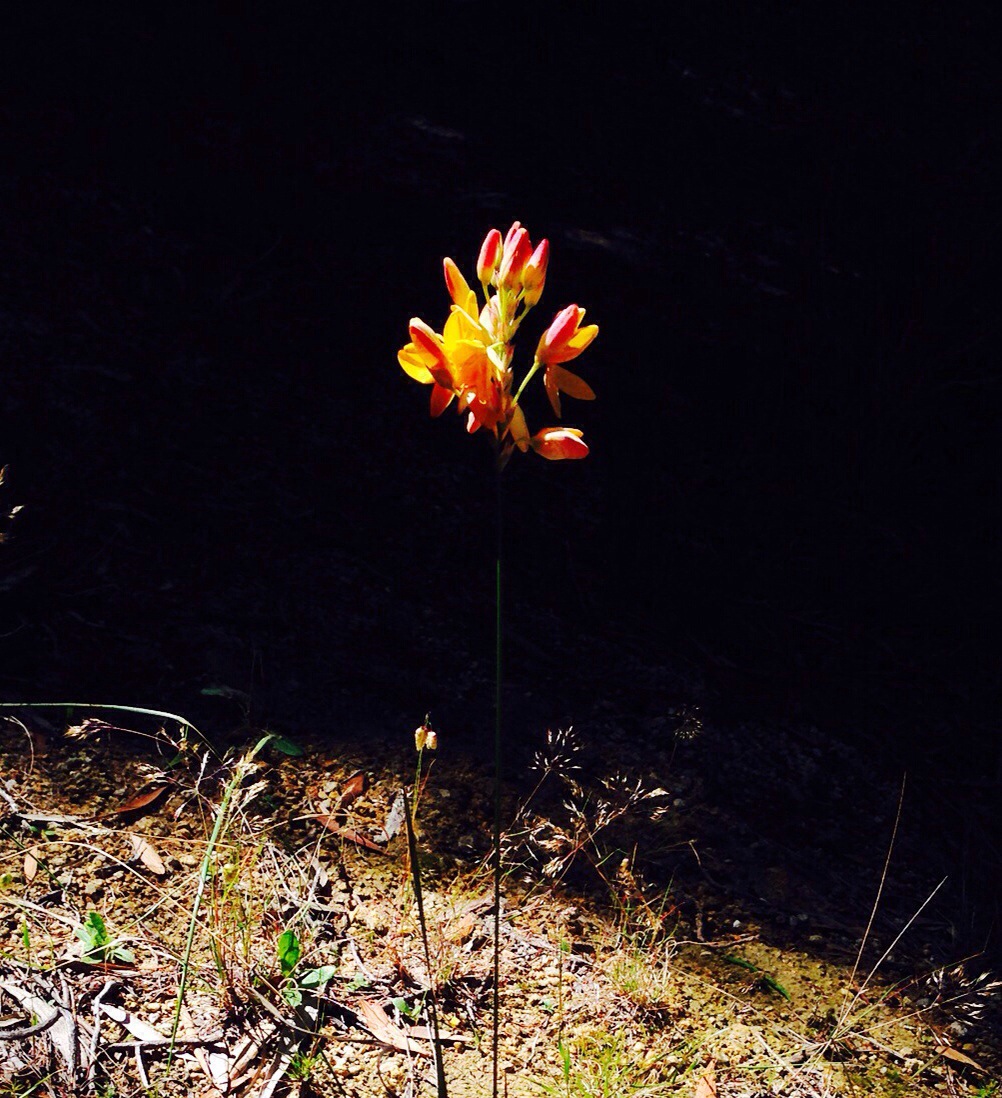
Finally a couple of flowering bulbs that I haven’t identified, one blue, one yellow.   The blue one has a twisting spike out of which the flowers grow and the yellow one grows tightly out of its stalk like a delphinium.  I haven’t been able to identify them in the general fynbos books and I really need a night in with the encyclopaedia of fynbos bulbs to see if I can identify these and a couple of others that we still have not named.  Sometimes it’s just a matter of a better photograph and all is revealed.  A good project for hot summer nights when the pressure of new flowers has eased and we will start a job of identifying and cataloging what we’ve found.

Unidentified blue flowering bulb which has a distinctive twisting flowerhead

Unidentified blue flowering bulb which has a distinctive twisting flowerhead

Unidentified yellow flowering bulb that is suddenly flowering all over the farm, particularly on damp roads

Unidentified yellow flowering bulb that is suddenly flowering all over the farm, particularly on damp roads

Summer

As spring turns into summer the intense proliferation of new flowers on the mountain is dying back and I don’t really expect to see new things as frequently. So far there has been something new on each of the 50 runs that I’ve done since I started the blog. That won’t continue when the summer sun sucks every last bit of moisture out of the ground, leaving it rock hard, dry and dusty.

Summer running has quite a different feel to winter running. The wind for a start; when it’s hot and dry the famous Cape Doctor, the southeaster, howls over the mountain, shredding all but the hardiest plants in the garden. Suddenly it is clear why so many fynbos plants have tough spikey or needlelike leaves. They need them to survive the wind and the summer drought.

We did some quick runs with no photo stops last week on a route that we run quite frequently and then on Friday morning the dogs and I decided to go for a proper blogging run to the highest point of the farm where there a shady damp road that always has something interesting to look at. When it gets hot like this we seek out the few shady groves, damp areas and streams to get a break from the relentless morning sun. Maebh as she often does, posed for the camera. Perhaps not the best ever photo of her but the colour of her coat is gorgeous in the dappled light.

20131126-084429.jpg

Just a little further on, caught in a pool of sunlight, stood this amazing flower. Although I can’t find it in the books, the slightly twisted sword like leaves tell me it is a kind of Gladioli and if I have some time I’ll hunt through the Fynbos Bulb Encyclopedia to see if any of the descriptions match this. I love this photo, the flowerhead in a pool of light against the dark shadow of the trees.

20131126-084910.jpg

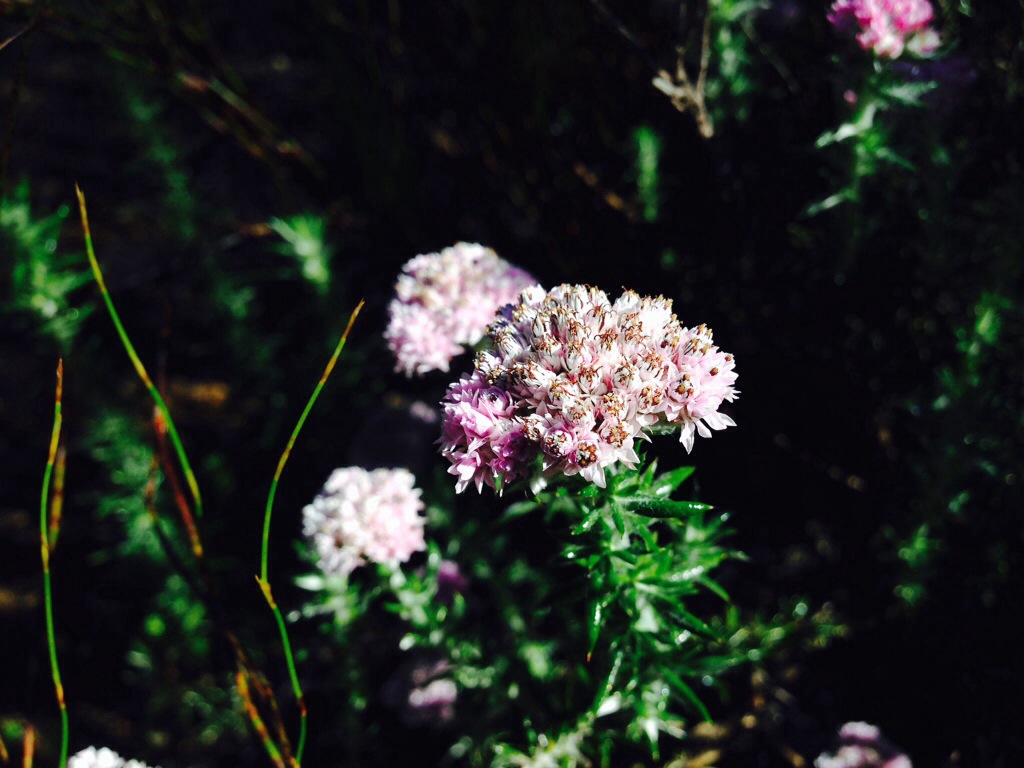
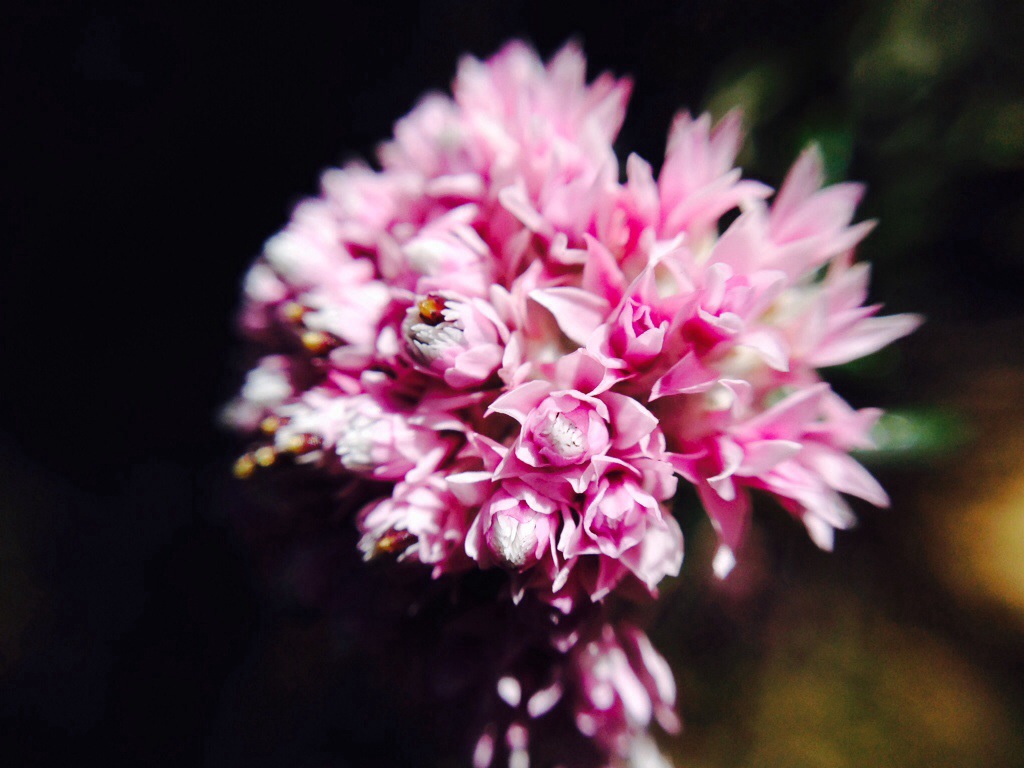
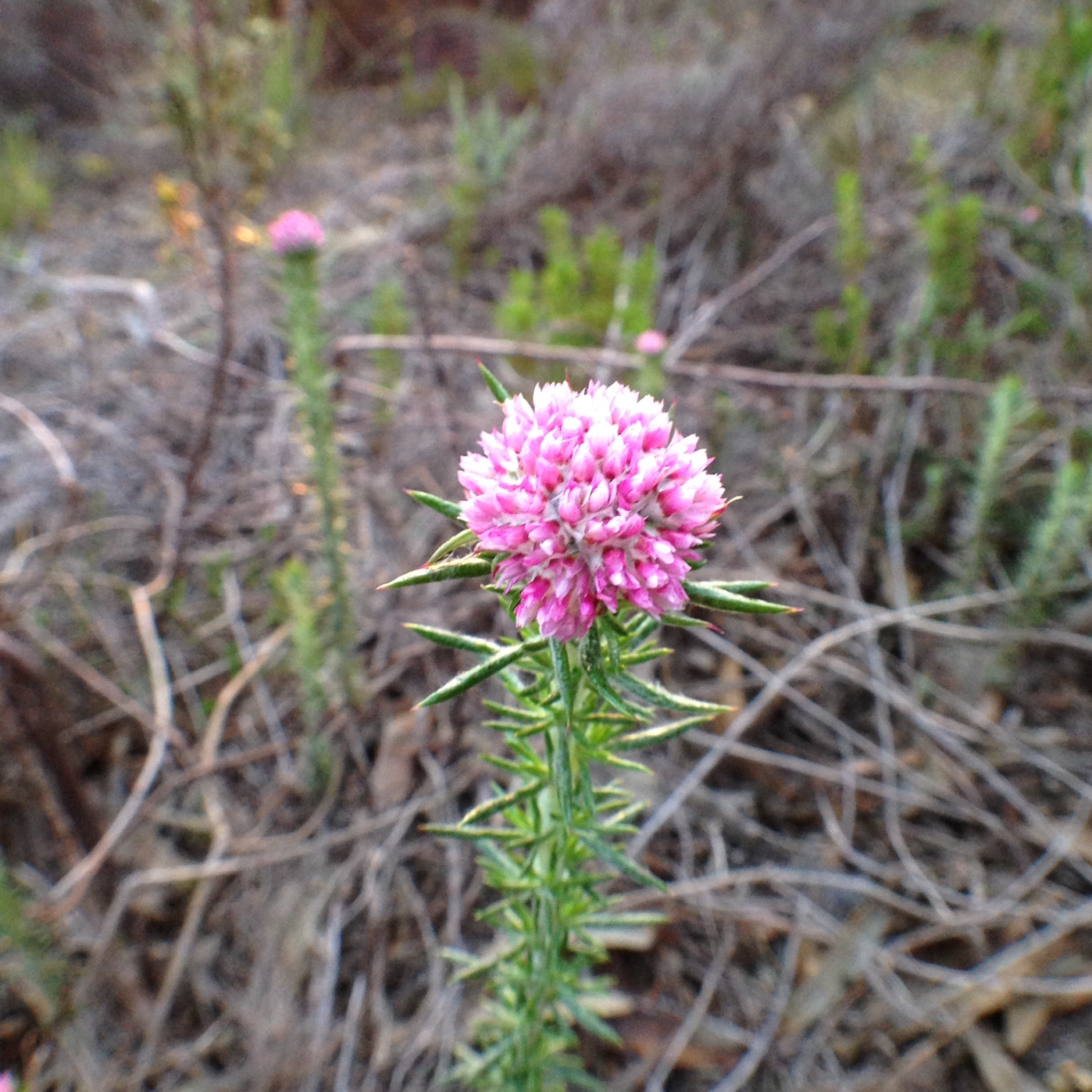
I’m never 100% sure that I have identified this flower correctly – there are 52 fynbos subspecies in the Metalasia family and the photos in the books are not great. I’ve published photos of them before and I couldn’t resist this one with its spectacular pink flower. I believe it’s Metalasia divergens.

20131126-085104.jpg

20131126-085113.jpg

A wet wet weekend

What better occupation on a rainy weekend than to go through all the flowers and spend some time researching those we haven’t yet identified. It’s been pouring with rain since yesterday morning, proper African rain causing floods and mayhem all over the province.  Minor mayhem here on the farm as Peter and I spent an hour trying to clear the weir, him in the river working on a valve that was stuck and me and the dogs providing moral support.  I can report that the new waterproofing that I applied to my raincoat works perfectly.  The dogs loved it, running in the rain, offering advice and admiration to Peter as dug and cleared the pipes and valves.

So it’s a good evening to catch up with some flowers that I haven’t identified or posted.

Like this Common Button Daisy or Cotula turbinata. It’s regarded as a weed in some places, but not on our mountain where it’s welcome to take all the space it needs.

Cotula turbinata

Cotula turbinata

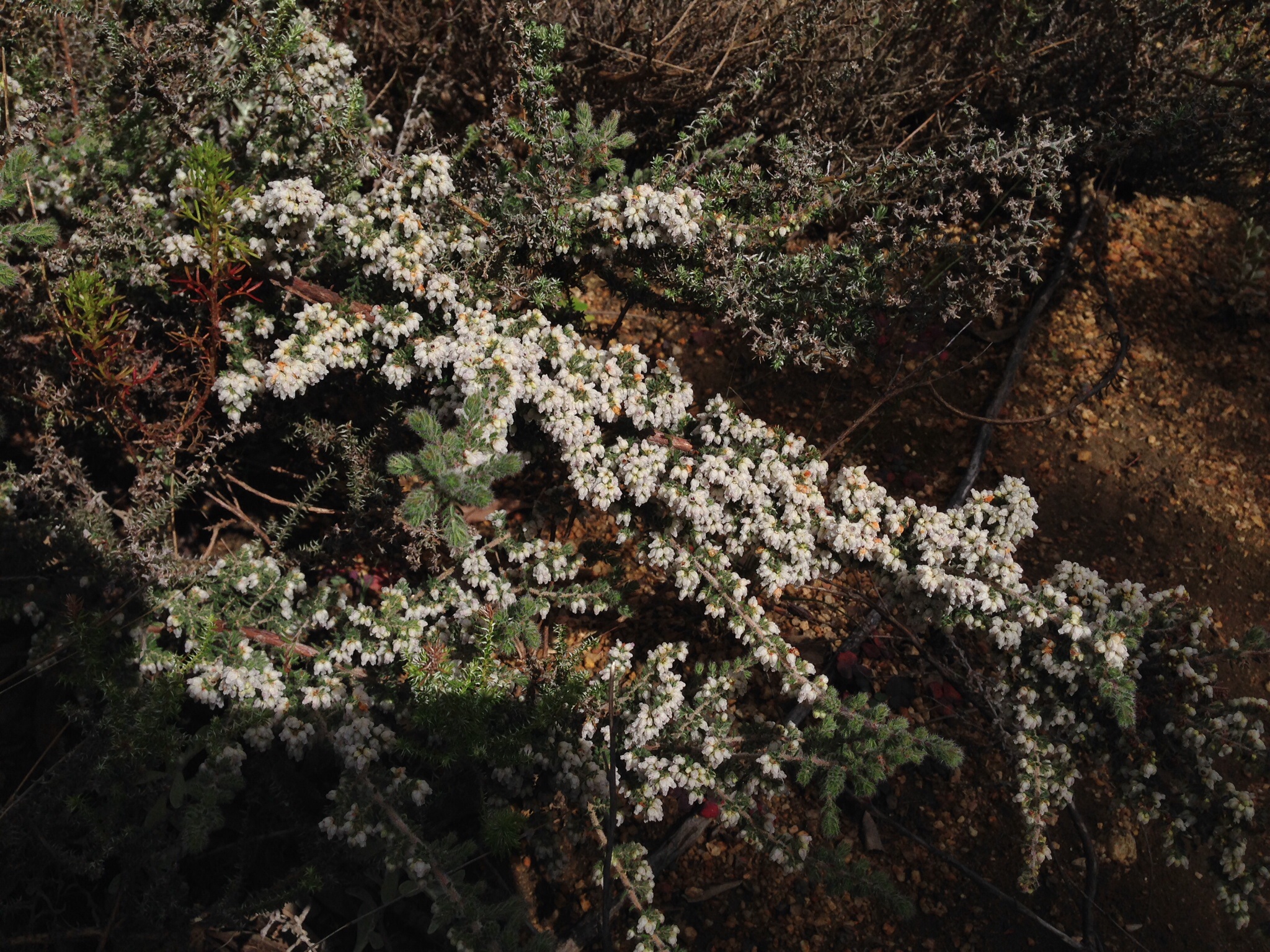
As is this spreading Erica. I have no idea which Erica it is, it rambles along the ground and can really take over in areas it likes.

Rambling white Erica

Rambling white Erica

Close up the little white flowers with their serrated edges are amazing.

Close up of the rambling white Erica

Close up of the rambling white Ericaa

Somehow I don’t think I’ve posted this Scabious columbaria yet. They are very common all over the mountain and they make great garden flowers.

Scabious columbaria

Scabious columbaria

This Common Butterfly Lily has the rather grand Latin name of Wachendorfia paniculata. It’s quite common and pops up in all sorts of places.

Wachendorfia paniculata

Wachendorfia paniculata

I always find blue flowers particularly attractive. So I was delighted to see these bright Purple Powerpuffs or Pseudoselago serrata close to the river.

Pseudoselago serrata

Pseudoselago serrata

I’m not sure I’ve correctly identified this. I think it is a Relhania as the leaves generally fit the description but this is not the subspecies that is photographed in my book.

Relhania

Relhania

This lovely blue flower is only about 10mm in size and it is another common, delicate flower found all over the farm. It is Lobelia pubescens.

Lobelia pubescens

Lobelia pubescens

I posted this shrub in the last blog, promising to identify it in the next one. It is Passerina corymbosa. It grows on disturbed ground, such as roadsides right acoss the Western and Eastern Cape. A little scruffy in appearance, and with flowers that can be either red or white. They are exquisite when photographed in close up.

Passerina corymbosa

Passerina corymbosa

This is a Roepera though I’m not quite sure which one as it most resembles Roepera flexuosa which is costal. Either its lost, or its a subspecies not included in my books. No doubt about the species though, the curled back yellow petals with red-brown splashes at the base and the oval leaves are all quite distinctive.

Roepera subspecies uncertain

Roepera subspecies uncertain

These lovely little flowering bulbs are called Ornithogalum dubium and they have suddenly emerged on the road that leads to the waterfall. It’s particularly satisfying when we find new colonies of lovely flowers in areas where we have cleared alien vegetation, as is the case here.

Ornithogalum dubium

Ornithogalum dubiumm

This however  I can’t identify – it is tiny fragile and shortliived.

image

This is another flower I can’t identify, though I’m pretty sure it’s a Selago of which there are over 100 subspecies and they do grow at the top of stems covered in spiky leaves, sometimes with very pretty flowers, as here.

Selago?

Selago?

Finally I’ve posted this a couple of times, unidentified. But now I suspect it is Aspalathus cephalotes, or possibly Aspalathus nigra. More likely the former as we see them in pink as well as blue.

Aspalanthes cephalotes

Aspalanthes cephalotes

Fire on the Mountain

In South Africa people rise early, so a call at 7 am is not necessarily worrying. Peters kids get up early to avoid the Johannesburg traffic and often call at that time for a chat. Anything earlier than that signals trouble, so when the phone started forth with ‘Gangnam Style’ (yes, that really is my ringtone) at 6.15 on Saturday morning I jumped out of bed to get it, knowing the news wasnt going to be good.

It was our neighbour and she was clearly concerned. A fire on the mountain, right by their house. We leaped into action – Peter quickly got dressed while I equally quickly manned the phone and made him a coffee to take with him. He’d call the local fire marshal, get down there, assess the situation, and they’d decide how much support was needed to get this under control quickly.

We have terrible fires here on the mountains, last year one burned all the way from Franschhoek to the N1, which must be over 20 kilometres. They go far further than that when they are out of control and the wind is high. But we’ve had a very wet winter and the past few days have brought the first southeaster of the season, a howling wind that comes with the dry spring weather and frays all our nerves.

We predicted this fire a few days ago. Another neighbour was burning in his lands and he didn’t seem to have taken care to put out the smoldering embers. “There’s going to be a fire” said Peter on Wednesday evening as we drove down the mountain on our way to dinner. Sure enough….

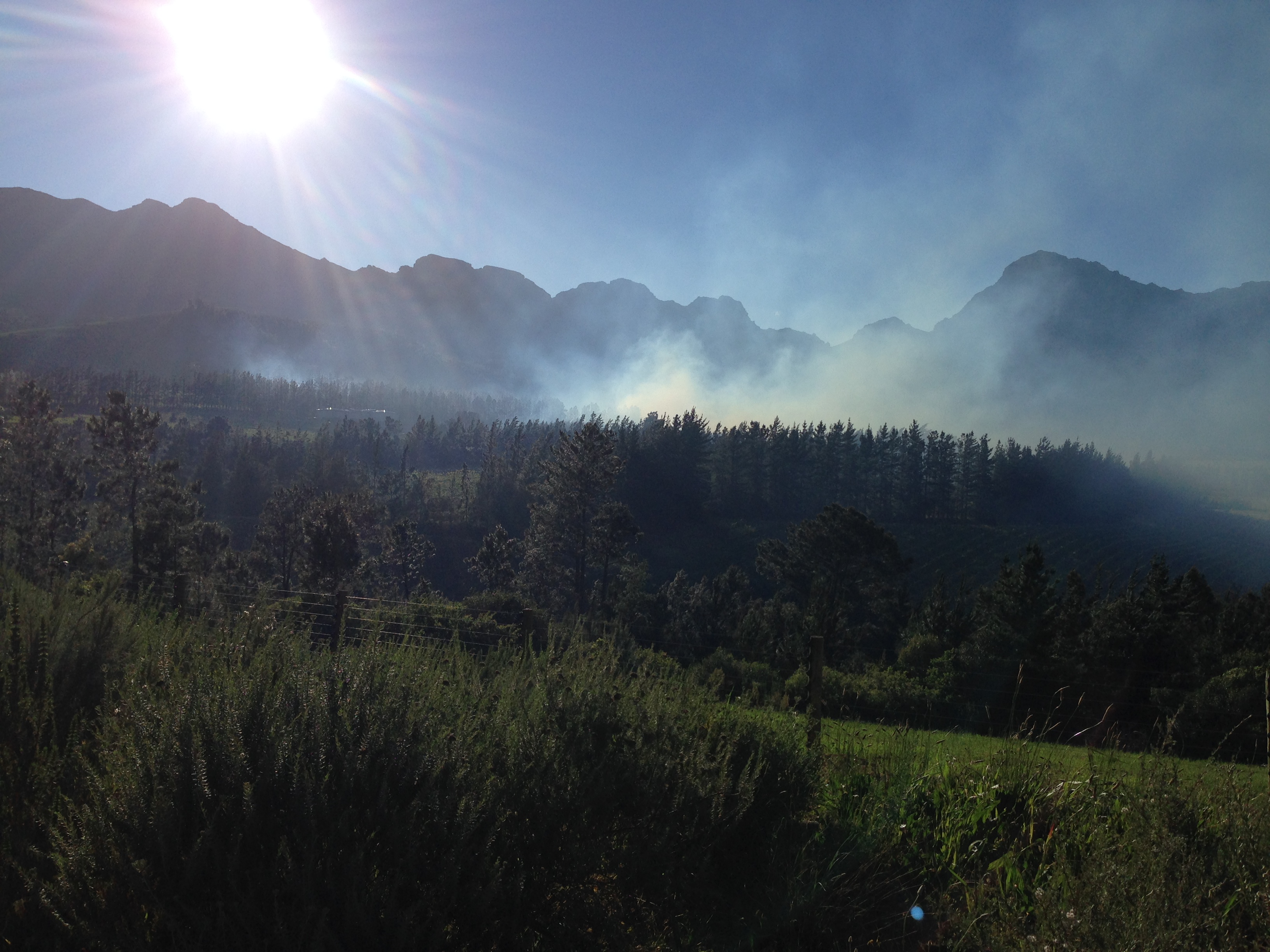
This was not a particularly dangerous fire. Frightening when it’s close to your house, but with the ground and the undergrowth still cold and wet, it was never going to be the frightening inferno we’d see later in the season. By mid-morning it was under control. Still, a good warning and we are very diligent about clearing potential fuel and firebreaks on the farm. In the season, January and February, we are on high alert. 

Fire on a neighbours farm just below us.

Fire on a neighbours farm just below us.


Today was altogether calmer. I went for an early run with the dogs and then we had some friends who came to lunch and were very keen to see the flowers. As ever plenty of new sightings emerged. Rather frustratingly I am writing this on a plane (London this time) and have left my books behind. So here are some pictures of new flowers, taken in case they are no longer flowering when I get back and I will do the research when I get home in a few days time and repost with some names.
 

This beautiful flowering bulb is all over the farm.  It must be common but I cannot find it in the books.

Blue flowering bulb

Blue flowering bulb

This kind of flower emerges in summer.  Lots of fynbos have these short spikey stems covered in leaves and a single flower on the tip.  We’ll see lots more and identify as many as we can.

Pink flowering shrub

Pink flowering shrub

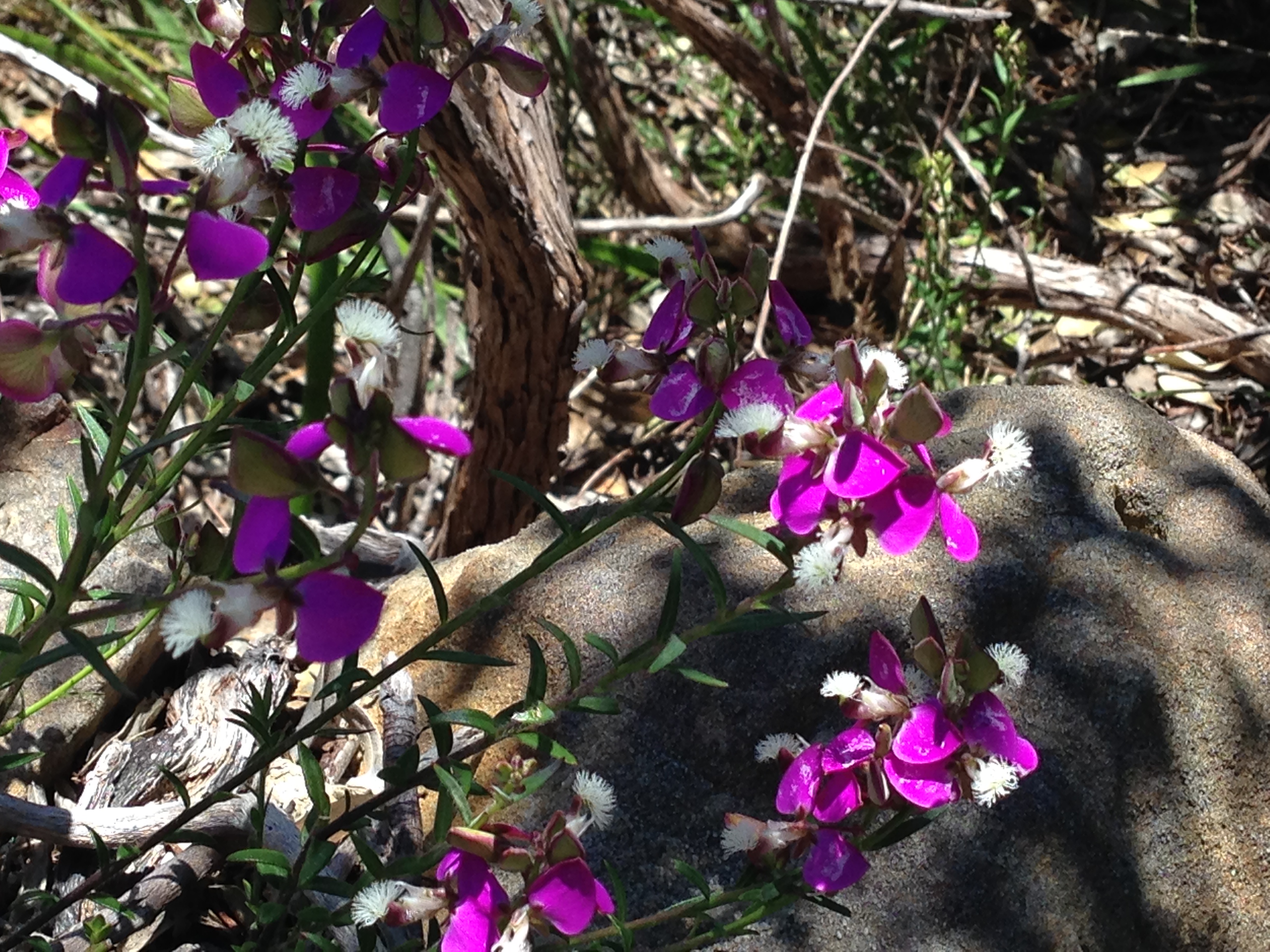
Polygala is identified by the fluffy bits on the flowers and this creeping plants is everywhere at the moment.

Polygala

Polygala

Maebh resting under the shade of a protea tree

Maebh resting under the shade of a protea tree

I’ve never seen a wild Aloe on the moutain before and this is growing in the area along the river where we’ve cleared huge amounts of alien vegation.

Aloe on the moutain

Aloe on the moutain

Another of these flowers on the end of a prickley spike.  Quite distinctive so I have hopes of identifying it.

Blue unidentified flower

Blue unidentified flower

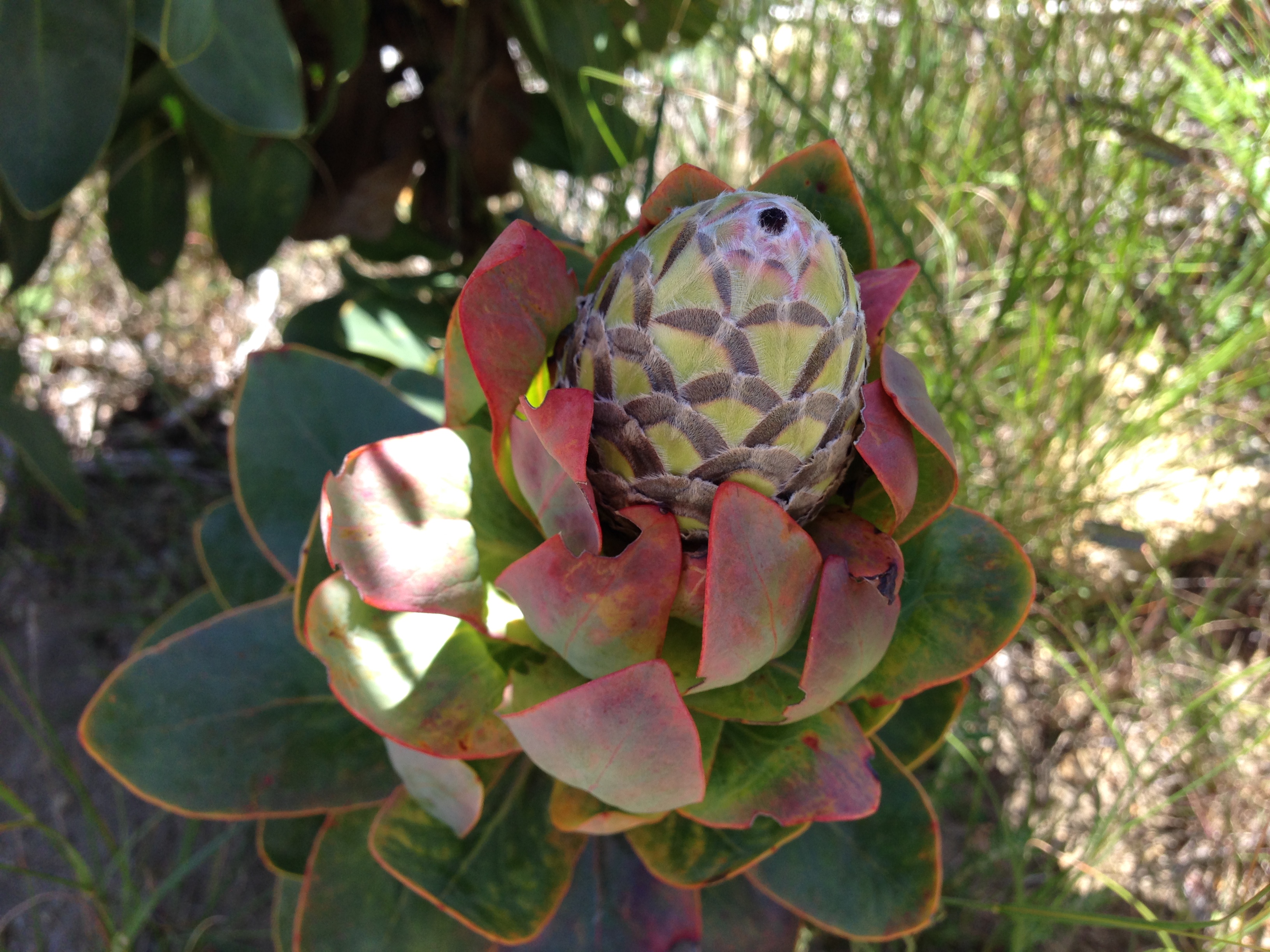
This stunning Protea bud is almost architectural.

Protea flower in Bud

Protea flower in Bud

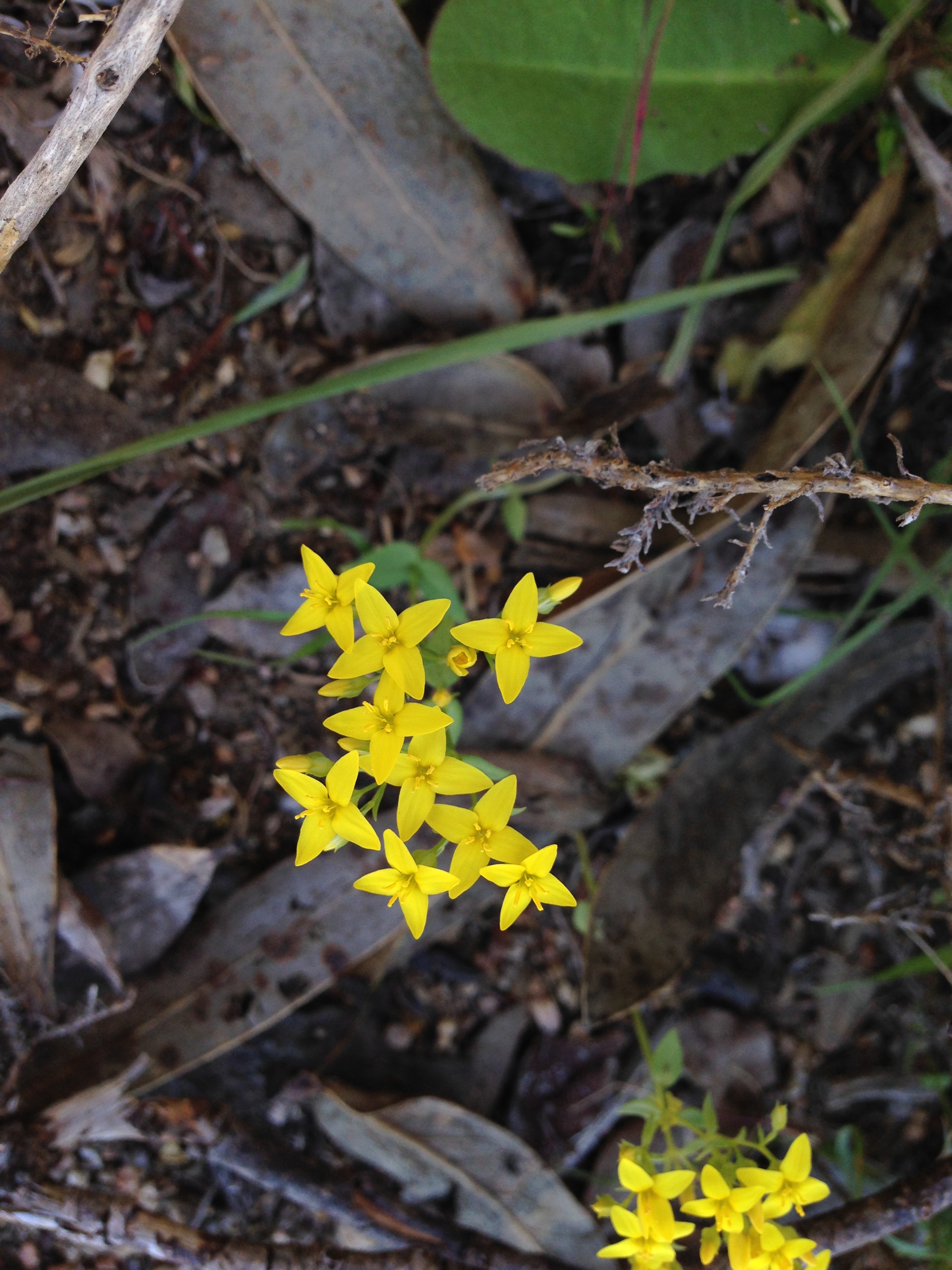
Tiny yellow stars appear everywhere.

Tiny yellow flowers

Tiny yellow flowers

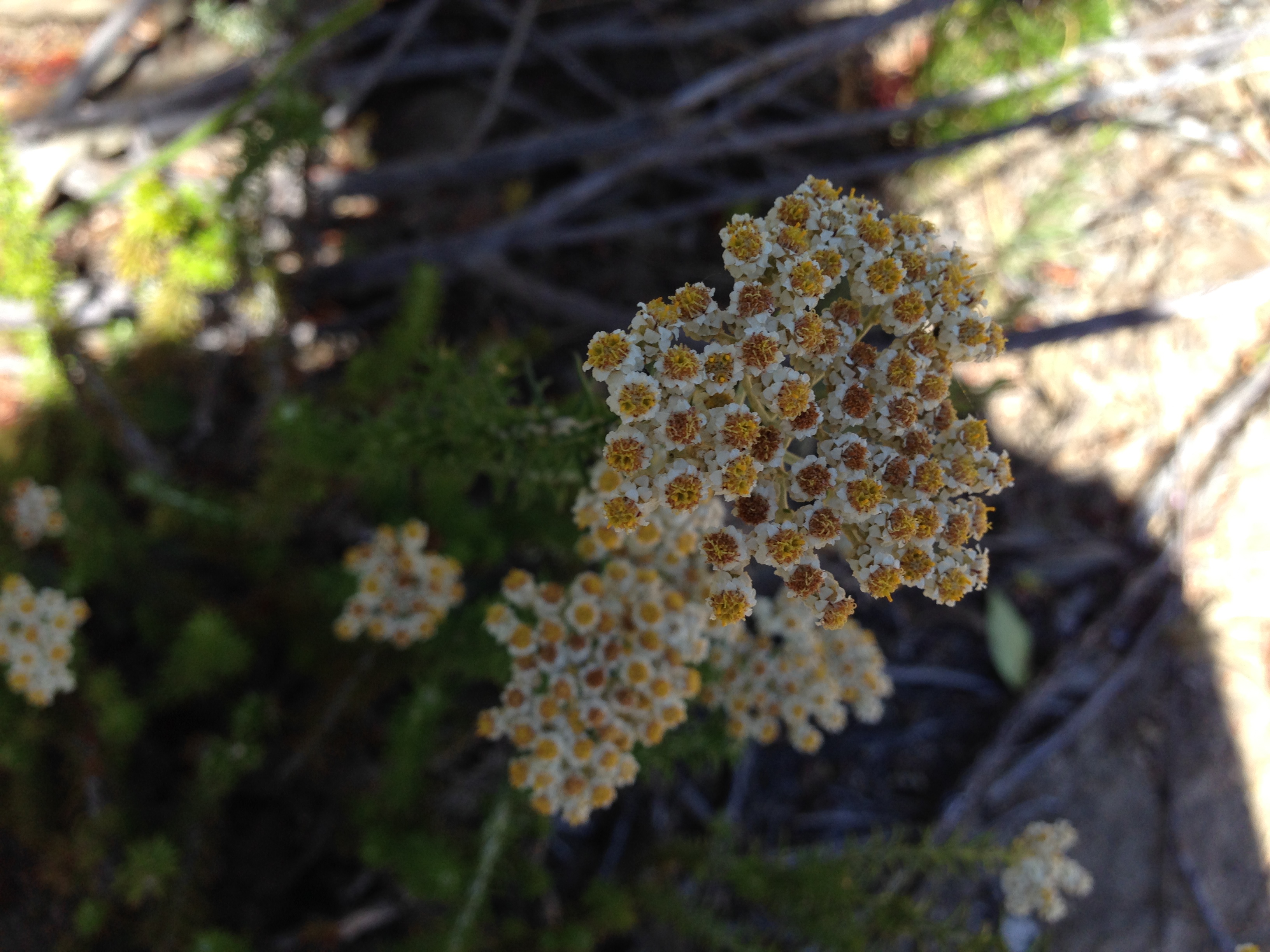
These clusters are also found in several different areas.  I had to use myself as a shadow to capture them in the bright sunlight.

Clusters of yellow and white flowers

Clusters of yellow and white flowers


Lilies and peacocks: prolific flowering on the mountain

When you wake up morning after morning and the first thing you hear is the thudding of rain on the zinc roof it is not really conducive to getting out on the farm to run and photograph flowers. Even the dogs stand at the doorway and barely want to get their feet wet.

The weather finally improved on Sunday and late in the day we finally got out onto the mountain. There is so much out there, the rain has made flowering prolific and the frustration is that we must have missed so many flowers that have had their brief moment of glory and disappeared.

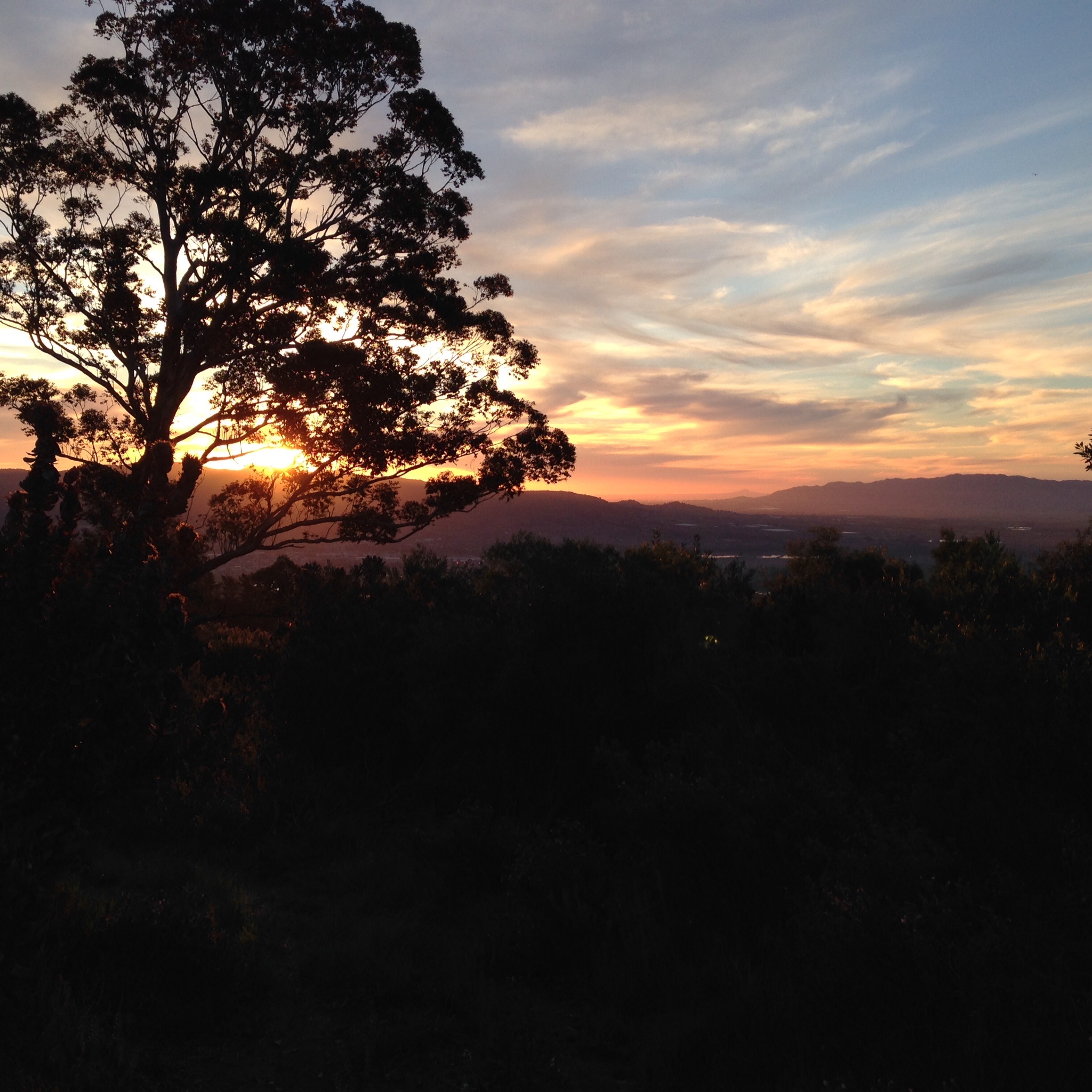
There is something about this mountain at the end of the day, as the light fades to the east and the last glow of sunlight flares in a spectacular display of light and colour. There is one huge tree, a bluegum or Eucalyptus that stands in splendid isolation high on the mountain. An alien, it doesn’t belong here and I cannot imagine how it came to survive so high; it must have found a spot where it is slightly sheltered from the howling winds. This evening it made a frame for the setting sun.

image

As we descended I caught this shot of the mountains behind us caught in spectacular orange.

image

Before us the sun was just about to go down behind Paarl mountain and you can see the mist gathering over the Berg River at the bottom of the valley.

image

The light was perfect as we ran up the mountain and captured flowers. There are many that flower like this, at the top of a spike of needle or threadlike leaves and this is a lovely one that we found right at the top of the farm. I couldn’t find it in the book and generally these are hard to identify.

Unidentified spike

Unidentified spike

Another beautiful spikey thing is this white one. Again I haven’t identified it yet – it’s gone into the unidentified folder for when I have some more books and helps.

White spikes unidentified

White spikes unidentified

While on the theme of unidentified shrubs, here’s another one. In one damp and quite shady place there are lots of these, little shrubs covered in white flowers, pretty enough to be cultivated in any garden. And indeed they probably are – so if any reader knows what they are please do let me know.

White flowering shrub

White flowering shrub

The waterfall is pounding away and my theory that at some point it will be flooded with evening sunshine seems likely to come true as the sun needs to be just a little higher and a little further to the south and the whole fall will be lit up for a few weeks.

image

I had a lot more luck identifying the flowering bulbs and there are lots of them. Just behind the house the bank is full of these brilliant blue flowers, Geissorhiza aspera.

Geissorhiza aspera

Geissorhiza aspera

And just above it the bank and many roads on the farm are littered with these white stars. I think it might be Strumaria spiralis but I do need to check as the identification is not 100 % confirmed.

Identity uncertain

Identity uncertain

I am completely sure of this one however. It is Baeometra uniflora, known as the Beetle Lily and there are plenty of them in damp areas at the top of the farm.

Baeometra uniflora - the Beetle LIly

Baeometra uniflora – the Beetle LIly

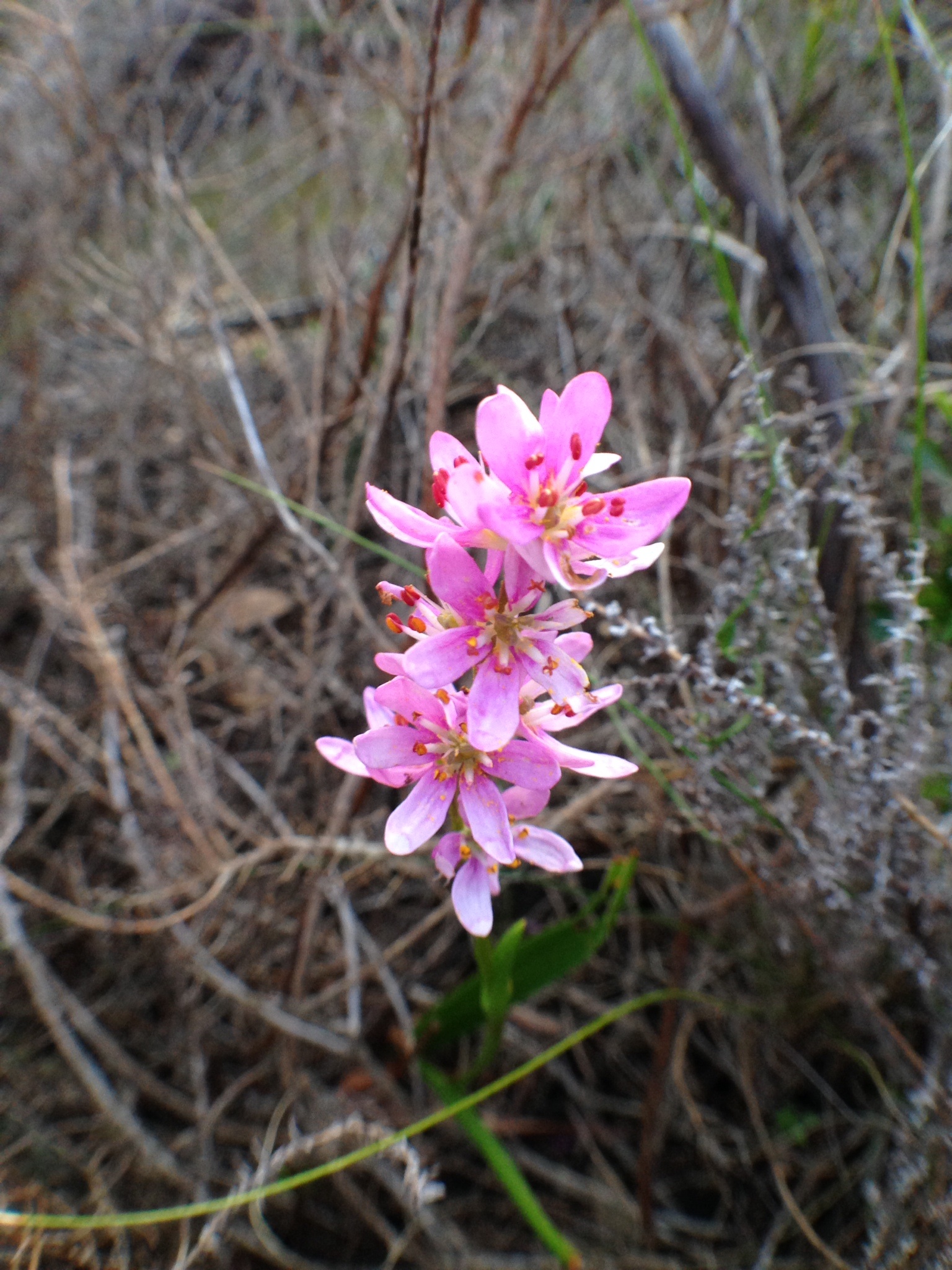
This was a busy run, a lot of flowers needing recording and worrying about more weather to come, and a lot more flowers, I wanted to be sure we’d capture them. One I saw during a quick morning run in the week, in between the showers, is this lovely little pink spike and I was worried that it might have disappeared by the time I got back to that part of the farm again with good light and time to do a long run. But no, here it is and it is known as a Spike Lily, Wurmbea punctata. I love it when we get a really clear identification of something new and there is no doubt about this one.

Wurmbea punctata - the Spike Lily

Wurmbea punctata – the Spike Lily

Another absolutely unmistakable flower and always a treat when they appear, as if out of nowhere, is the lovely Spiloxene Capensis, one of the Cape stars and known as the Peacock flower. We were rewarded by this sight at the very top of yesterday’s climb and before the light abandoned us.

Spiloxene capensis - the Peacock flower

Spiloxene capensis – the Peacock flower

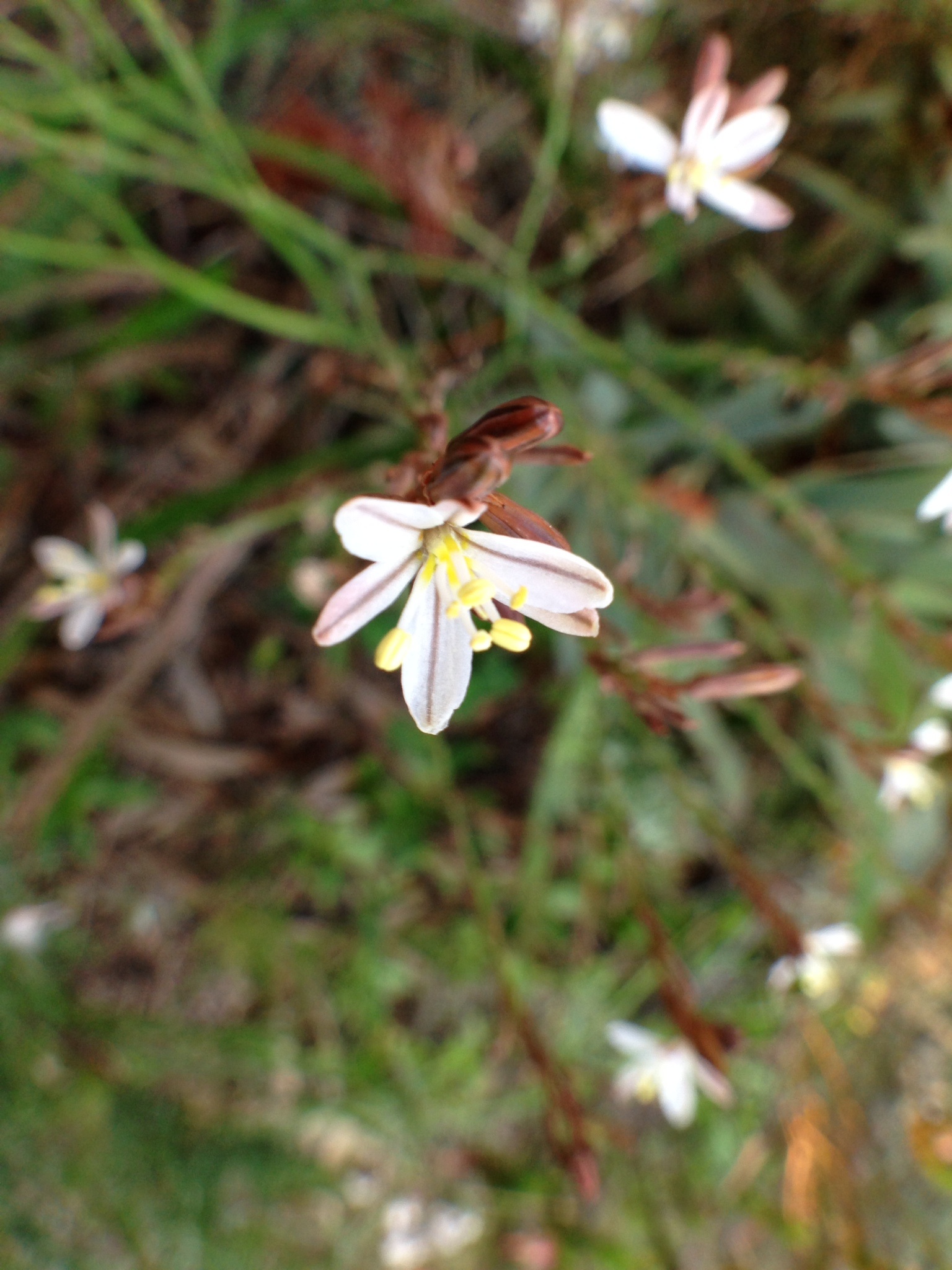
This was much harder to identify and I think it must be the Grass Lily, Chlorophytum rigidum perhaps? It has a very localised habitat and this is exactly the right area. But the picture in the book isn’t great so I would be happy to be corrected.

Chlorophytum rigidum?

Chlorophytum rigidum?

« Older Entries Recent Entries »