Tag Archives: the fynbos blog

A spring weekend

I have been away too much over the past few weeks and am overjoyed to be back on the farm for a few weeks before I have to do any serious travel again. The last post talked about the Bulbinia fragens, the harbinger of spring. Spring here does not arrive over many weeks as it does in Europe. Within one unseasonably warm week I have returned to find the farm full of new flowers. This is building up to the height of the flowering season for Fynbos and the next few months are going to see an explosion of life. I’m already struggling to keep up – this blog will be quite long and I’ll be trying to keep regular posts so that we capture as much as possible of what’s happening on the mountain.

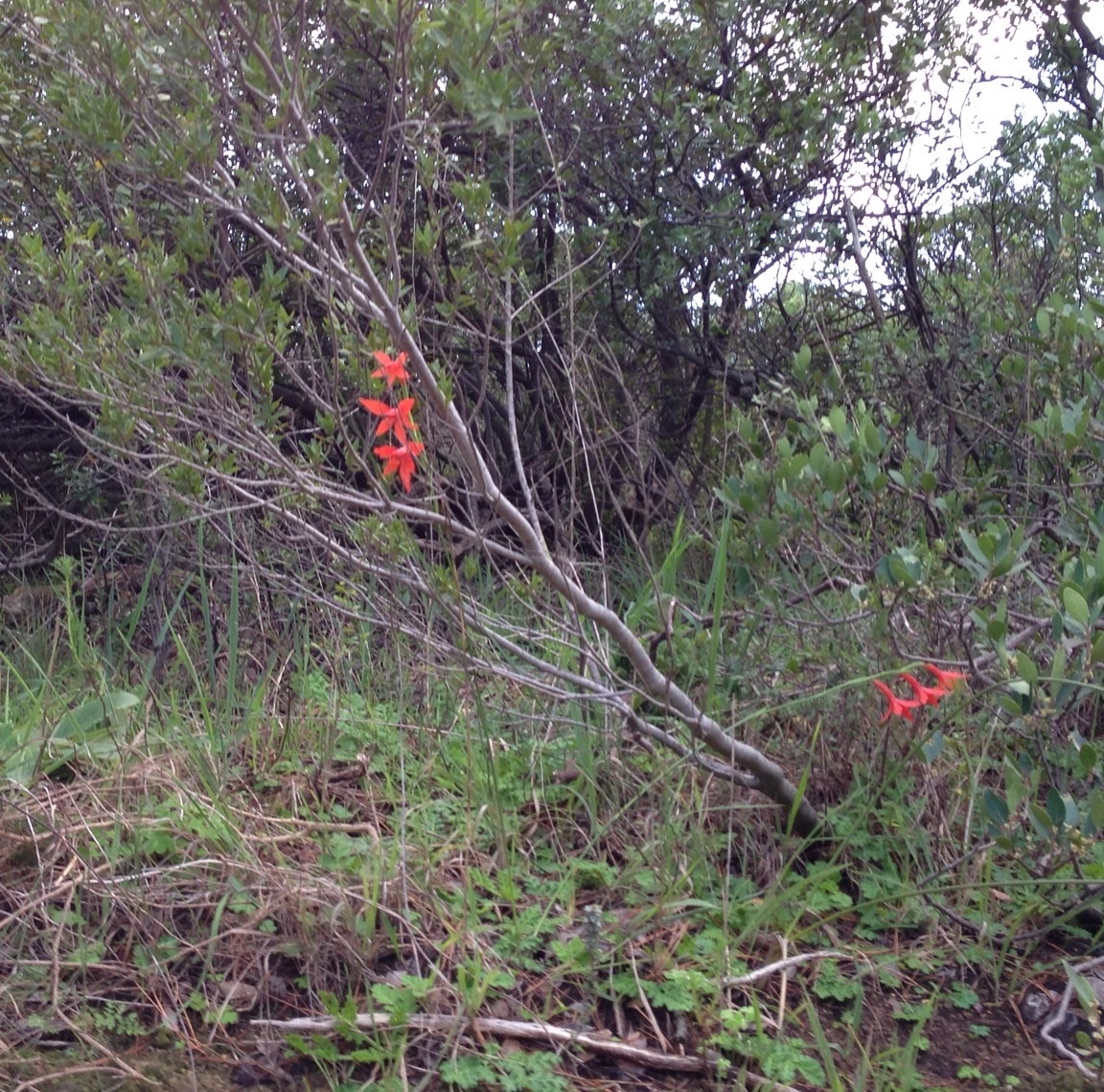
I’ve been looking out for this flower – it’s a dear friend, one of the first that made me realise the special nature of our fynbos bulbs. This photo is quite deceptive as this is a tiny iris-like flower – each petal not much bigger than my fingernail. This is Moraea tripelata and it has started to flower all over the farm. I spotted it first thing when I went running with the dogs on Saturday morning.

Moraea tripetala

Moraea tripetala

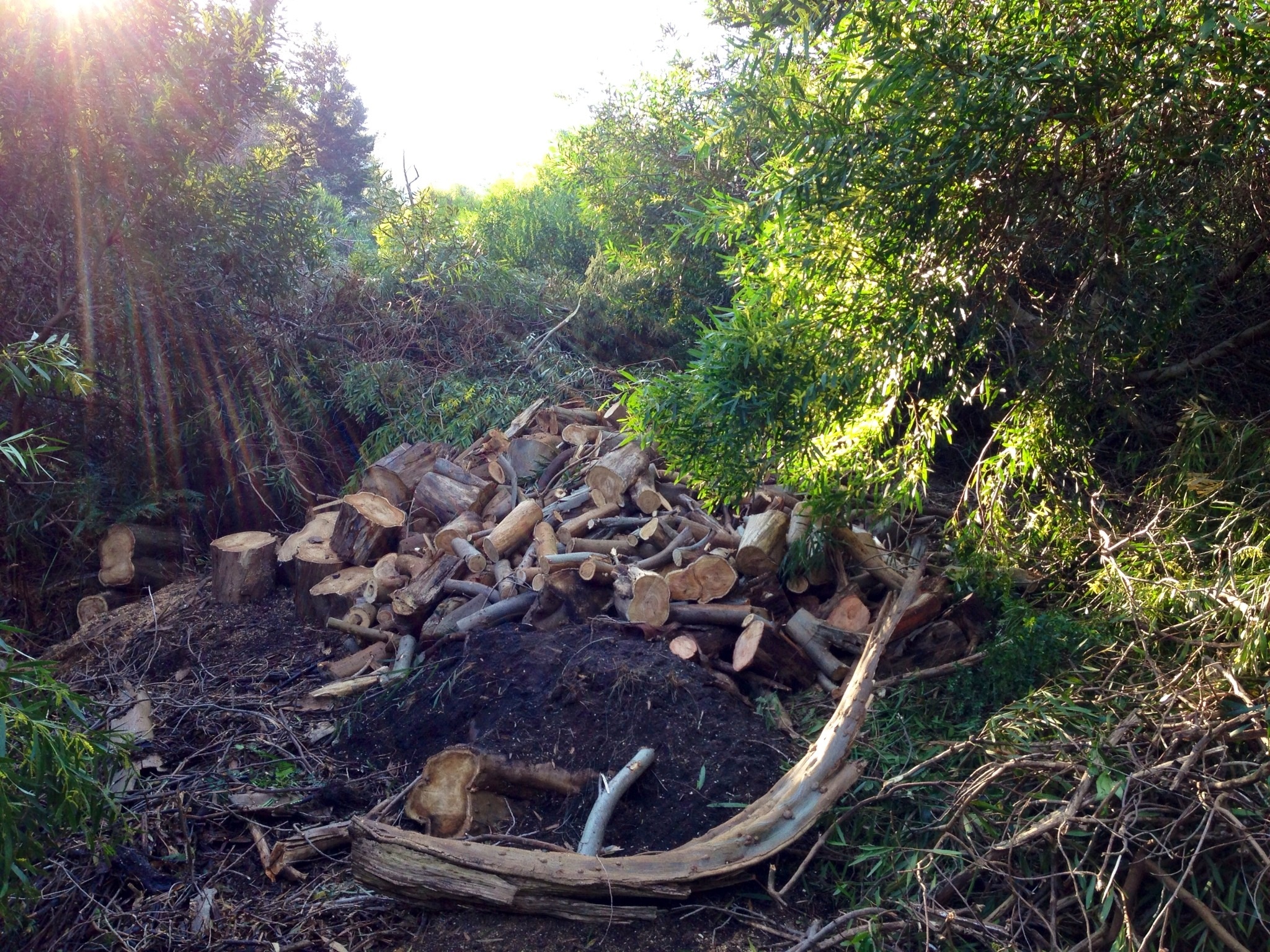
Peter then took us up to see the work he’s been doing clearing alien vegetation, especially the Port Jackson trees that choke the river. Every winter when the planting on the farm is done he attached this for a few weeks. Two winters ago we cleared around the waterfall and what was a chocked up watercourse that you couldn’t see is now full of vibrant fynbos life. He has just opened up this area, so dense with trees that you couldn’t get into it and has found the spot where the two rivers that run through the farm meet, before tumbling down the mountain to add their waters to the mighty Berg River that runs through the Paarl valley below us.
Clearing alien trees along the river

Clearing alien trees along the river

The place where the two rivers meet

The place where the two rivers meet

In the late afternoon I took some guests on our first “Flower safari” of the year. All we did was walk down the front drive and we were enchanted with the profusion of flowers we came across, many old friends that we have posted before, and quite a few new ones.

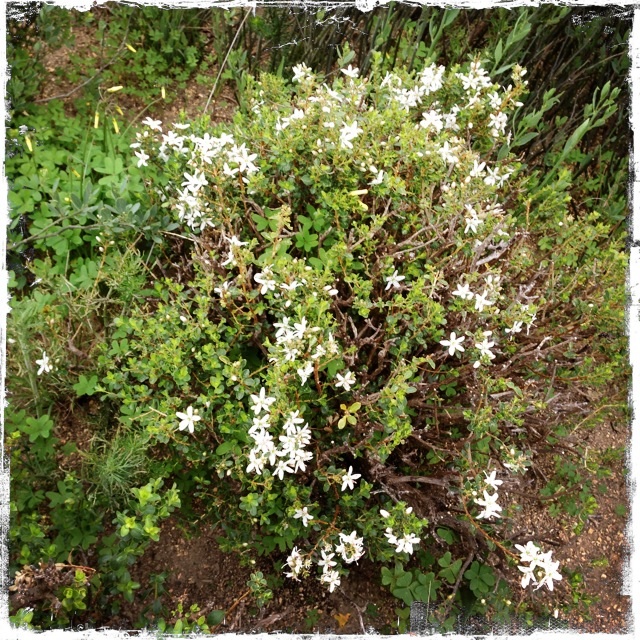
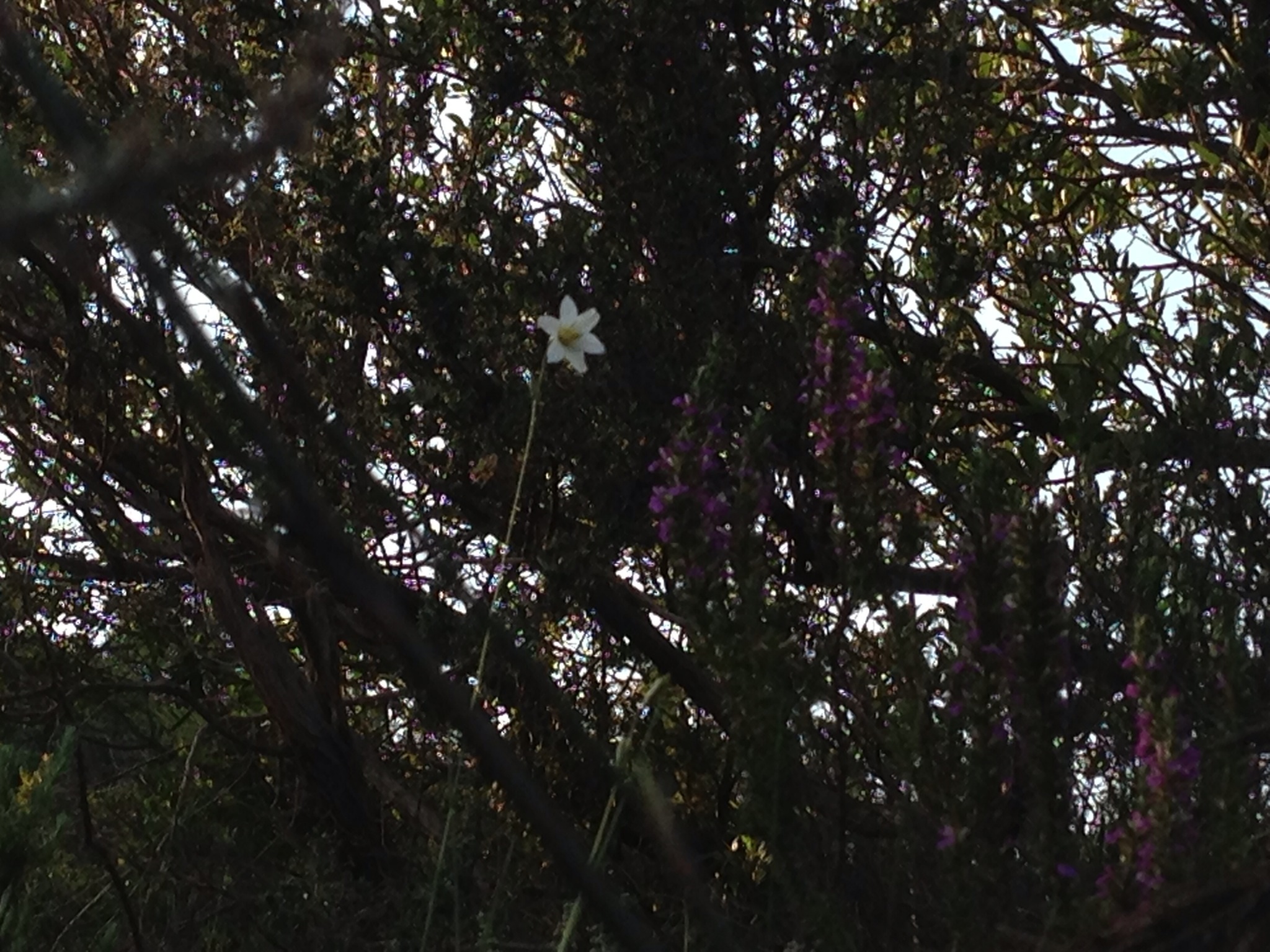
First of all we came across this tiny white gladiolus. I first saw it at the top of the bank, which gives an idea of scale.
Unknown gladiolus

Unknown gladiolus

Then I realised they are growing along the side of the road. I cannot find this one in my book at all – not even in the bulb encyclopedia. I’ve done this before, failed to identify a flower and then realised I’m not looking properly at the description, so if I do realise what it is, I’ll post it. It is quite enchanting, with a delicate fragrance, like so many of the gladioli.

Gladiolus unidentified

Gladiolus unidentified

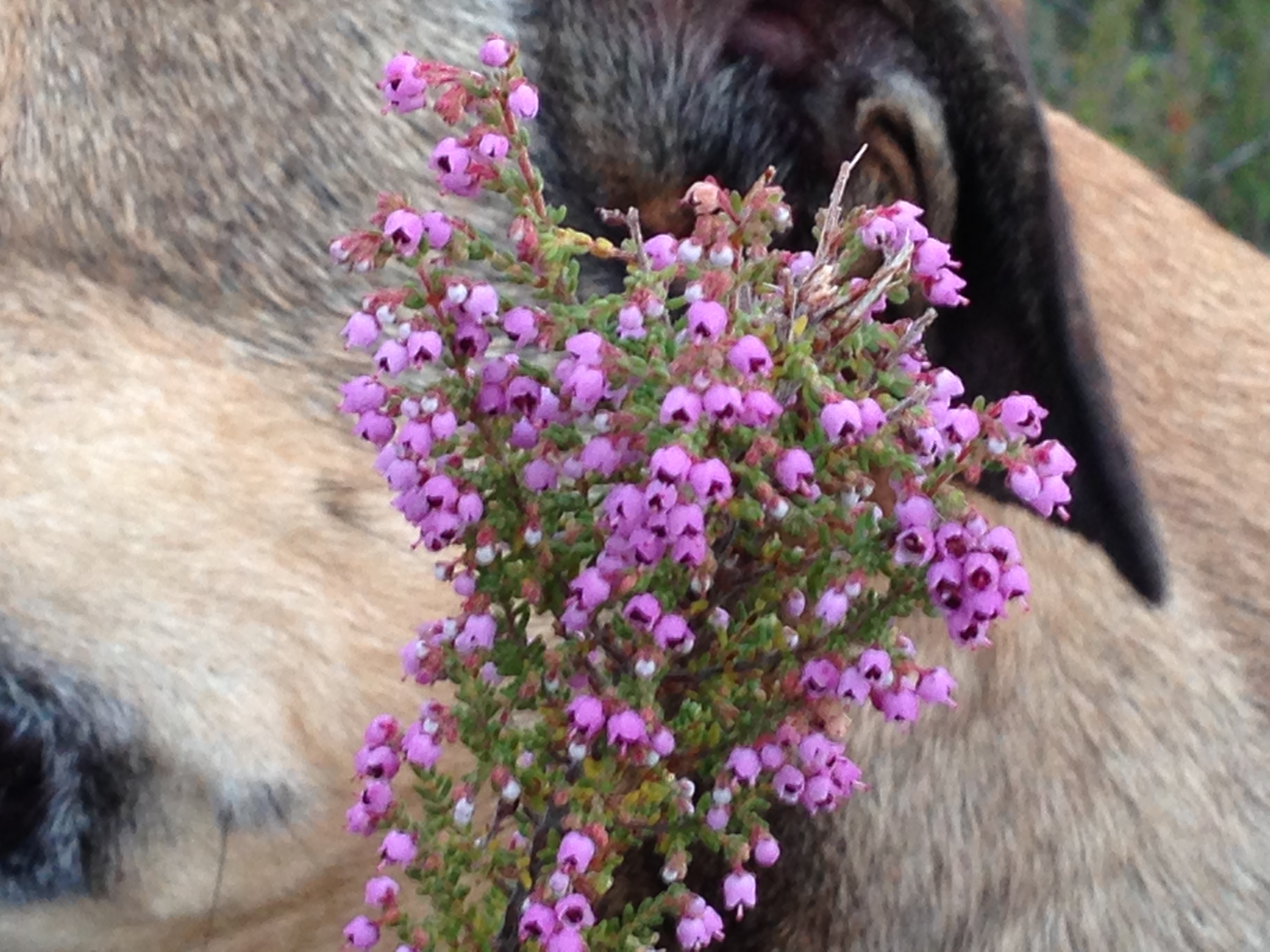
Then we came across another example of the bell like pink Erica that I posted last week, this time a lot closer to home.

Erica with pink bells

Erica with pink bells

There are masses of these on the drive, and masses of what I guess to be Erica daphniflora, in colours of green, white, red and a particularly vibrant pink.

Erica, probably daphniflora

Erica, probably daphniflora

Erica, probably daphniflora

Erica, probably daphniflora

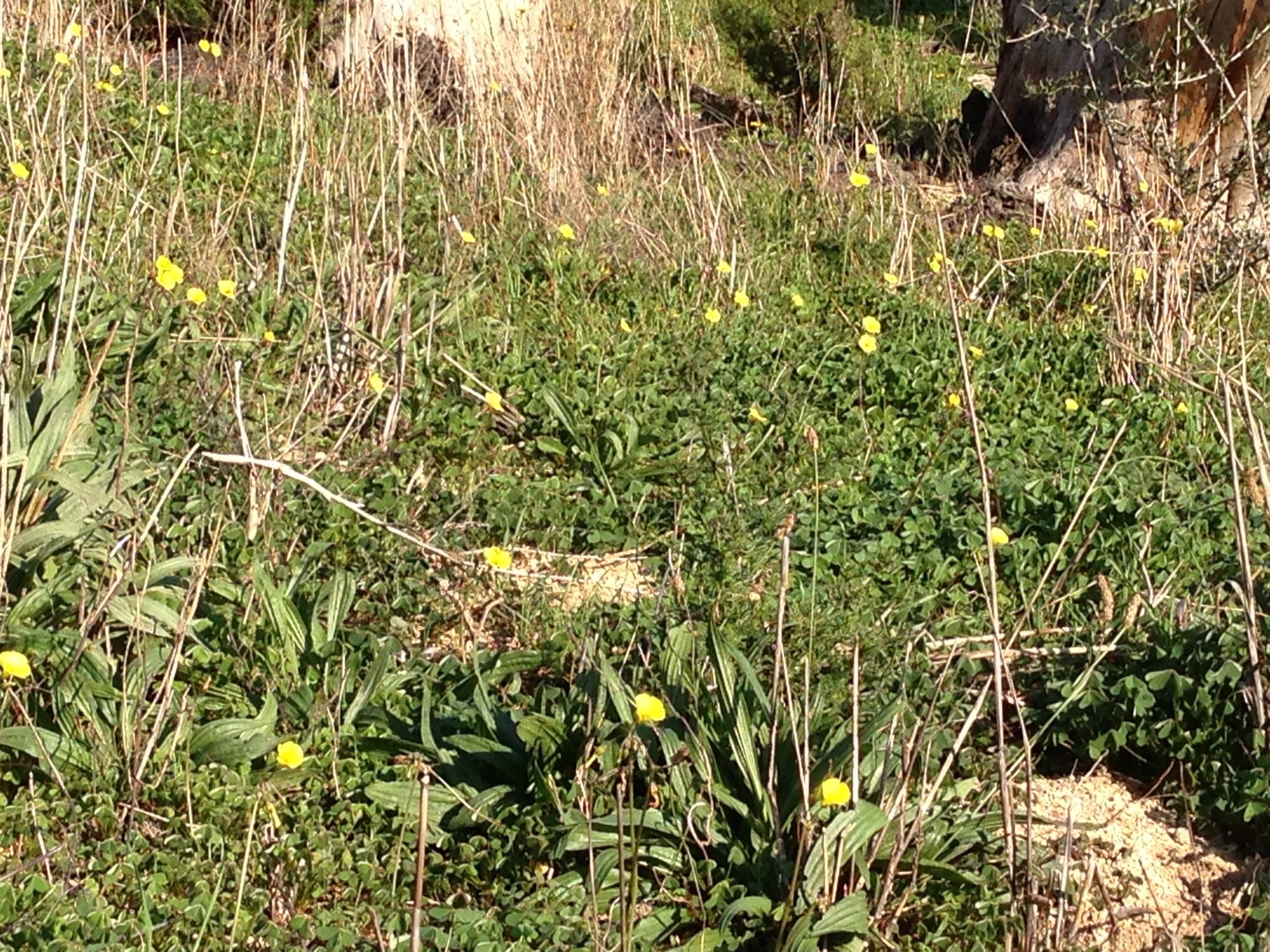
The Oxalis are still flowering away, these ones in white and pink profuse along the bank and the lands still covered in the yellow ones.

Oxalis

Oxalis

The next new find was this Erica – you can see it’s quite distinctive in the way it grow and flowers and the little white bells have the brown anthers exposed at the end. This was very attractive in the late evening light.

Erica, unidentified

Erica, unidentified

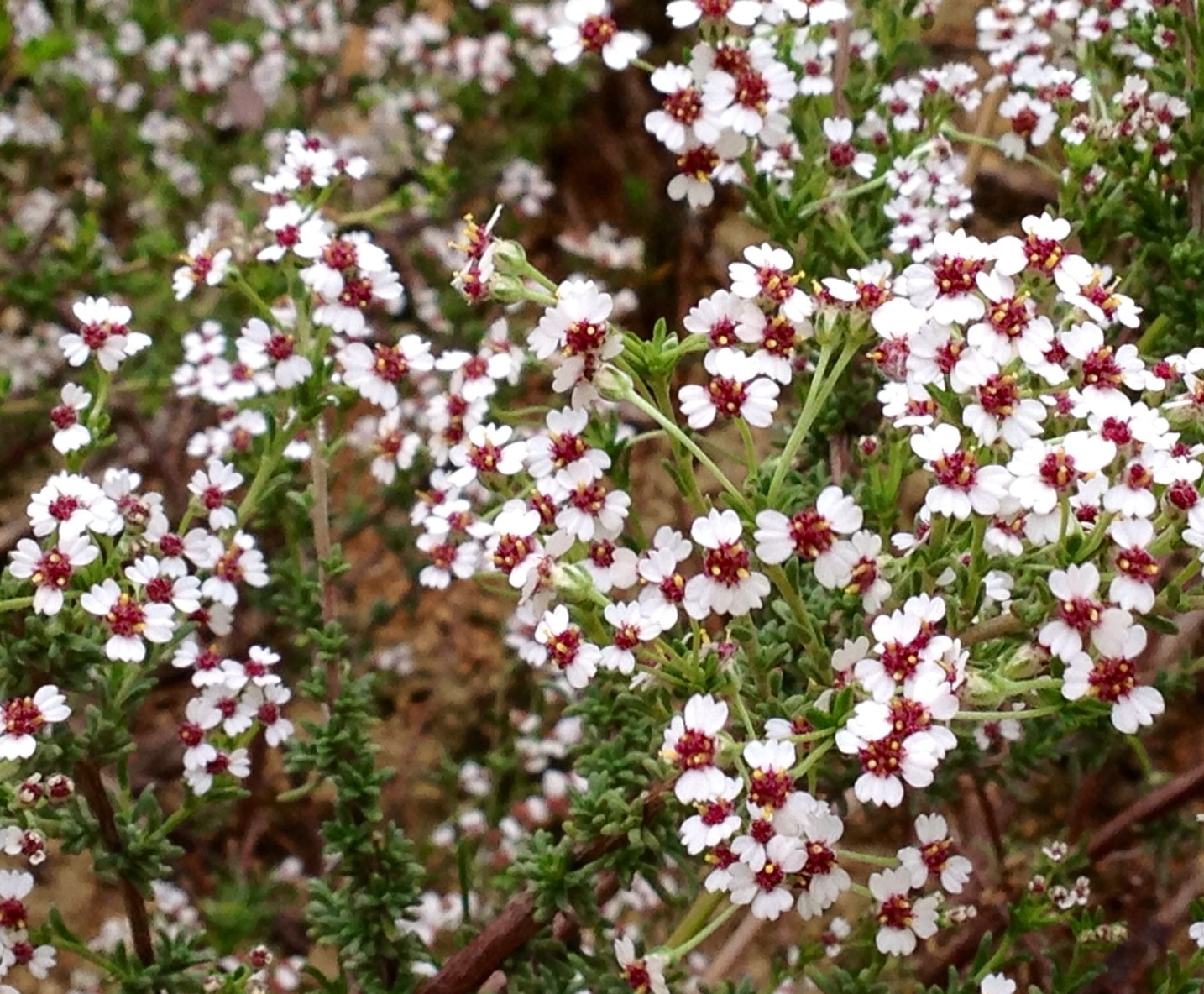
Another new find is this flowering shrub which is common all over the farm. I have always assumed it to be Cape Confetti, but with my evolving botannical eye I think it is more likely to be Adenandra villas, possily . I’m sure I will have many more occassions to photograph this stunning shrub.

Cape confetti - coleonem album or adenandra villas?

Cape confetti – coleonem album or adenandra villas?

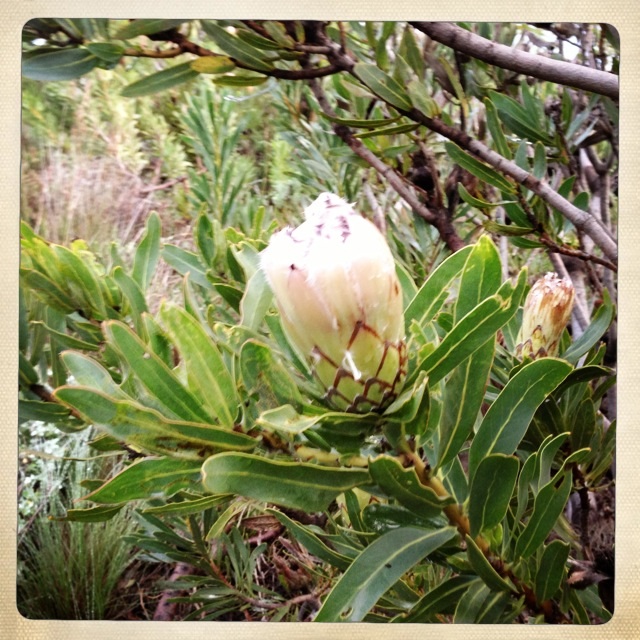
As I was showing our guests one of the Protea nerifolias along the road we saw this little bud. We were delighted as it means these glorious proteas are going to continue to flower for some time.

The bud of a Protea nerifolia

The bud of a Protea nerifolia

The Felicia is such a wonderful flower. This is the first one I have seen this year and it will flower from now until the summer, along with the Lobostemum it is one of our commonest shrubs. That makes the first sighting of these pretty lilac flowers with their yellow centres no less exciting, both for their own sake and the promise of more spring flowers to come.

Felicia filifolia

Felicia filifolia

This warm weather won’t be with us for long, with temperatures expected to plummet during the week. Luckily up here on the mountain we almost never go below 5 degrees, so the flowers will be safe. In the valley below it can freeze, but the moutain seems to hold the heat of summer and protects us from the coldest weather.

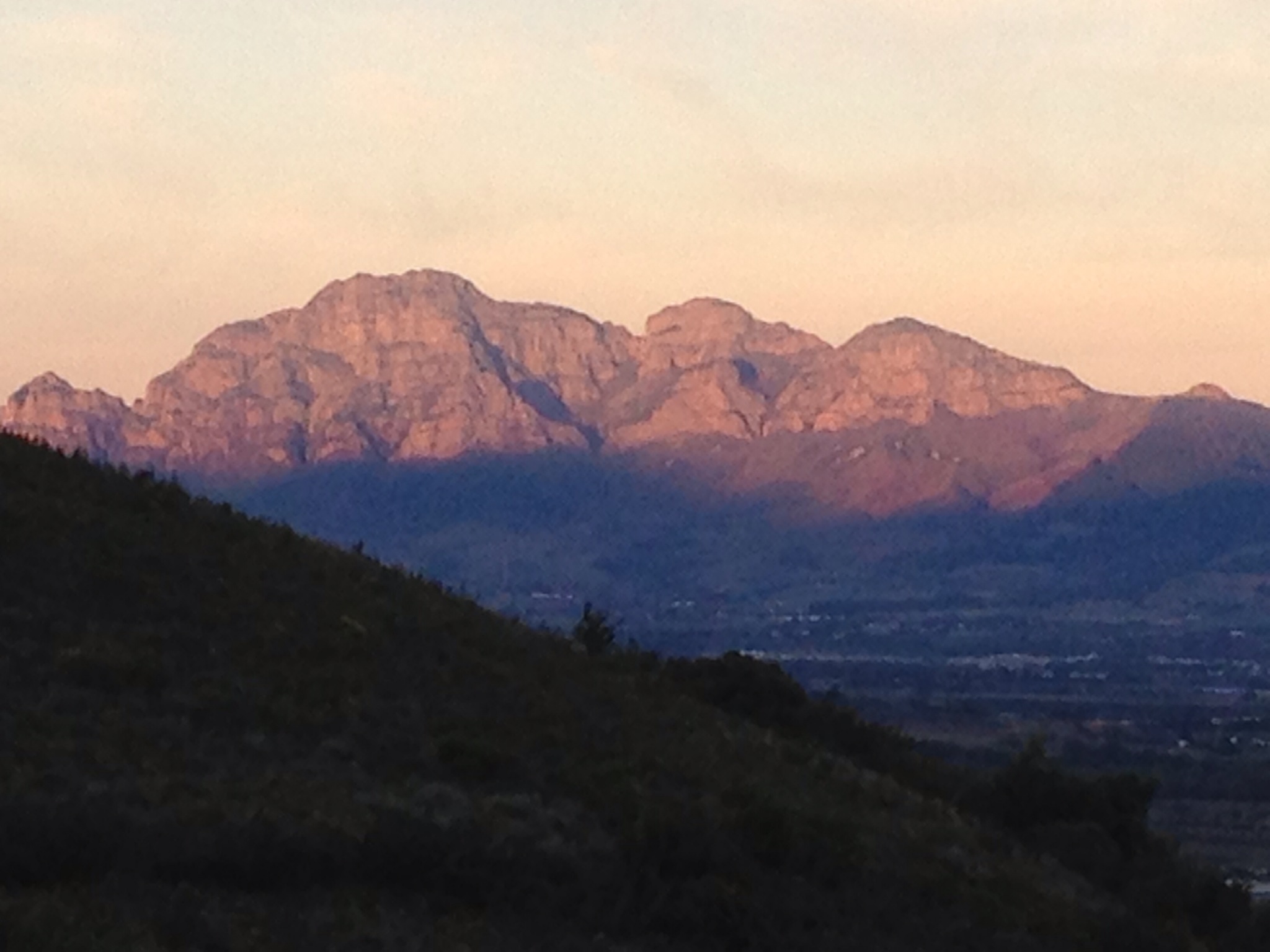
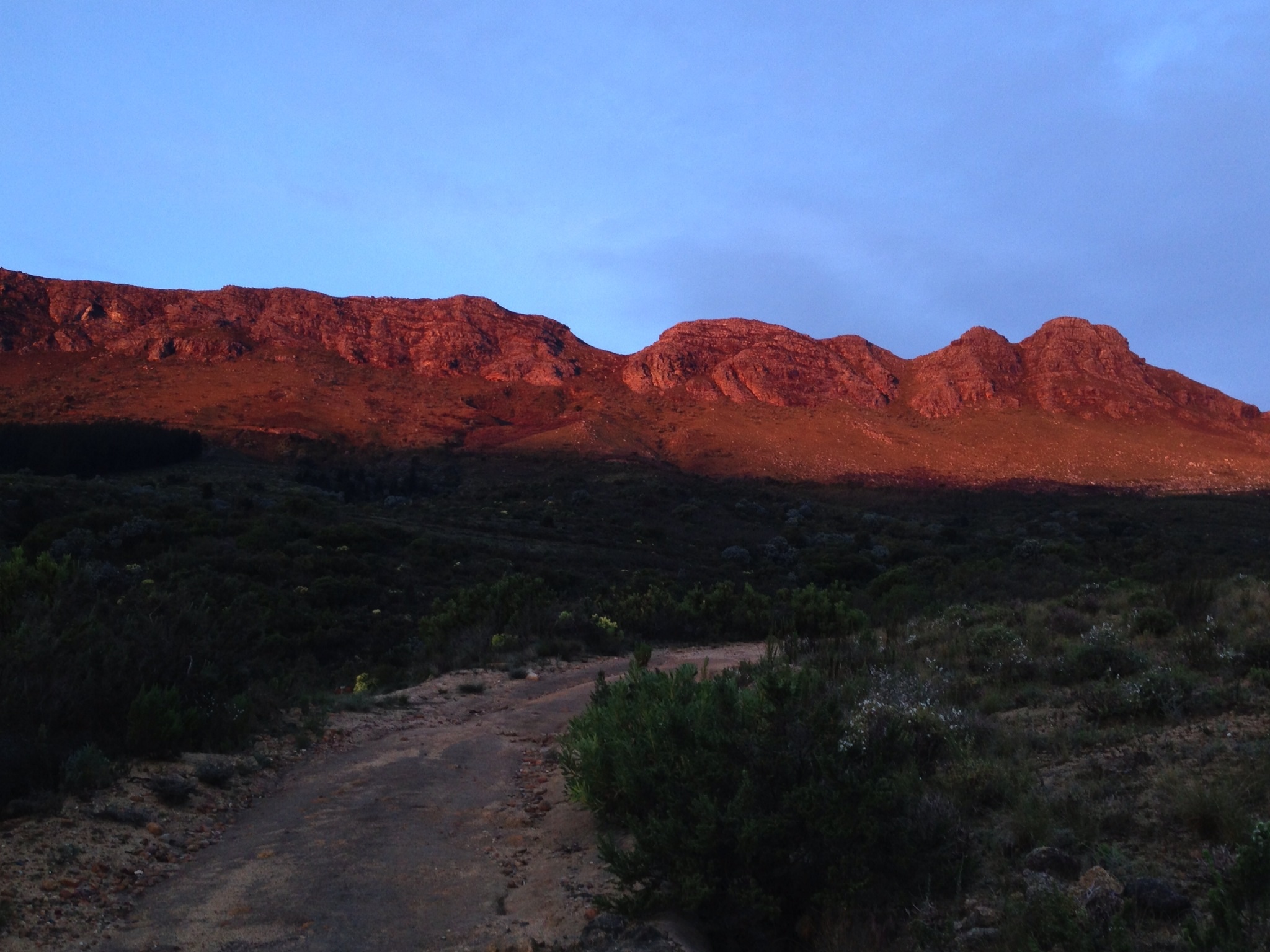
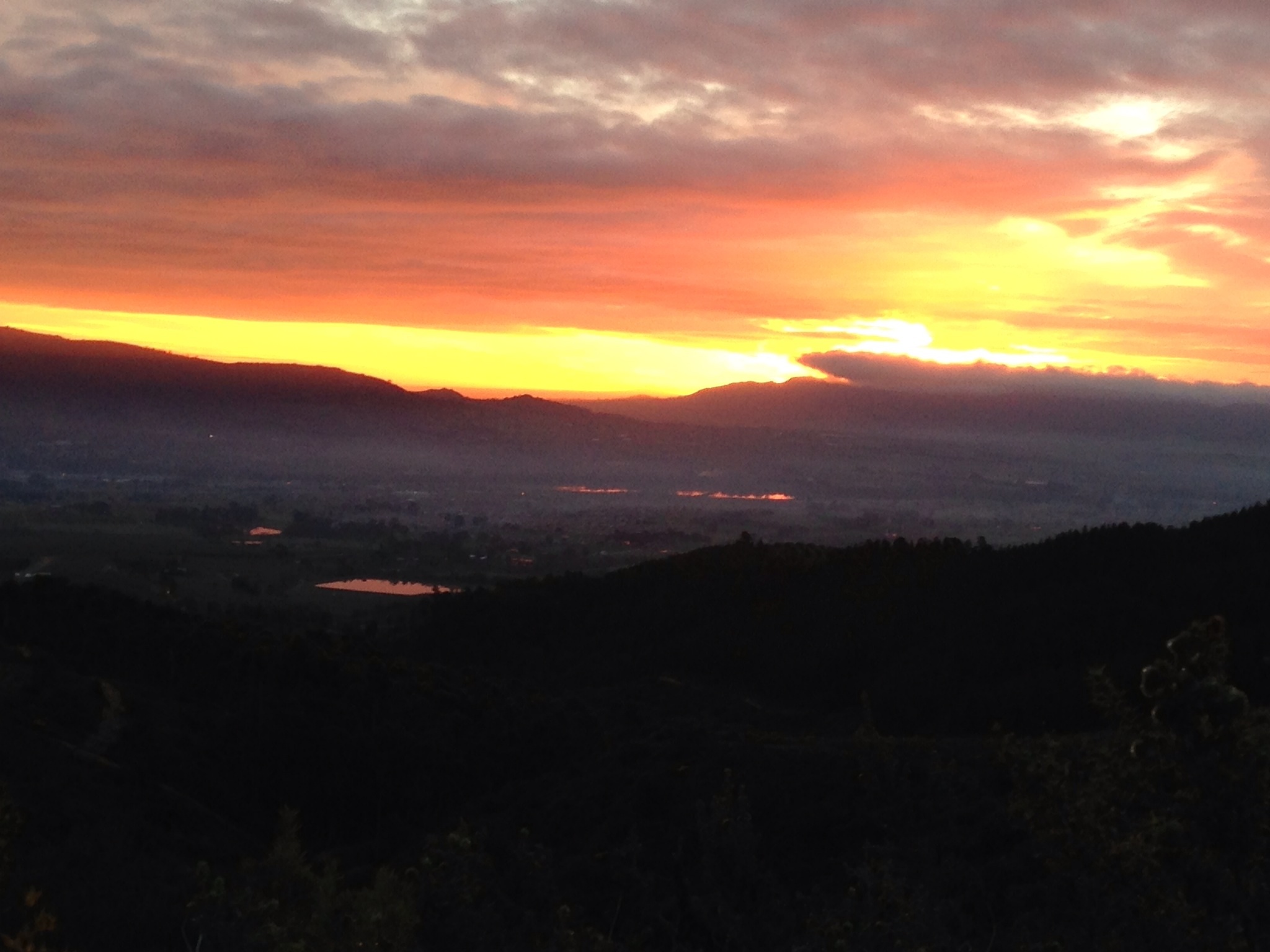
We are coming into the best season for sunsets. Yet another amazing sunset this evening as I was finishing some more traditional gardening and the mountains behind turned a glorious orangey-pink.

image


imagein

Babinia Fragrens, the Harbinger of Spring

I got home on Tuesday morning and of course my first thought was to get up on the mountain and see new flowers though I didn’t achieve it until late in the day.

Every year as we reach the end of July, the coldest and wettest six weeks of the Cape year, a flower emerges that is for me the harbinger of spring.  Like hearing the first cuckoo, I always note where and when I see the first Babinia fragrens.  These crocus-like flowers cover the farm, they are everywhere – and the bulbs are particularly loved by porcupines.  Last year I was running up a steep hill on the farm when I came across a 300 metre stretch of road where a happy porcupine had wandered up and dug up every single plant to munch on the bulbs.  There are plenty to share and it was fun to think of him happily crunching not far from the house in the night as we slept.

Babinia Fragens, the first of the year

Babinia Fragens, the first of the year

Next up was this delicate white flower.  I didn’t get a great picture of it – I think it’s a Cape Snowflake, to give it it’s common name, but will pop it into the research folder and see if we can get a better shot.  These are quite common so I’m sure we’ll see more.

Image

Opposite the Cape Snowflake, the water was tumbling in huge volumes down the waterfall in the evening sunlight – there’s been a lot of rain while I’ve been away.

Image

One of the other wonderful sights of late winter and early spring is the Lebostemum.  Another very common flowering shrub which flowers now and for several months.  I have tried several times to transplant these to the garden, but they have a long fragile tap root and even very young ones invariably die.  They are magnificent shrubs and flower in blue, pink or anything inbetween.

Lobostemon fructicosus

Lobostemon fructicosus

We wanted a good view of the sunset and went to the highest point of the farm on a road we don’t often run.  This wonderful combination of Protea nerifolia and Protea nitida blocked our route at one point and forced a detour.

Protea nerifolia and Protea nitida in the evening light

Protea nerifolia and Protea nitida in the evening light

On the detour we came across this stunning Erica with little pink bell-like flowers in full bloom.  Pink ericas with bell-like or urn-like flowers are like yellow daisies, there are an aweful lot of them and they are hard to tell apart.  Thanks due to Jemima Chew who stood behind them, making them much easier to photograph!

One of the many ericas that flowers with a tiny pink bell-like flower

One of the many ericas that flowers with a tiny pink bell-like flower

The Cape Sugarbirds are in full mating feathers at the moment and they are having a lovely time in areas where the proteas are thickest.  Their tails are so long they can hardly fly – that’s the males of course, the females look drab and take their pick.  I haven’t yet managed to get a really good shot of one but hopefully it’s a matter of time.

I don’t believe we have posted and recorded this protea which is now in full flower.

Protea - indentification will be confirmed in a further posting

Protea – indentification will be confirmed in a further posting

Finally – another sunset.  As dusk gathers and the sun sets you can see the mist from the Berg River gathering on the valley floor.  No wind, the light is stunning and in the far distance table mountain and the whole of Cape Town is covered by a dark wall of cloud.  The rain is coming.

2013-07-24 17.59.37

Philosophical musings, buchu and wild rosemary

I don’t remember all that much about my schooldays, more important things have happened since.  But I clearly remember one lesson.  Mr Clifford, the science teacher, was explaining the structure of an atom.  Someone asked the inevitable question “but if we can’t see it, how do we know it is there?”  “Ah”, said Mr Clifford tapping the table in front of him, “but how do we know anything is there, how do we know this table is here?  But”, he said, “that’s philosphy.”
That question really caught my imagination, and years later when I was studying philosophy at Trinity College Dublin, I read Bertrand Russell’s The Problems of Philosphy where that question about the table comes under discussion.  As does another question: that of truth and knowledge.  Simply put, I know all bachelors are men because that lies within the very meaning of the word men “bachelor”.  Similarly, can I know that all swans are white?  No, I have to keep seeing swans and noting their whiteness.  One day I’ll go to Australia, or the zoo, and see a black swan.  Whiteness is not a defining factor of swans; that was Russell’s point.

It was buchu that led to these musings as the dogs and I ran this morning.  We grow buchu commercially and I always have the notion that buchu flowers are white.  As we peaked at the highest point of the run and headed down the moutain (always a very happy moment in the morning run) I suddenly saw this flash of lilac.

Buchu - in this case a hybrid of Agthomsa Crenulata, with an unusual mauve coloured flower

Buchu – in this case a hybrid of Agthomsa Crenulata, with an unusual mauve coloured flower

I stopped at once, and low and behold it was a little buchu plant, a hybrid from the farm, with lilac coloured flowers.  They were hard to photograph in the dim morning light – I can’t wait for the days to lengthen so that photography becomes easier in the early mornings when I run.  Where did this purple come from?

In referring to the books, buchu, or Agthomsa as it is properly known, can indeed flower in mauve.  Rather like a swan can be black.
The buchu harvested on our farm is mostly a hybrid.  The oils are distilled from the leaves and is used in the European food flavouring and perfume industry, mostly for its strong blackcurrent flavour and smell.  Here in South Africa it is used medicinally, it is one of the oldest medicinal flowers in the Cape, indeed in the world.  Personally I believe in its natural anti-inflammatory and anti-oxidant properties and I love its aniseed, fennel like flavour and drink a cup or two most days.
Agthomsa crenulata hypbrid: this plant is farmed here and harvested for its essential oils

Agthomsa crenulata hypbrid: this plant is farmed here and harvested for its essential oils

The other highly aromatic plant on the farm at this time of year is the wild rosemary.  This grey scrubby bush used to irritate me, but no longer.  Running my hand down the leaves and smelling the rosemary scent, seeing the lands full of shrubs and this exquisite, delicate flower has become a winter joy.
Eriocephalus africanus or wild rosemary

Eriocephalus africanus or wild rosemary


Wild rosemary has taken over this land on the lower slopes of the farm

Wild rosemary has taken over this land on the lower slopes of the farm


We are enjoying a mid-winter break at the moment.  Winters in the Cape can be long and stormy and sometimes quite cold.  This year we are enjoying a warm July.  Here in Africa the temperatures are as warm as an Irish summer – over 25 degrees during the day.  It’s a bit confusing for the poor plants though and I’m sure we’ll see some strange flowering dates as a result.
The mornings are clear and lovely.  As we ran we saw the first rays of sun over the Simmonsberg to the South West.  A joyous morning.
The first rays of sun on the Simonsberg

The first rays of sun on the Simonsberg

Proteas, Montinea and another glorious sunset

Most of this Sunday it drizzled, a slow cold Irish-type drizzle, the kind of soft grey day we don’t often get here.  We huddled up in the study before a blazing fire and watched Andy Murray win the tennis at Wimbledon.  He wrapped it up pretty quickly, and by the time he’d finished it wasn’t yet dark and I felt in need of exercise after a cold damp weekend, so I put on some running shoes, to the delight of the dogs, and set off up into the mountain with pounding paws and wagging tails leading the way.

I hesitate to say we see something new every single time we go out, but it does feel like it.  On Wednesday we came across this Montinia caryophyllacea by the side of the road as we ran up the mountain.  I’d taken a picture of it, but these white flowers are hard to photograph when there isn’t enough light.  Today was a bit better, though I still need to go up in full daylight to get a better picture.  There seems quite a lot of it coming into flower so I’m sure we’ll find more in better light.
Montinia caryophyllacea

Montinia caryophyllacea

That part of the mountain is covered with Muraltia heisteria – it’s not supposed to be flowering at this time of year but this does seem a perfect match.  They are lovely, the colours vibrant in the evening light.  We’ve seen these before; their vibrant colour means they deserve the occasional picture as they are long flowering and dominate the winter months.
Muraltia heisteria

Muraltia heisteria

I’m learning to question everything, and although our Protea nerifolia does come in cream as well as pink and this is probably nerifolia (looking at the leaves) we need a bit more research to be sure.  It’s a lovely flower and there are hundreds of these shrubs flowering on the farm at the moment.  The house is filled with vases full of proteas, leucadendrons and oddly enough the most wonderful camelias which thrive in the acid sandstone and decomposing granite (and lots of good compost) of the garden here and flower all winter long.

Protea (nerifolia?)

Protea (nerifolia?)

Quite quickly it was far too dark to take good pictures of flowers and although I saw the first of one of our favourite late winter shrubs, we will have to wait another day for a photo (that’s today’s new flower).  As the sun dropped behind the Paarderberg mountain, we trotted quietly down the montain, remembering to turn around from time to time to see the glow reflected in pink and orange on the moutains behind.

image
There is something emotional about a sunset.  This evening the air was completely still, quite rare here in the montains.  After a rainy day, the sky cleared and the sun broke through, flooding the mountains with colour.  The river and dams in the valley reflected the deepening sky.  The smell after the rain is clean and scented with flowers and rain, washed and pure and you want to breathe deeply, happily.  We were so glad to be up there this evening, thanks to Andy who polished off his victory  in time for us to catch this glorious sunset on the night of his even more glorious victory.
imageimageimage

The Rooi Afrikaner or Gladiolus watsonius – a technical blog

For at least four weeks I’ve been frustrated by this glorious red gladiolus.

Gladiolus watsonius

Gladiolus watsonius

The species is easy to identify, the subspecies has been confusing; our first sighting was at the end of May and the book says it doesn’t flower until August.  Even the more detailed encyclopedia says that it flowers from July to September. Furthermore it grows in clay and granite slopes in renosterveld. We have granite and sandstone slopes which is a subtle but important difference when it comes to fynbos. Over the weekend I got more serious and looked more closely – the only possible suspect was Gladiolus priorii. But Gladiolus priorii has a yellow throat and although I didn’t have a photo of the throat, I was pretty sure it’s not yellow. I couldn’t really bring myself to believe that we have a previously unidentified Gladiolus on the far, tempting though it might be.

Today I picked one.

It had fallen over a bit on the bank above the drive, it’s a bit tatty and it was time to take this whole process of identification a bit more seriously. And I can reveal that Gladiolus watsonius has one particular distinction. The lowermost leaf is narrow and H shaped in cross-section. No I didn’t get the scalpel out – I’m not that much of a geek yet. It’s pretty obvious just looking at it.

The lowermost leaf of Gladiolus watsonius

The lowermost leaf of Gladiolus watsonius

We have a positive identification – it may be the wrong time of year, it may not be quite the right soil-type but there is no doubt: Gladiolus watsonius likes Du Toitskloof and it likes our farm. It flowers when it chooses to and it’s not going to change, so the sages who write the books may need to change a word or two.

Gladiolus watsonius

Gladiolus watsonius

Magnificent Proteas, more water and some new finds

There is a lot to share so today’s blog is all flowers and less about the run.
Up until now I’ve been going by the flowering dates shown in my reference book but I’m now not so sure.  I know from the records I’ve kept over the years that the different weather can mean flowering even in the garden here can vary by a month or six weeks from year to year, so why not the fynbos.
Stachys aethiopica, for instance, is supposed to flower in August and September, in the early spring.  But we saw one in May and there are small groups of them in different areas at the moment.  They are unmistakeable with their flower reminiscent of a pelargonium and distinctive mint-like leaves.  Indeed they are a member of lamiaceae, the mint family
Stachys aethiopica

Stachys aethiopica

The red gladiolus has cropped up in a few places.  There was one by the road when I left in early May that was easily photographed.  The latest two are high on the bank above the drive, but worth sharing even if the photo isn’t great.  The nearest possibility is gladiolus priorii, though in that case the flowers should be dull red and these are a vibrant scarlet.  It should also have a distinctive and easily visible yellow throat and I can see no evidence of that in our flower. I will look again as the size, shape and flowering season fit.  I need to look a little closer if one appears in a more accessible area.  If not, we’ll have to wait until next year to be sure.
Gladiolus - unamed

Gladiolus – unamed

The dogs and I had a wonderful run today and we visited the weir to see how much water is flowing.  This is always a lovely place; the whitish trunks of the Ilex Mitis or Cape Holly, are magnificent and the permanent water flow makes it a favourite of the dogs.
An ancient Ilex Mitis with its feet in a permanent stream

An ancient Ilex Mitis with its feet in a permanent stream

Jemima Chew enjoying the water in the weir

Jemima Chew enjoying the water in the weir

While I’ve been away the magnificent protea trees have come into flower.  They are tall and have spikey white flowers and silver leaves.  I believe they are Protea nitida.
Protea - probably nitida

Protea – probably nitida

Near them stands this delicate pink protea.  It is probably a nerifolia, though the flowers are barely bearded and a paler pink than most of the nerifolio on this farm.
Protea nerifolia - a very pale pink specimen

Protea nerifolia – a very pale pink specimen

Flowers found in the forest that abutts the farm are included in our blogs as they are on our regular running route.  We’ve seen Ursinia paelacea before and there is lots of it along the forest roads.
Urisinia palaecea

Urisinia palaecea

Not everything is easily identified. This little clump of yellow daisy-like flowers is lovely and quite distinctive but I can find no record of them. Suggestions welcome.

A mystery flower - yellow daisy-like flowers are the hardest to identify

A mystery flower – yellow daisy-like flowers are the hardest to identify


As we ran into the forest the path is lined with Leucadendron salignum.  There are hundreds of these all over the farm.  At this time of year they glow in the dark, another plant that seems to absorb the sunlight and render it back to us on the darker days.  Today was bright and they gleam in the early winter sun.


Leudadendron gleaming in the winter sunlight

Leudadendron gleaming in the winter sunlight

Flowing Water and Fowers – 28 June 2013

Home.  The desert sands of Qatar behind me at last.  It was a shock to return to glorious green after the thick humid sandy air of Doha.  It seems it’s done nothing but rain since we left home three weeks ago and the farm has a rich sodden feel to it, with water roaring through the river and tumbling down the waterfall.  The roads are in need of maintenance, full of rivulets and potholes but the seeds I planted in the garden before we left have all sprouted into healthy young plants and the fynbos is settling into a winter burst of life.   Seamus, the senior wolfhound, is joyous at my return and cannot bear to leave my side.
The dogs and I went for an evening walk, inspecting some of our usual routes, the dogs looking for new smells, and me looking for new flowers.  We started down in the stream below the house that leads to the damn.  The banks are lined with Arum Lilies at this time of year.  Just as the luminous grasses have disappeared the lilies flower along the rivers and roads all winter and their beauty speaks for itself.  We have a few months of them ahead, and there will be a lot more pictures to come.
Image
Arum Lilies
The great thing about this blog is that it focuses the mind on home, on the magnificence of this land and the plants that grow here.  I’ve seen Chasmathe all over the Cape, they remind me of the Montbretia that grown wild in Ireland, another South African wild flower that grows all over Ireland’s verges and banks in the summer.  At first I thought it was the same flower but Montbretia doesn’t grow in this part of the world, it belongs further north in a summer rainfall area.  This Chasmanthe is lovely, another of the anchors of a certain time of year, this winter time, when growth is rich and lush and yet only a herald of things to come.
 
image
Chasmanthe, most likely floribunda, but to be verified

When we moved to the farm eight years ago this little red creeper was one of the first flowers to awake my interest in fynbos. The flowers are tiny, smaller than my little fingernail and they appear suddenly in midwinter, winding around the stems of thicker fynbos. Despite their tiny size the jewel-like coral jumps out of the greenery and draws the eye. We will have them until mid-spring or later, all over the farm.

Microloma tenuifolium

Microloma tenuifolium

We could hear the waterfall long before we saw it – with the rainfall we’ve had in June the rivers on the farm are roaring and the land feels replenished.

The Waterfall

As we walked along the new road that leads to the waterfall this enchanting sight greeted us.  I don’t know what to say or even think about the
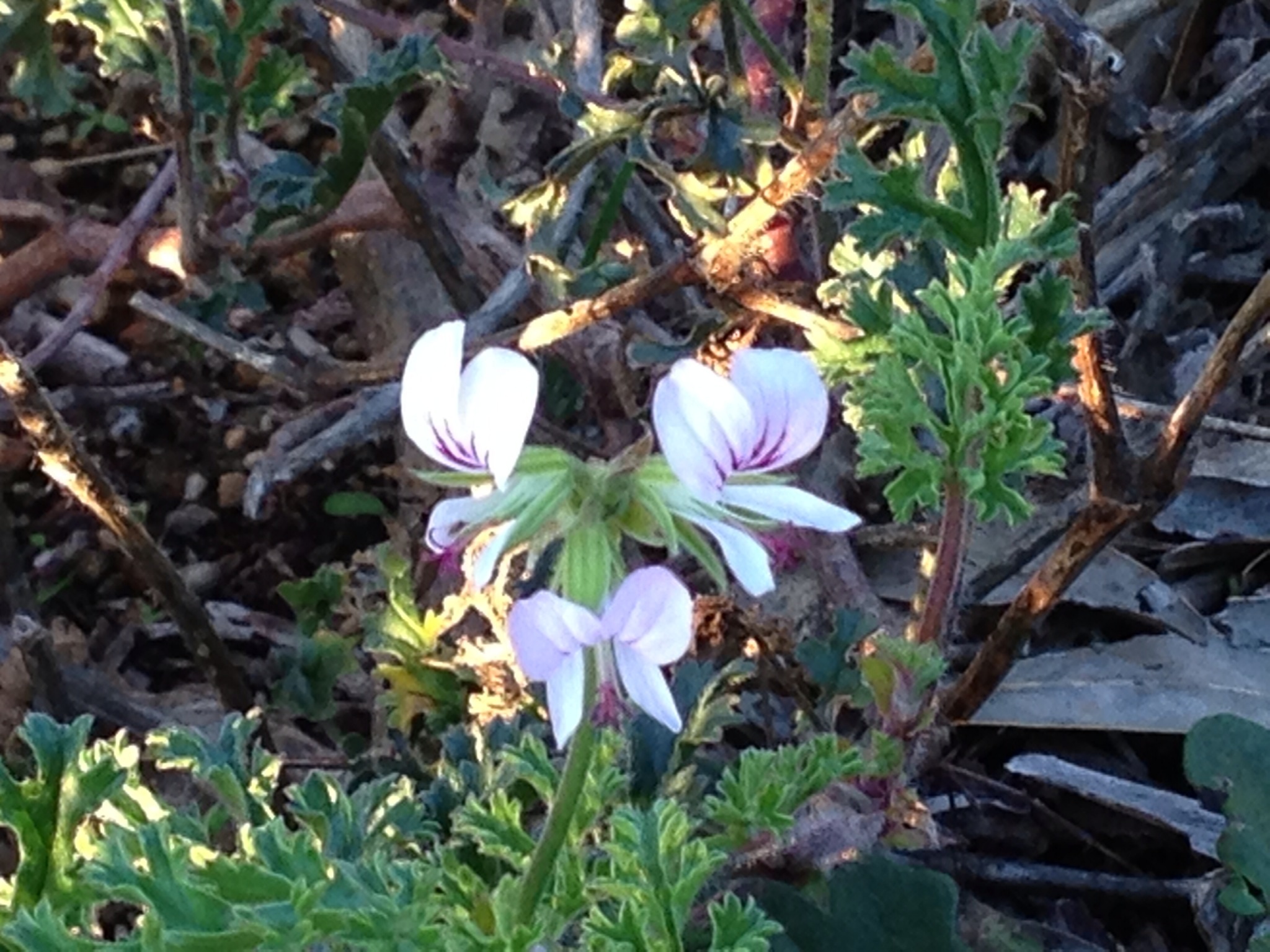
pelargoniums; though are stunning, charming, and endlessly delightful the sub-species seem impossible to identify.  Our new road is a pelargonium nursery and they thrive here all year round.  At least this one allowed me to take a good picture – gracefully gleaming in the evening light.
Pelargonium - subspecies unknown

Pelargonium – subspecies unknown

Pelargonium

Pelargonium


The books have a few pelargoniums but they don’t seem to flower at the right time of the year.  We have dozens and the best I can do is document them and find a real expert.  Some of those that I’ve transplanted to the garden are doing really well, perhaps that will help.  They are endlessly endearing.  My grandmother grew them, pelargoniums and geraniums, nursing them through the Irish winters.  She would have loved this place; not lush like Ireland with it’s dense choking green; more selective; intense; dramatic – she would most definitely have appreciated the drama.  It was her birthday on 22nd June, just after midsummer.   I was in Doha, so missed the shortest day of the year on the farm.  Today is the shortest day we will see this year, and this is the most north-westerly sunset, far over the Paarderberg.
Sunset over the Paaderberg  28 June 2013

By mid-summer this sun will set far to the South of Table Mountain.

My love of botany is definitely inspired by her, and by my stepgrandmother, both of whom were dedicated and knowledgable horticulturalists.  I thought of them both this evening as we descended in the gloom.  Two women, one Irish, one English, both Catholic, both of whom were born in one world war and raised their children through the next.   Gracious women, much loved, characters, who instilled in us both values and manners. They loved their gardens and gardening brought them together, unexpectedly and into a lifelong friendship.  They admired one another and both of them would like to know they are remembered and that they continue to inspire us.  

The Ericas are coming out all over the farm and I have not yet identified this one – a detailed book on Ericas as we as Pelargoniums is most definitely called for. The Erica family runs to 660 subspecies in the fynbos region, so we can’t expect to identify them all, but it will be fun to see how many we have on the farm and I will start a library page on them soon.

image

Stormy Weather 4 June 2013

We have been having the most dreadful weather.  Day after day with torrents of rain and low cloud on the mountain, we can barely see a flower, never mind try to photograph one in the gloom.  This morning when I woke up there was silence.  No rain drumming on the zinc roof.  If I don’t run for a few days I feel horrible and miss it and worse, I know it will be harder when I do get out there.  It’s cold, there is probably snow on the mountain above us but the thought of fresh air and happy dogs was enough to get me up and into running things.  I took the precaution of wearing a rain jacket on top, in case the deluge came.  

In the gloom and the early light I didn’t expect to see much and it’s true that there is nothing new.  I suspect we need sunshine and a little warmth to encourage flowering.  One plant that has come out in profusion is the wild rosemary.  The tiny white flower is too delicate and subtle to capture in the half light of the early morning but they are everywhere and will be the subject of a future blog.  

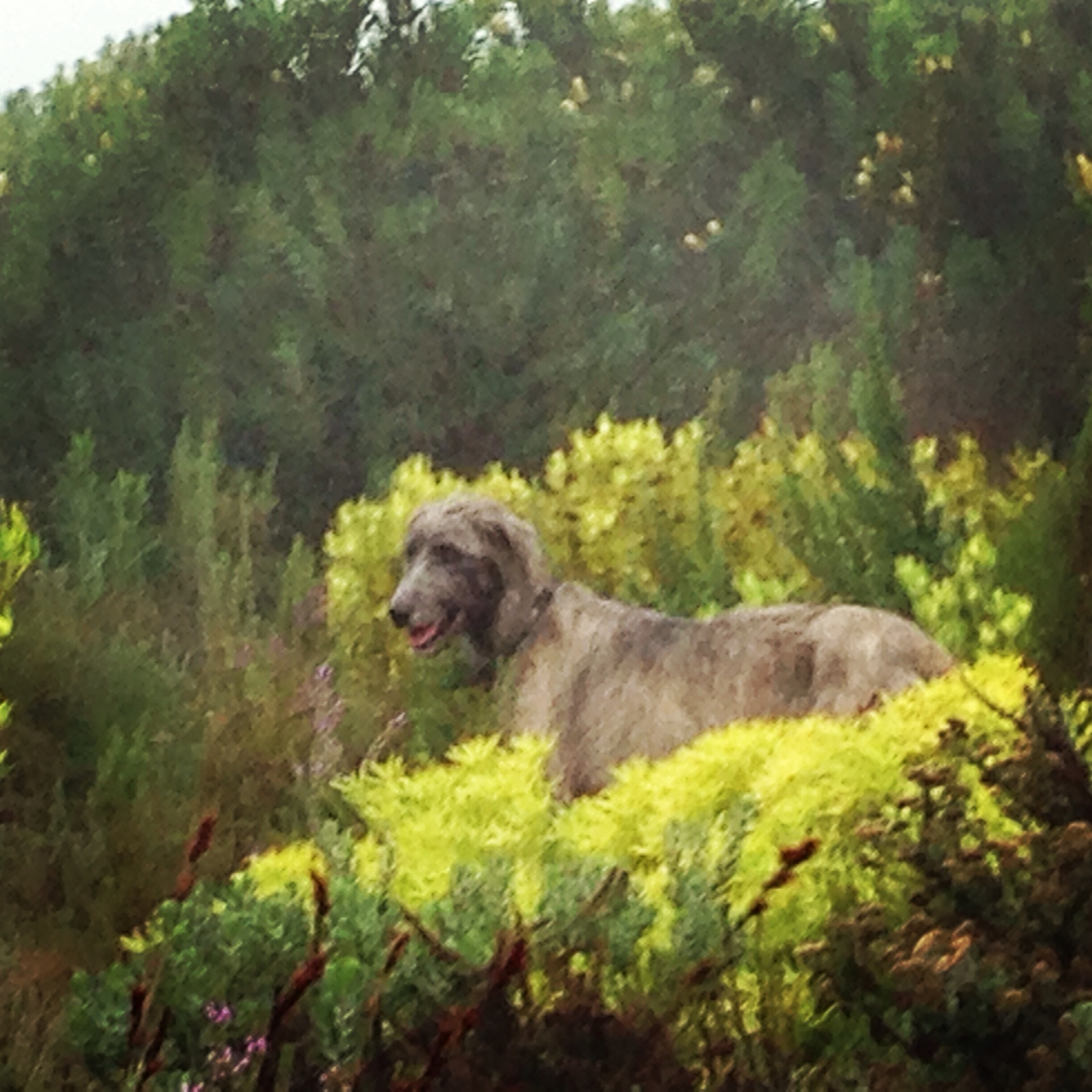
Jumping out of the gloom are the lime green leucadendrons and Maebh the wolfhoud (pronounced “mave” as in “wave”) chose to position herself photogenically behind them.  I think she may be taking lessons in modeling, she’s certainly getting better at posing fetchingly for the camera.

image

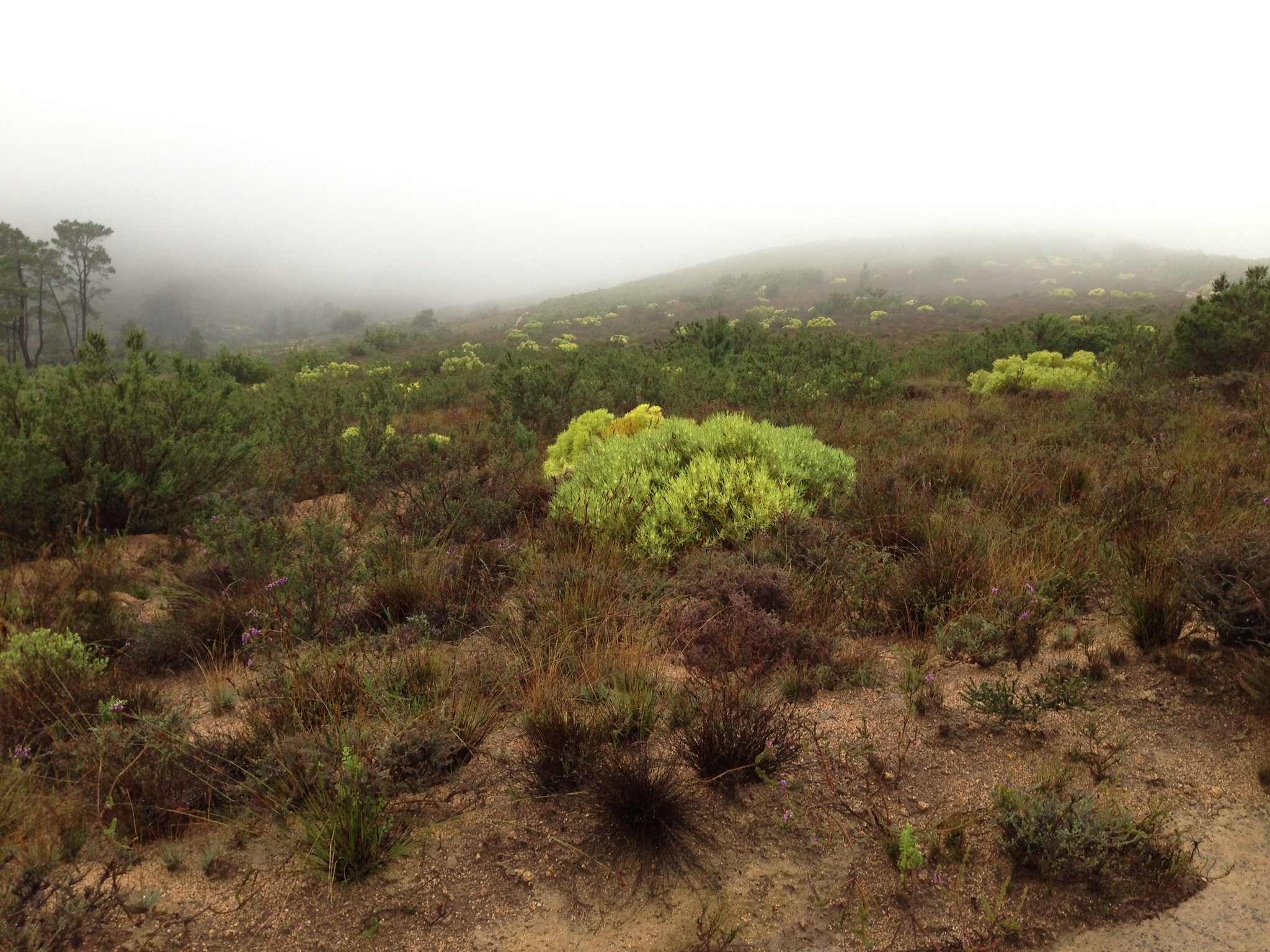
The leucadendron was particularly stunning in the morning light – a photo of the mountain shows the green shrubs glowing in the gloomy morning.

image

Close ups give you an idea of this lovely wild, winter flowering shrub.

image

image

The proteas start flowering even before the rains come, typically in late March and continue for months. They love the rain and the flowers gleam white while the buds can be bright pink.

image

image
Protea Repens

Another pink protea is the nerifolia which flowers prolifically at this time of year. I went up this evening to see if the evening light would let me capture the waterfall and chanced on this one as the first rays of sunlight we’ve seen in days caught it.

image
Protea Nerifolia

Peter told me that with all the rain the waterfall would be looking spectacular. There is a story to this – when we bought the farm this entire area was covered in alien vegetation. We started a programme of clearing those trees, hundreds of them, and revealed an old road, which must have lead up to the pass over the mountains, and this beautiful fall of water from a permanent stream. We’ve planted some indigenous trees, continue to do the clearing and we’ve seen the most amazing resurgence of fynbos in this area. The fall is hard to photograph as it sits in a crevasse that blocks the light, you can see the shadow – at this time of year the late flash of sunlight sneaks into the crevasse and nearly catches the water, so at leasst you can get a sense of it. There must be a moment when the light is at just the right angle and I’ll endeavour to be there when it does.

image

It’s raining again now, but as I walked home in the last of the light the sky seemed to hold a promise of better things to come. After 10 days of almost constant rain and increasing cold we’ll welcome a little sunshine. This photo of the road that leads from the main farm down to the farmhouse wouldn’t win any prizes, but I like the gleam of wet on the road and the glimpse of blue in the sky. We need this rain in the winter, it keeps this land fertile and the more rain now, the better the spring flowers will be. The dogs and I hope for better things and brighter runs for the rest of this week.

image

image

Arum Lilies, a dedication and 11 new species/subspecies

On the 19th of May I think of my brother Mark, who’s birthday this is, and this blog is dedicated to him.  Peonies are my favourite flowers because they bloomed in our garden the day he was born and I picked some to bring to the hospital the first day I met him.

Yesterday I took the dogs for a walk in the evening and as we crossed the dam wall I saw the first Arum Lily of the year.  I’ve seen them on the roadside already; all winter the roadsides and fields are covered in them – amazing that something so rare and precious in Europe should be a common winter wildflower here.  They thrive in watery places and the streams and banks on the farm are covered in them, hence this first sighting.  Before our run this morning I took this photograph – the flower shimmered against the brown dam water – its perfection needs no embelishment.

 Image
Then off we went for our favourite weekend run.  The northern boundry of the farm abutts the nature reserve and the lower slopes of the reserve are covered by a commercial pine forest.  Crazy in this environment where the fynbos needs to burn every seven years or so in order to regenerate but if the forest goes up it will be a disaster, not least because there is a village in the middle of it.  That said, we love it.  On hot days it’s a joy to run through the forest’s dappled light and today was an unusually hot autumn day.  Once we leave the property both wolfhounds go on the lead.  I probably look a bit ridiculous running along with these two huge dogs, one of which weighs more than I do, but even with baboon sightings they are too polite to pull me over or the lead out of my hand.  A passing cyclist generates no more than an enthusiast tug from the dogs, and pedals all the faster when he sees them.  They are gentle giants but look quite fierce; this may be Africa, but I feel perfectly safe.
As we set off I was thinking that surely I wouldn’t find anything new on the farm – after all a few days ago I photographed everything I could see.  Now I’m curious to see how the year goes, because in one day I’ve identified 11 new species and subspecies, not all of which I’ll talk about yet but still; 11.  And as I think about it 12 because I saw the buds of one of very favourite flowers about to bloom and didn’t take a picture as the months to come will offer splendid opportunities to capture it at its best.  Out I went thinking, probably won’t see anything new today and 11 new things pop up.  This bodes well for our blogging year.
We ran later than usual so the Oxalis, mentioned in a previous blog, are all showing off in the glorious autumn sunlight and as soon as we left the house I notice this lovely yellow version, on the banks of the roadside and also in the lands, this in the last couple of days.  There are 120 Oxalis fynbos subspecies so forgive me if I dont’ try and identify this one which doesn’t have a perfect match in my book.
Image
 Image
While on the subject of Oxalis, I published a picture of one from the southern part of the farm which I described as unusual.  Clearly I shall be humbled by this blog; this flower may be unusual on the southern boundry, but in the north of the farm these jewel-like flowers are everywhere.  There is one road in particular which always has the best display of flowers and of course it is littered with these lovely pinky white stars.  On closer study I believe it may be Oxalis Argyrophylla.
Image
While photograhing those I noticed this creeping pink Oxalis with finer leaves and a creeping or rambling disposition.  I can’t identify it but it is most certainly a different and very charming sub-species.
 Image
Ericas or heathers are one of the great marvels of fynbos and the flowers take many forms, often bells or trumpets, others less musical.  The trumpets are to my mind the most beautiful of all – and this coral version has started to flower in the past week or so.  The morning light was not good enough to capture it and I had a busy Sunday afternoon in the garden so I asked Peter to take me up to the top of the farm this afternoon to capture it in the southwestern sunlight.
 Image
This expedition led to several more sightings which I’ll share during the course of the week – too much for one blog.  One thing I saw late last night, photographed this morning and again this afternoon is this tiny, delicate flower, of which I could find only one example in the middle of a fertile piece of road.  Initially I thought it must be yet another of the 120 sub-species of Oxalis but on looking at this photo that’s clearly not the case; the leaves are all wrong. I think it must be Chaenostoma, yet those in my book are all shrubs and this is somewhat standalone. Perhaps this plant will develop over the years, or I shall find others that permit a more accurate identification.  Delicate, delightful, terribly discrete and utterly charming.
 Image
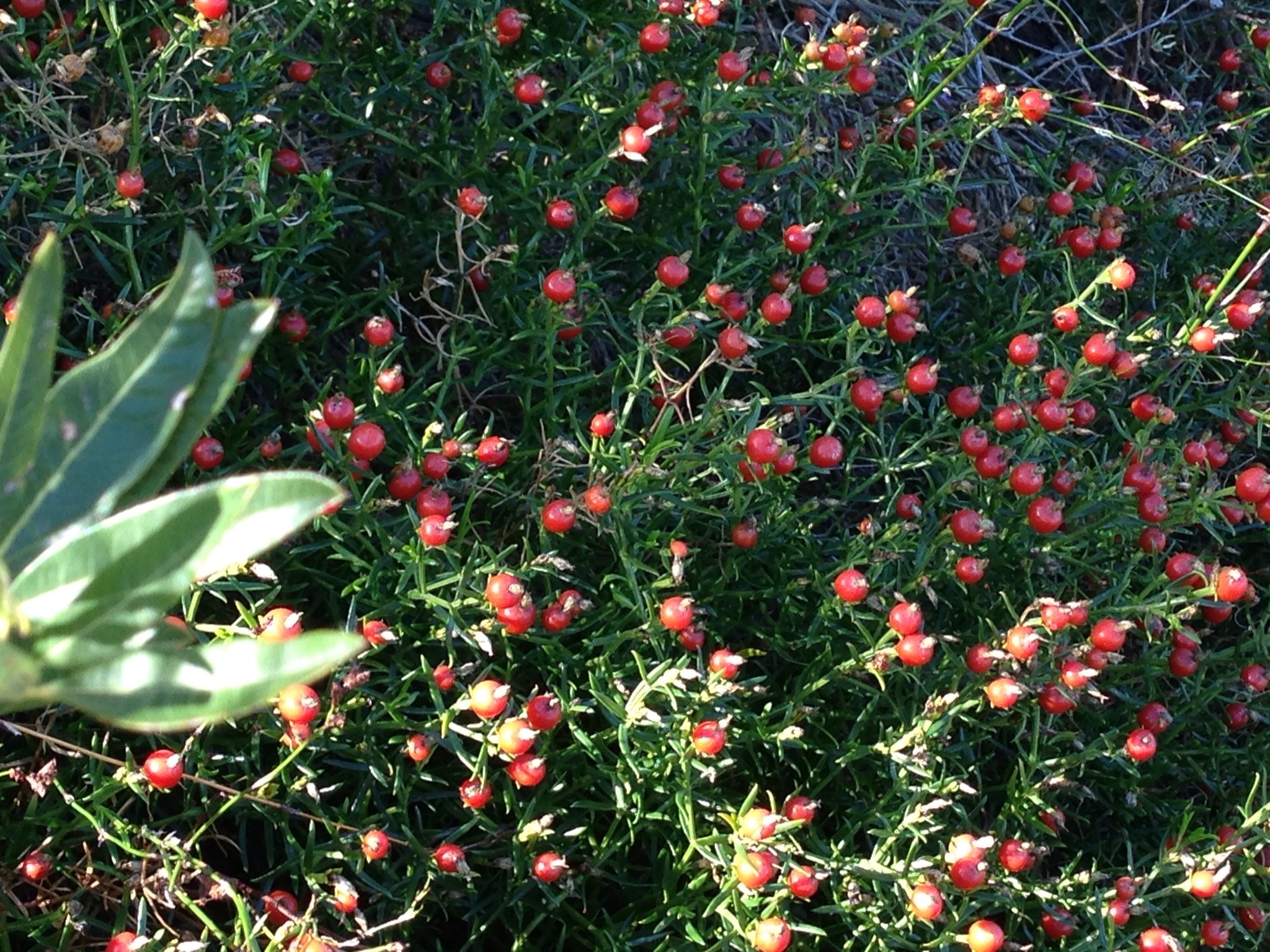
Finally – what on earth is this?  It looks like it belongs in a very smart herbaceous border, yet here it is, casually on the roadside, red berries glistening in the afternoon sun.  Further investigation is clearly required and we need to see what the flowers look like.  What a beauty.  And if you look closely you will note the little violet wild lobelia flowers growing through it.
image
image

15 May 2013 Misty morning run, sunlit evening departure

Here I am, sitting in a hotel room in London, going through the photos and evoking the memory of my morning run the day we left.  I can smell the wild rosemary and the cool misty air and imagine the rush of happy hounds as they head off to inspect all their favourite places.

The night before I left I had a meeting in Cape Town and driving up the drive at about 11.30 at night a huge presence emerged out ofthe night.  It was such a surprise that it took a second for recognition to kick in .  A porcupine, a large, ungainly porcupine with his quills fanned in outrage as he bumbled off the road and into the night.  What a lovely sighting.  We’ve always known they are on the farm because we see their quills, but our first ever sighting was only a month ago on the same road, so he must have changed his routine and perhaps we’ll see more off him. I didn’t have the presence of mind to photograph him; maybe next time I’ll be quicker.
I went early for my run the day I left and it was too dark to see much or to take good photos.  There are mornings when the valley is covered with fog, lapping at the foothills like waves on the beach. The world below us disappears and we float on the white sea clothed in clear morning light.
 Image
Not such a good day for flowers but I did capture one photo of Seamus looking particularly like himself, standing in his favourite spot.  It’s a little dark, but you get an idea of him.
 Image
Some plants seem to capture the light and glow in the gloom.  One of the is the Leucodendron, a close relation of the protea.  I’ll write more about these when I get home, the farm is covered in them and they are the most elegant of plants.
« Older Entries Recent Entries »